The list of firsts for advanced nuclear power grew a little longer Aug. 18 with a power purchase agreement between Kairos Power and the Tennessee Valley Authority.
The electricity — or more exactly, its clean energy attributes — would be assigned to Google data centers.
The terms — only 50 MW, not until 2030, from a technology still being developed — are not by themselves a huge splash in a sector that is projecting a need for dozens of gigawatts of capacity in the next five years.
But it is the first PPA signed by a U.S. utility for the output from an advanced GEN IV reactor, and it is the latest of many indications of the strong interest the tech sector has in next-generation nuclear power, with its promise of emissions-free baseload power and its potential for co-location.
The PPA between Kairos and TVA would deliver up to 50 MW from Kairos’ planned Hermes 2 Plant to the TVA grid, which powers Google data centers in Tennessee and Alabama.
It is the first step under Google’s October 2024 agreement with Kairos on a partnership to develop a 500-MW fleet of advanced nuclear reactors by 2035. (See Google, Kairos Sign 500-MW Nuclear PPA.) Kairos will boost Hermes 2’s output from 28 MW to 50 MW to reach the PPA’s terms.
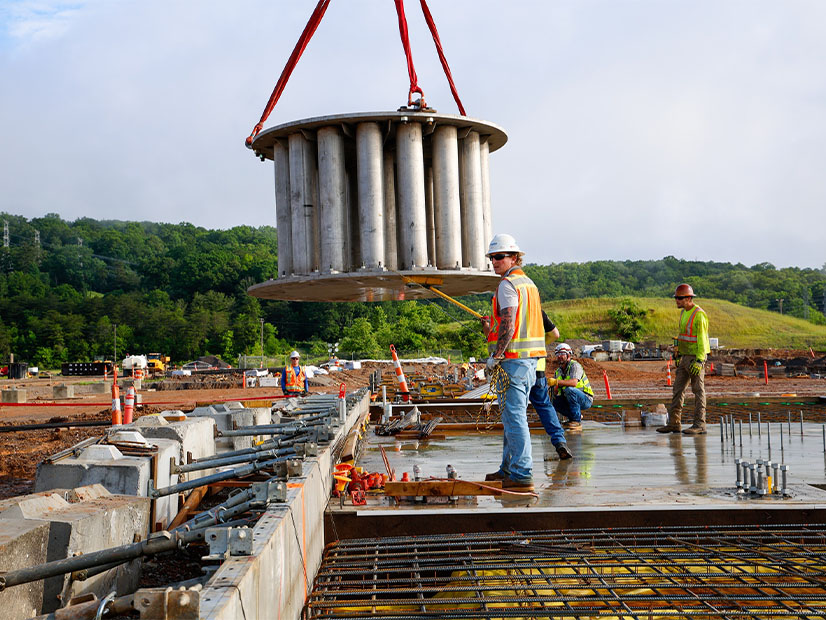
Kairos is designing a high-temperature small modular reactor fueled with pebble-form TRISO and cooled with low-pressure fluoride salt.
Hermes 1 is a demonstration reactor under construction in Oak Ridge, Tenn., with an anticipated 2027 startup date. It is intended to produce only heat, not electricity. Lessons learned from Hermes 1 will shape the Hermes 2 demonstration reactor, to be built nearby. (See Kairos Power Cleared to Build Demonstration SMRs.)
There are two more advanced-nuclear firsts: Hermes 1 was the first GEN IV reactor approved by the Nuclear Regulatory Commission and the first non-light water reactor permitted in the United States in more than half a century.
Also in Oak Ridge, TVA in May became the first U.S. utility to request a construction permit for a small modular reactor — a GE Hitachi BWRX-300. (See TVA First U.S. Utility to Request SMR Construction Permit.)
There are many other recent firsts in SMR and advanced nuclear development, but not the most important first: None in this part of the world has entered commercial operation.
Ontario in May authorized construction for what could be the first commercial SMR in North America. (See Ontario Greenlights OPG to Build Small Modular Reactor.) But the target date for connection to the grid is not until late 2030.
There is intense interest and effort focused on the development of SMRs, with their promise of faster, less expensive construction. The Nuclear Energy Agency is tracking more than six dozen designs at some stage of development; more than two dozen of the efforts are headquartered in the U.S.
How many of those efforts obtain sufficient capital and overcome technical hurdles to reach commercial viability remains to be seen.
The Trump administration is trying to expedite the process, but the 11 projects recently chosen for a fast-track pilot program will receive no financial assistance — only help cutting through regulatory red tape. (See Advanced Nuclear Fast-track Effort Gets First 11 Projects.)
Nonetheless, advanced nuclear developers often speak with present-tense confidence about their business models and technologies.
“We build mass-manufactured nuclear plants that will power anything from a data center to a city,” declares Aalo. In fact, Aalo’s liquid-metal reactor design is only in the non-nuclear prototype stage, and the company was a 10-person operation in a coworking space until recently.
Some of the other companies in the SMR race are not as far along as Aalo.
Others are steadily moving closer to splitting their first atoms, aided in some cases by the technical and financial resources of the U.S. government.
In 2021, the U.S. Department of Energy Office of Nuclear Energy put Kairos’ Hermes project on its list of “5 Advanced Reactor Designs to Watch in 2030.” DOE already had begun assisting Hermes financially during the first Trump administration; in 2024 it committed up to $303 million in grants to the effort.
The cost of developing a first-of-a-kind SMR and bringing a working copy online is considerable — $5.6 billion, in the case of the first Ontario reactor, plus a projected $9.6 billion for the three follow-up SMRs planned on the same site.
Google, Kairos and TVA said the PPA announced Aug. 18 would help ease some of that first-mover cost and drive down the price tag for future reactors.
“Google stepping in and helping shoulder the burden of the cost and risk for first-of-a-kind nuclear projects not only helps Google get to these solutions, but it keeps us from having to burden our customers with development of that technology,” said Don Moul, CEO of TVA.