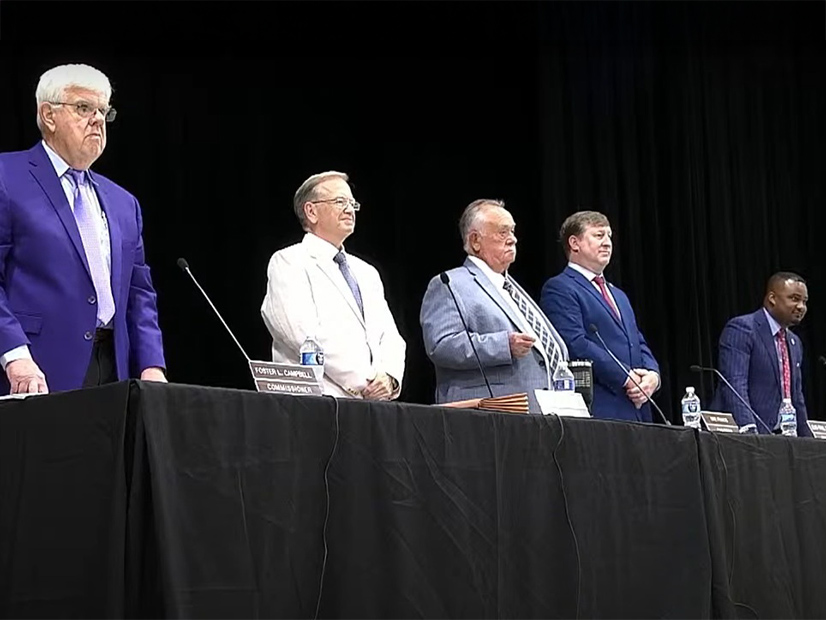
The Louisiana Public Service Commission voted two months earlier than initially planned to approve 2.3 GW in new Entergy gas plants to supply a new, $10 billion Meta data center.
The PSC voted 4-1 to allow Entergy to build three gas generators to power the Meta facility at a cost of $3.2 billion, drawing boos from the audience at the Aug. 20 meeting. (See Entergy La. Confirms Meta Data Center Behind 3 Proposed Gas Plants.) Entergy requested the early vote.
Larry Hand, Entergy Louisiana’s vice president of regulatory and public affairs, said the electric service agreement for the next 15 years ensures Meta will pay to cover the new generation costs, mitigating impacts on other customers.
“Entergy’s goal, and I believe I can safely speak for Meta, was not to come to Louisiana and cause costs to be shifted to other customers,” Hand said. He said while Entergy took pains to strike the most sensible deal it could, there nonetheless would be risks associated with the project.
“It’s a 15-year deal, so we can’t predict everything,” he said.
Hand estimated that net ratepayer impacts will be “plus or minus a dollar” per month. He also said if Meta doesn’t renew the contract after the first 15 years, then the MISO South region will have “a gift” of half-paid-for, relatively new gas plants among the region’s other aging thermal plants in 2041.
According to the contract, should Meta exit the contract early, the generating assets would become wholly owned by Entergy. Louisiana PSC staff said while Meta’s abandonment of the project is a remote possibility, Meta likely would have paid for the most expensive start-up years of the project by the time it leaves.
Hand said it was necessary for Entergy to circumvent commission procedure — forgoing conducting a request for bids on the plants — and self-build the generation to meet Meta’s aggressive timeline. He said opening an RFP would have added a second year to the project.
Entergy Louisiana ratepayers are set to cover an additional $550 million in transmission costs that are necessary to connect the data center’s generation to the grid.
Hand acknowledged not all who protested the deal agreed with the final, settled version of the contract. Louisiana PSC staff, Entergy, Sierra Club and the Southern Renewable Energy Association signed off on the settlement deal.
The finalized deal contains more consumer protection, including a provision that Meta’s minimum bill payments would cover 100% of the costs of the trio of generating units, including cost overruns. Meta also agreed to fund development of 1.5 GW of solar generation under the state’s Geaux Zero program and to provide up to $1 million per year for Entergy’s Power to Care, which is a bill assistance program for low-income, elderly and disabled Entergy Louisiana customers.
Meta, which has a goal to be carbon neutral by 2030 both in operations and suppliers, also expressed a willingness in a separate corporate sustainability rider to help fund carbon capture and sequestration at Entergy’s existing Lake Charles Power Station.
Entergy plans to submit the gas plants to MISO’s newly approved expedited interconnection queue. Hand said it wasn’t efficient to try to build the generation behind the meter, noting that the data center likely would need twice as much generation as planned to run at a more than 99.9% load factor behind the meter.
The data center is slated for a 2,250-acre state-owned site known as Franklin Farms. Two of the new gas plants will be named after Franklin Farms.
Commissioner Eric Skrmetta called the deal groundbreaking because Entergy found a way not to burden the public with new generation builds. He said the contract “sets a new standard to develop power resources to the advantage of our ratepayers.”
Davante Lewis — who provided the sole “no” vote — said he liked the contract’s strong consumer protection and Meta’s assistance with solar expansion but said he ultimately struggled with Entergy’s claim that it needed to bypass a competitive bid process and self-build generation.
“The truth is there are a lot of things that I just cannot verify at this moment,” Lewis said. “I cannot say with enough certainty that this deal and its power agreement serves the greater good, has the public in interest, with the least-cost revenue.”
Lewis said he hoped that future deals with data center hyperscalers contain competitive bidding, battery storage, possibly flexible load provisions and “a full suite of front-end customer protections.”
Commissioner Foster Campbell, whose northeast Louisiana district will host the plants, said the development was something his community was “waiting a long, long time for.” Campbell said he had been “pulling for jobs” in those poverty-stricken parishes for more than 50 years. Campbell said he was supporting the project despite being a Democrat. He explained that it’s easier to be against everything than support something.
“This is something we drastically need in North Louisiana; it’s a shot in the arm,” he said, noting the area was hemorrhaging residents to Dallas, Houston, Baton Rouge and New Orleans.
Campbell also said there’s no such thing as a “bulletproof” contract.
Residents at the meeting voiced concerns ranging from Meta’s potentially massive water use, the lack of permanent jobs created by the facility and doubts that Entergy wouldn’t raise rates because of the project. A few said they considered the project speculative because no one knows how AI would function in 15 years. Multiple residents asked the commission to consider delaying their vote.
Logan Burke, executive director of the Alliance for Affordable Energy, told the commission there are many people living in Louisiana who “cannot handle another dollar on their bill.” She said she was concerned the contract could shift costs and risks onto ratepayers. Burke said ratepayers would foot maintenance costs of the plants, which are poised to deepen the state’s overdependence on gas.
The Union of Concerned Scientists said the vote was rushed. The organization said the project would further tax Louisiana’s grid, which is considered unreliable when compared to other states because of its shortage of transmission capacity, an overreliance on methane gas and the state’s commonplace extreme weather.
“Observers inside and outside the state have undoubtedly taken notice of this pattern of fast-tracking utility proposals with very little public notice and transparency for the residents most impacted,” UCS energy analyst Paul Arbaje said in a statement.
Entergy Sticks by Gas Choice
At the Aug. 19 Midcontinent Energy Summit in Indianapolis, Kurt Allen, director of industrial accounts at Entergy, said the utility is trying to build generation “as fast as they want it.”
Allen said developing renewable energy to meet large load customers remains difficult for Entergy.
“The price is not really coming down on those. There’s a challenge there, and I think it’s going to be a challenge for the next several years,” Allen said. He said it’s tough to convince large customers to pay the resulting prices from Entergy’s requests for proposals on renewable energy. He also expressed doubt over Entergy’s ability to install carbon-capture technology.
Allen said the Meta project is labor-intensive and getting the three generating units and associated transmission built fast enough for Meta’s timeline will be challenging. He said Meta representatives commended Entergy on its swiftness in assembling the deal.
Despite the Meta’s Louisiana plans relying on natural gas, Allen predicted decarbonization likely will be driven by hyperscalers that have the money and the will.
Allen declined to answer an audience question on whether Entergy is thinking about how to bring down the costs of network upgrades so it’s more cost-effective for renewables to connect in MISO South.
At the same event, Entergy’s Wyatt Ellertson said the utility believes natural gas generation is the most reasonable solution for high-load factor customers.