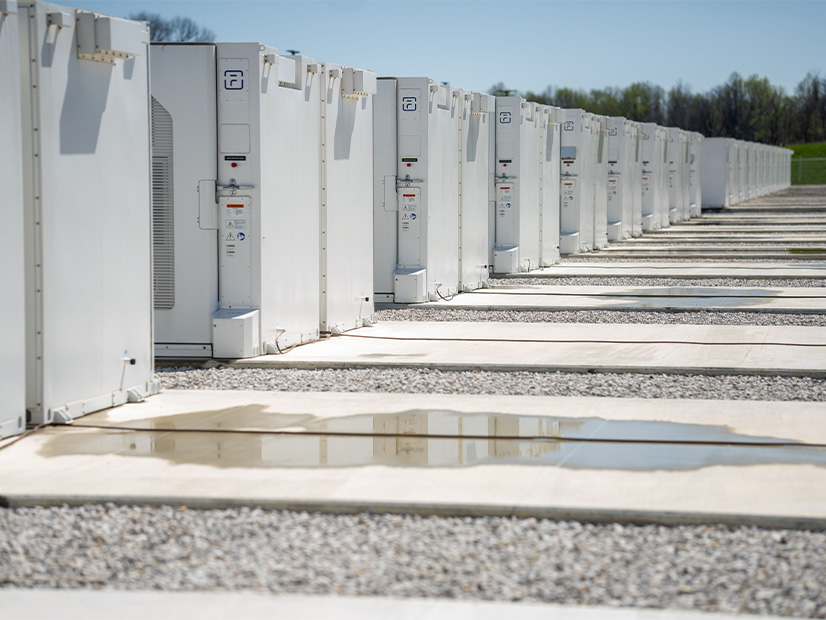
Investment bank Jefferies’ latest analysis finds that the levelized cost of solar-plus-battery storage is cheaper than that of gas, saying slow turbine deliveries and inflationary equipment pricing make the renewable alternative an “attractive” opportunity as data centers drive demand.
Jefferies’ analysis for combined-cycle gas turbines shows levelized cost of energy (LCOE) at $87/MWh, while paired solar-plus-four-hour battery energy storage systems have a levelized cost of $77/MWh, despite several obstacles ahead, the investment bank said in an Aug. 27 research note.
The renewable alternative still will be cheaper at $83/MWh even after new rules on foreign entities of concern (FEOC) become effective in 2026, according to Jefferies. The rule is intended to prevent tax credits from going to companies owned or controlled by entities tied to China, North Korea, Iran or Russia. (See Tax Credit Phaseout Threatens Projects, Jobs in New England.)
“Given the elongated delivery timelines for turbines coupled with inflationary equipment pricing upending project economics, we see attractive solar+battery development opportunity with [investment tax credits] relatively intact,” the bank said.
Jefferies’ analysis follows the Trump administration’s tightening of tax credit rules on new wind and solar construction. However, the new guidance was not as strict as many in the industry had feared. (See IRS Guidance on Wind and Solar Credits Not as Bad as Feared.)
To establish eligibility for tax credits under the new rules, developers now must show that significant physical construction has been started before July 5, 2026, proceeded continuously and was completed within four calendar years.
Jefferies said in its update that the “optimum route for developers” is to procure Chinese solar and BESS and claim the base 30% tax credit, while forgoing a 10% tax incentive aimed at promoting U.S.-sourced materials.
“Going into 2026 once FEOC kicks in, we estimate the ideal route is to procure U.S.-made solar panels, but Chinese batteries (still competitive vs. U.S. due to reliance of U.S. on Chinese supply chain) thus claiming ITC+domestic content adder on solar only,” Jefferies said.
The bank added that FEOC, tariffs and other potential levies related to national security concerns “will be a major swing factor in our equation.”
Gas plants have timelines of five to six years, given slow turbine deliveries, while renewables have much faster deployment cycles, according to Jefferies. This can give paired solar and batteries the upper hand as data centers continue to drive power demand, the bank said.
“With gas equipment increasingly inflationary, while renewable technology continues to improve AND get cheaper (holding tariffs constant), we see hybrid generation as an increasingly viable solution to meet power demand/supply gap on a timely basis,” Jefferies contended. “As data centers begin to explore paths to work with interruptible service (which is happening), expect these tailwinds to strengthen.”
Jefferies’ report is consistent with findings published in June by financial advisory firm Lazard. (See Lazard: Solar and Wind Retain Lowest LCOEs.)
Lazard concluded that wind and solar are the least expensive new-build power generation for the 10th year in a row, while new gas-fired generation has hit a 10-year high, with equipment shortages expected to drive further increases.
“Batteries are not fungible equivalents to gas alternatives — they are simply just available ‘today,’” Jefferies said in its note. “We are seeing wider adoption from geographic perspective (Midwest/etc.) to help accelerate data center timelines. Core markets (TX/CA), however, appear to offset meaningful growth elsewhere for storage. What’s more is the low cost of Chinese alternatives could yet incent developers to side-step the ITC altogether, given procurement impediments to qualify for [One Big Beautiful Bill Act] benefits.”