The Ontario Energy Board (OEB) plans a 22% increase in its 2025/26 budget with the addition of 32 employees, its biggest hiring surge in at least five years.
The board cited “the increased volume and complexity” of its job in announcing the hirings, which would increase OEB’s staff by 14% to 260 full-time equivalents.
“We are building an organization that can enable government policy and be the regulator Ontario needs during the energy transition,” OEB said in its Business Plan for 2025/26 through 2027/28, which outlines $70.3 million in spending for the current fiscal year (beginning April 1) and preliminary budgets for the following two years.
The board said the $12.5 million budget increase was needed to respond to the Ministry of Energy and Mines’ 2024 vision statement and the ministry’s Dec. 19, 2024, Letter of Direction, which outlined the province’s strategy for responding to an expected 75% increase in electric demand by 2050.
“These additional resources will enable the OEB to deliver on its mandate, which, when coupled with the minister’s letter, requires taking on additional deliverables at a time when the organization is at full capacity with existing commitments and adjudicative work,” the board said.
“Resources will be applied across the organization to meet the highest-priority needs at any point in time, balancing adjudicative support and policy development, and matrixing resources depending on expertise, topic and timeline,” it added.
Three initiatives each will receive six new FTEs:
-
- Advancing the Energy Transition: ensuring regulated entities plan across fuel types; considering how to apply the “beneficiary pays” principle; and streamlining approvals for electric connections and “priority” pipeline projects.
- Driving System Modernization: developing local market opportunities for distributed energy resources, such as distribution system operators; implementing performance-based rate regulation for electric distribution companies; supporting Indigenous participation; and ensuring cost-effective integration of innovative business models.
- Sustaining Resources: adding legal, public affairs, finance and human resources staff to support OEB’s expanded operational requirements and strategic priorities. OEB said those functions “have not kept pace with recent growth across the organization.”
The board plans five new staffers to boost DERs, including providing incentives for implementing non-wires solutions, publishing capacity maps for distribution and transmission systems, and reducing barriers for new energy efficiency programs.
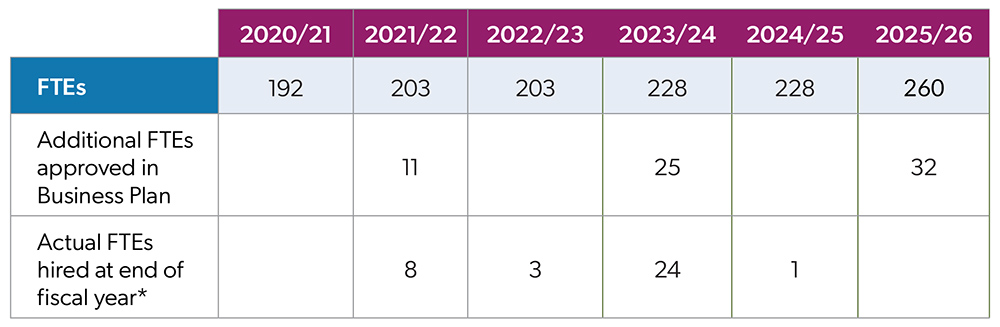
In total, the salaries and benefits budget is increasing by 19% to $50.4 million.
Because they will have staggered start dates, the 32 new hires will cost $4.15 million in 2025/26 and $6.2 million annually thereafter.
The budget also includes $1.8 million for salary increases for existing staff and $1.2 million for short-term contract staff needed to “backfill” for subject-matter experts shifted under the Business Operations Optimization and Systems Transformation (BOOST), a new platform for data and workflow management across OEB processes.
The plan pointedly reiterates the board’s belief that “diversity, equity and inclusion (DEI) is not just an ideal but also our competitive business advantage, a defining characteristic of our culture and an essential organizational strategy.”
The new hires will allow OEB to “provide strategic and prudent oversight of Ontario’s energy sector through initiatives that support broader government priorities such as planning for growth, keeping costs down, enabling energy system modernization and streamlining solutions that will make Ontario an energy superpower,” the board said.
Impact of Integrated Energy Plan?
Roy Hrab, senior manager for policy research at Power Advisory, noted on LinkedIn that OEB’s plan was completed before the release of Ontario’s Integrated Energy Plan (IEP) in June “and the accompanying (quite prescriptive) implementation directive to the OEB.” (See Ontario Energy Plan Gives IESO Long ‘To Do’ List and Ontario Integrated Energy Plan Boosts Gas, Nukes.)
“How the OEB’s planned key projects presented in the plan have changed and will be prioritized post-IEP (and directive) remain to be seen,” he added.
The big spending increase caught the attention of Martin Benum, former director of regulatory affairs for London Hydro.
“The OEB is supposed to regulate industry costs, not grow into another bloated cost-recovery machine itself,” Benum said in response to Hrab’s posting. “Is the OEB still focused on consumer protection and efficiency, or are we watching another cost monster take shape here in Ontario?”
Capital Spending Trending Down
While the board is increasing spending on personnel, it expects capital spending (business systems, infrastructure and end-user computing) to drop slightly, from $474,000 in 2025/26 to $451,000 in 2027/28.
“With more resources available as services, the OEB’s IT capital budget is expected to be stable in the coming period with some spending moving to the IT operating budget,” it explained.
Priorities
The board’s priorities for the coming year include simplifying the connection processes for DERs, incentivizing electric distribution companies to use third-party DERs as non-wires alternatives and a benefit-cost analysis framework for addressing system needs.
OEB also is considering changes to its rate design to accommodate electric vehicles and battery storage, following up on its analysis of the impact of delivery costs on EV charging facilities. “The OEB is also planning to consider reforms to rate design for resources providing grid services and other emerging technologies,” it added.
Also on the schedule for the board is a ruling on Enbridge’s 2026-2030 electric demand-side management application, which includes a residential program that would be delivered through a “one-window” approach in conjunction with IESO. OEB said it expects to rule on the case this fall.