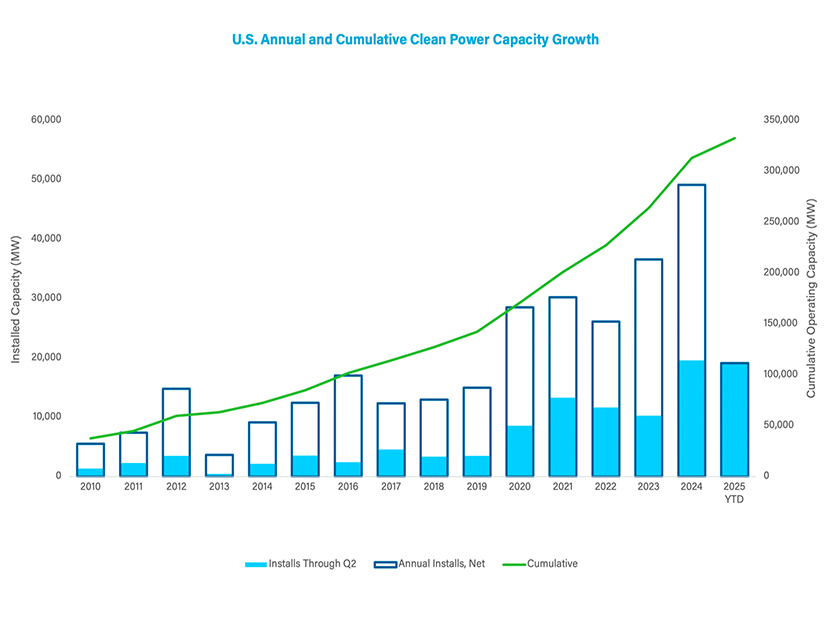
Developers installed more than 11 GW of new utility scale solar, storage and wind worth $15.2 billion in the second quarter, but signs point to abrupt decline in renewable development, the American Clean Power Association said Sept. 3.
While those overall numbers were in line with last year, the clean power pipeline showed virtually no growth (adding less than 100 MW to an existing pipeline of 184.5 GW), solar installations declined 23% during the first half of 2025 and power purchase agreements plummeted, which are early indicators of federal policy attacks and fluctuating trade policies, according to ACP’s Clean Power Quarterly Market Report.
“America’s clean energy industry continues to add much needed power to the grid. Unfortunately, federal policy obstacles and restrictive mandates are threatening hundreds of billions in planned energy investment,” ACP CEO Jason Grumet said in a statement.
“The uncertainty created by new bureaucratic delays and unclear demands is having a chilling effect on the pipeline for future energy projects, stalling growth precisely when our nation needs more energy to power a growing economy,” he said.
Policy actions from nearly every federal department and an unstable regime of tariffs have led to a drop in clean power purchasing, despite skyrocketing demand across the country. PPA contracting fell 32% in the first half of 2025 compared to 2024, battery storage PPA announcements fell 88% from the first quarter to the second, and wind announcements were down 93% on the quarter.
Corporate wind and solar PPA prices were up 6% quarter-over-quarter, and 8% on the year, which reflects instability in the purchasing environment. The pace of procurements slowed in the second quarter as developers and buyers waited for clarity on tax credits and attempted to budget with shifting trade agreements.
While solar installations were down 23%, overall numbers of deployed projects were fairly level with 2024 installations, as storage deployments were up 63% to 6,510 MW and wind deployments were up slightly by 12%.
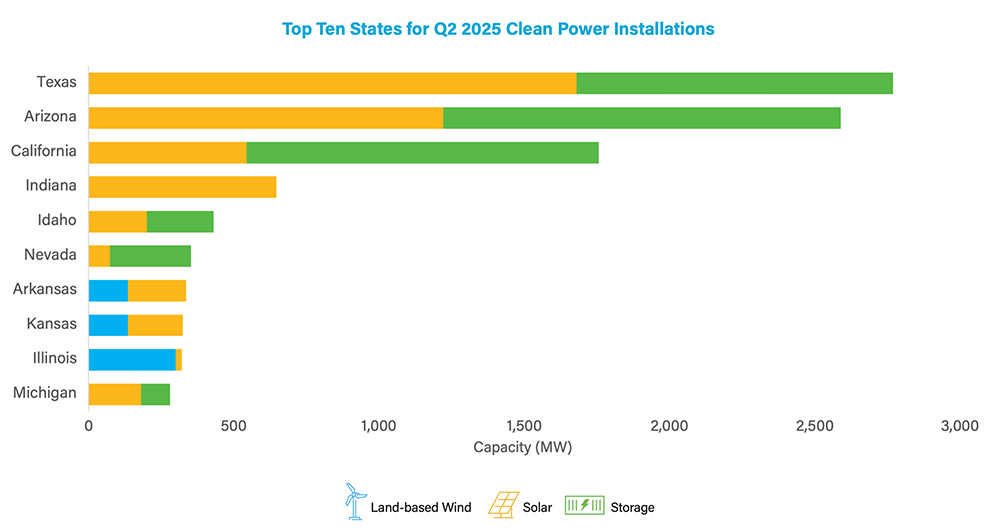
Arizona became the third state to reach 10 GW of nameplate clean energy, as it added 1,220 MW of new solar and 1,369 MW of new storage.
Texas has the most installed capacity and largest pipeline, and it edged out Arizona for additions in the quarter, while California took third place for quarterly additions. Eight of the top 10 states for deployments in the second quarter voted for President Donald Trump in last year’s election.
Overall, the country has installed more than 330 GW of clean power as of June 30, 2025, which is enough to power more than 81 million homes.
Developers reported that 83,403 MW of renewable capacity was under construction as of midyear, which includes 580 projects. Construction activity was highest in Texas at 21 GW, followed by Arizona at 7.8 GW, California at 7.2 GW, New Mexico at 4.8 GW and Wyoming at 4.1 GW.
Solar makes up just over half the national project pipeline, with 96 GW under construction or in advanced development. Storage took second place from land-based wind during the first quarter of 2023 and, along with solar, it has driven the growing pipeline of projects, with the backlogs growing by 32 GW and 22 GW, respectively, since the second quarter of 2022.
“Clean energy is the fastest-to-deploy energy resource. With demand for electricity at historic highs, Americans cannot afford policies that limit power production and raise household electricity bills,” Grumet said. “The U.S. must support all forms of energy.”