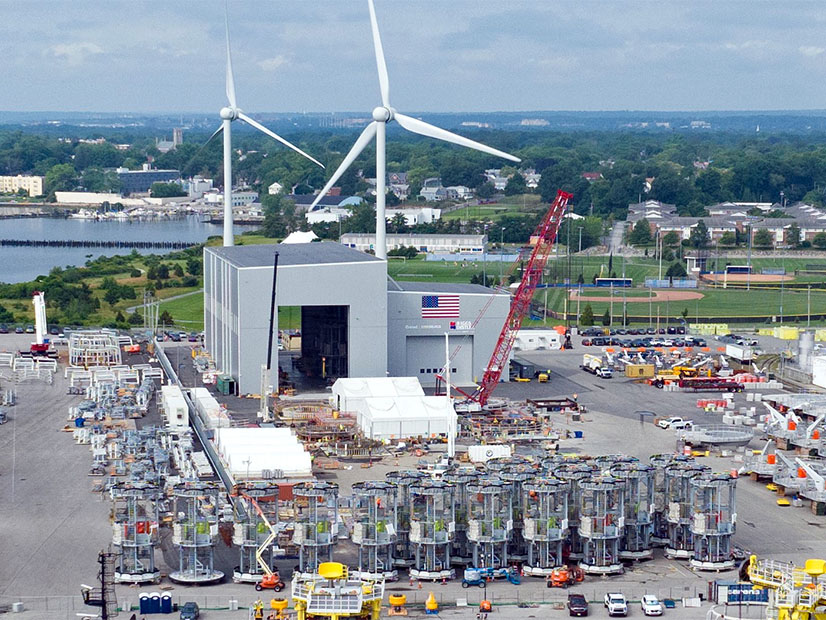
Revolution Wind is seeking an emergency injunction against the federal stop-work order slapped on its offshore wind project.
The Bureau of Ocean Energy Management’s Aug. 22 order was arbitrary and capricious, violated the due process clause of the Fifth Amendment and is beyond statutory authority, attorneys argued in a complaint filed Sept. 4 in the U.S. District Court for the District of Columbia (1:25-cv-2999).
The project off the southern New England Coast would send 704 MW at peak output to Connecticut and Rhode Island. BOEM approved it two years to the day before the stop-work order, and construction is 80% complete. Developers say they have spent or committed more than $5 billion so far on Revolution Wind and had expected a first-half 2026 commercial operation date.
Also Sept. 4, the attorneys general of Connecticut and Rhode Island announced a lawsuit in U.S. District Court for the District of Rhode Island seeking to overturn the stop-work order.
Developer Ørsted said in a news release that while Revolution Wind would seek to work collaboratively with the administration and other stakeholders for a prompt resolution, litigation is necessary due to the substantial harm the stoppage inflicts on the project.
The new litigation is the latest step in what largely has been a one-sided battle over U.S. offshore wind energy development that began a few hours after the inauguration of President Donald Trump, an outspoken opponent of the technology.
Trump’s executive actions and his Cabinet’s multitude of policy adjustments have made it unlikely any new construction will start during his term, but he has been more ambiguous about the five projects already under construction in U.S. waters.
A previous stop-work order against Equinor’s Empire Wind in April was widely seen as an attempt not to kill the project but to twist New York’s arm to reconsider previously rejected gas pipeline proposals. Equinor lost millions of dollars in the monthlong stoppage; it threatened to take the administration to court but never did.
Some have speculated the Revolution stoppage is Trump’s attempt to twist the arm of Denmark, which owns a majority of Ørsted and also controls Greenland, which Trump covets.
But if there is such an ulterior motive, it has not been stated. Connecticut Gov. Ned Lamont (D) has said he thinks there is one but needs to find out what it might be.
The stop-work order references national security interests, and Interior Secretary Doug Burgum later offered a vague explanation in a CNN interview about the wind power array interfering with defense against submarine and aerial drone attacks.
Revolution Wind occupies a seabed lease awarded in September 2013. Ørsted and its partners — first Eversource, now a consortium led by Skyborn Renewables — spent years preparing the project.
The complaint states that every conceivable aspect of construction was reviewed by 15 state and federal agencies (including the Department of Defense) during three presidential administrations, resulting in more than 20 local, state and federal permits and approvals.
The stop work order does not accuse Revolution of violating any law or condition of approval, the complaint states, and is unlawful, lacks evidentiary basis and was issued without statutory authority.
The attorneys general, meanwhile, say the stop-work order did not identify any violation of law or imminent threat to safety.
“Revolution Wind is fully permitted, nearly complete and months from providing enough American-made, clean, affordable energy to power 350,000 homes,” Connecticut Attorney General William Tong said. “Now, with zero justification, Trump wants to mothball the project, send workers home and saddle Connecticut families with millions of dollars in higher energy costs. This kind of erratic and reckless governing is blatantly illegal, and we’re suing to stop it.”
Rhode Island Attorney General Peter Neronha cited the Trump administration’s “all-out assault” on wind energy: “Just yesterday, we learned of reports that the administration is pulling in staff from several different unrelated federal agencies, including Health and Human Services, to do its bidding. Does this sound like a federal government that is prioritizing the American people? This is bizarre, this is unlawful, this is potentially devastating, and we won’t stand by and watch it happen.”
National trade group Oceantic Network does not comment on active litigation, so it had nothing to say Sept. 4 about Revolution Wind’s court filing, but it reinforced its longstanding message about the importance of offshore wind in general and Revolution Wind specifically to the American economy.
Various media outlets have placed the project cost at $4 billion or $6 billion. Ørsted will not provide an exact cost but said in the Sept. 4 court papers it has cost $5 billion so far and said Aug. 25 that the combined investment in its two active U.S. offshore wind projects — Revolution and Sunrise — is expected to be in the $16 billion range.
Oceantic pointed out the secondary benefits of all this: 183 Revolution Wind supply contracts for 179 companies in 34 states, with over $1.4 billion in related investments and 2,500-plus American jobs supported.
The renewable energy industry has been making similar statements about the sector’s importance to the grid and to the economy since Election Day, but that has had minimal effect — Trump and his Cabinet and his congressional allies have loosed a flurry of actions to stymie solar and especially wind development.