A new report estimates keeping New York’s aging commercial nuclear reactors running through 2050 would save $50 billion in energy.
Other economic and environmental benefits would accrue from continued operation of the four reactors, which now account for nearly half of New York’s emissions-free electricity, the authors point out.
The state’s energy planners have concluded the same — they included nuclear energy in the state’s updated energy plan and have recommended the state continue subsidizing the reactors until 2049.
The Carbon Free NY Coalition, a nuclear power advocacy group, announced the new report by the Brattle Group on Sept. 4.
Along with the $50 billion in savings, the Brattle analysis concluded that extended operation would contribute $38 billion to the state’s economy; support 2,020 direct jobs and 12,380 other jobs; and preserve $10 billion in tax revenue, $4 billion of it going to the state.
The four reactors also are increasingly important to New York’s decarbonization goals, as efforts to develop solar and wind generation within the state’s borders are proceeding more slowly than hoped.
Fossil generation equivalent to the reactors’ 27.5 TWh output in 2024 would have emitted 16.4 million tons of CO2, the coalition noted. The state has paid the reactors’ operator $3.69 billion in subsidies since 2017, in recognition of the reactors’ high cost of operation as well as their high value to the state’s grid and environment.
“Keeping the upstate nuclear plants operating until midcentury will contribute substantially to New York’s clean energy goals and keep costs lower for ratepayers. It will also support the New York economy, contributing substantially to GDP and jobs — particularly in the upstate region,” said Dean Murphy, lead author of the report and a principal of The Brattle Group.
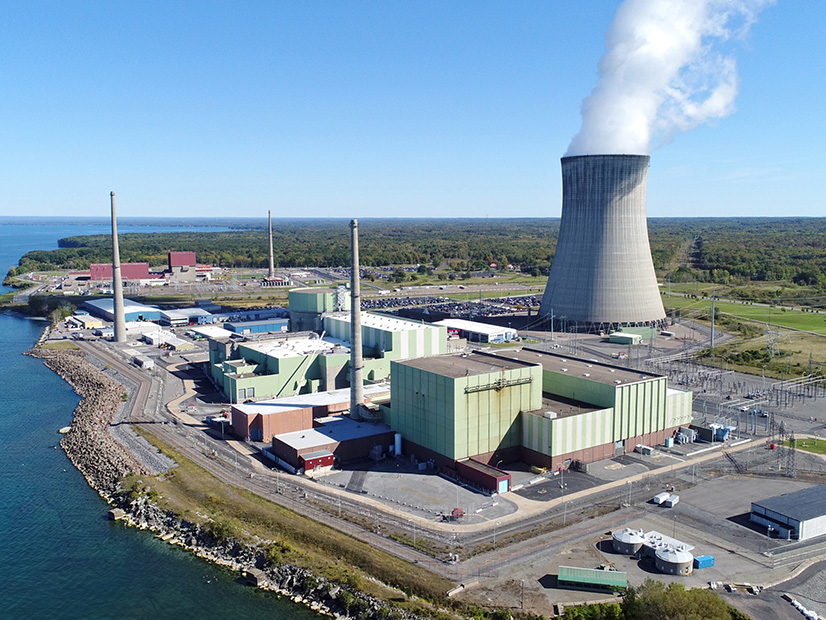
The four reactors at three plants in two locations along the south shore of Lake Ontario all are owned by Constellation Energy, which is part of the coalition that commissioned the Brattle report.
Nine Mile Point Unit 1 is the oldest operating commercial reactor in the nation, and the Ginna reactor is the second-oldest. The FitzPatrick reactor entered commercial operation in 1975; Nine Mile Point Unit 2 is a relative youngster, entering commercial operation in 1988.
Constellation needs signals of support to take the step of updating and relicensing the geriatric plants, and New York is moving to provide those signals. (See N.Y. Makes Case for Extending Nuclear Subsidies to 2049.)
Given that renewables are developing slowly in New York, and given that the state is pinning its energy strategy on the hope that new technologies will be perfected, affordable and scalable, nuclear power takes on considerable importance for the Empire State if it is to meet its decarbonization targets. (See N.Y. Considers New Fossil Generation as Renewables Lag.)
The report analyzes the impact of FitzPatrick, Ginna and Nine Mile Point 1 retiring in 2029, due to expiration of New York’s ZEC subsidy program, and Nine Mile Point 2 retiring in 2032, due to expiration of the federal 45U tax credit.
They have a combined nameplate rating of 3,537 MW and run at a five-year average 94% capacity factor, and their retirement would lead to an average 3.36% annual increase in retail prices from 2030 to 2050, the report states.
Retirement of the four reactors likely also would increase the amount of fossil generation the state needs — the report points out that this is exactly what happened when the Indian Point nuclear plant was shut down.
Earlier in 2025, Gov. Kathy Hochul (D) directed the New York Power Authority to develop new nuclear generation. (See N.Y. Pursuing Development of 1-GW Advanced Nuclear Facility.)