Update on New Jersey and Maryland SAA
PJM and the New Jersey Board of Public Utilities are in discussions on how the transmission and interconnection facilities planned for the state’s offshore wind aspirations can be put on ice in the wake of all the generation developers pulling out of their projects. (See N.J. Puts on Hold Remaining Pieces of $1.07B OSW Transmission Project.)
The RTO has responded to a BPU request to pause transmission planned under FERC Order 1000’s State Agreement Approach (SAA) by asking for clarification on what a “delay” means and to clarify that PJM requires amendments to the SAA and designated entity agreements for those tasked with developing the transmission. That includes new in-service dates for the OSW projects and a solicitation schedule for finding new developers for the generation.
PJM Senior Manager of Policy Initiatives Susan McGill told the Transmission Expansion Advisory Committee that the RTO’s request is not adversarial but meant to ensure that the BPU’s request can be fulfilled to the greatest degree possible without compromising reliability. She added that staff have also reached out to all entities involved in the SAA projects.
Planning staff have sorted through the SAA transmission to identify radial expansions with no impact on reliability, which can likely be deferred without issue, and multi-driver projects, which support both OSW interconnection and larger reliability needs or the interconnection of unrelated generation. Multi-driver projects may have to proceed regardless of the BPU’s request.
PJM is also processing a request from the Maryland Public Service Commission to use the SAA to support its goal of installing 8,500 MW of OSW by 2031. The two are working to draft an approach on how to proceed with the SAA, which would be PJM’s second, with the goal of the RTO completing its analysis and opening a competitive window for transmission projects in 2026.
The RTO has conducted an initial study on possible interconnection points based on the 2024 Regional Transmission Expansion Plan (RTEP) case, the results of which led the state to support a plan with five injection points. The scenario identified would begin with injecting 2 GW at Delmarva Power’s Indian River substation in 2028, followed by 3,500 MW in 2030 split equally between the utility’s Cool Springs, Piney Grove and Nelson sites. The last 2 GW would come online at PEPCO’s Calvert Cliffs substation in 2031.
McGill said PJM staff and transmission developers participating in the New Jersey SAA competitive windows found having two separate windows was disruptive to the RTEP process, so the intention going into the Maryland SAA is to have one solicitation and window.
PJM Presents RTEP Update
PJM is evaluating 134 proposals submitted, of which 57 are classified as greenfield and 77 as upgrades, in the 2025 RTEP Window 1 competitive window, which closed Aug. 18.
The projects also include grid-enhancing technologies, with five involving HVDC lines and five advanced conductor proposals.
PJM’s Matthew Wharton said there’s a need for solutions providing west-to-east transfer capability, with most of the corresponding submissions focusing on expanding the 765-kV backbone. Many of the 500-kV proposals focus on improving north-south flows within the eastern side of the RTO. The proposals are skewed toward higher-voltage solutions, both in number and cost, with 56 involving 500-kV projects and 29 at the 765-kV level.
Wharton said the projects have been reviewed for deficiencies, and PJM is waiting for responses from the submitters. Staff plan to review the proposals and pursue a first read on noncompetitive projects during the TEAC’s October meeting, with recommendations on competitive projects to be held throughout the winter. The RTO’s goal is to receive Board of Managers approval for a package in the first quarter of 2026.
Generation Deactivation Update
Vistra has notified PJM that it intends to deactivate two coal-fired units at its Kincaid generator with an installed capacity of 1,112 MW. The deactivation notice states that the company is seeking to bring the units offline by Nov. 30, 2027, to comply with the EPA’s coal combustion residual rule.
Milepost Power has also submitted a deactivation notification for its 31-MW gas-fired Forked River Unit 2 because of “its inability to meet New Jersey air permit requirements.” The company initially requested to bring the unit, located in the JCPL zone, offline on June 1, 2026, but shifted that out by one year.
PJM’s Michael Herman said staff have completed a reliability analysis on requests to deactivate Warren Evergreen CT 1 and Cooper Unit 1, together amounting to 121 MW, and did not identify any violations.
Supplemental Projects
AES Ohio presented a $74.1 million transmission project to serve a customer near Marysville, Ohio, seeking to ramp its load to 135 MW by July 2028; the customer plans to initially come online in February 2027 with 22 MW.
The project would construct a new 138-kV substation in a breaker-and-a-half (BAAH) configuration cutting into the 138-kV Millcreek-AD2-163 line and expand the Darby substation with a 138-kV BAAH yard. The new substation would be connected to Darby with a 5-mile 138-kV line. The project is in the conceptual phase with an in-service date in April 2028.
Duquesne Light Co. presented a $46.3 million project to fulfill a new service request seeking to bring 250 MW to Monroeville, Pa., with a projected in-service date in January 2029. It would construct a new 138-kV substation, named McGinley, in a BAAH configuration with 12 breakers and a 50-MVAR capacitor bank. It would be looped into the 138-kV Cheswick-Yukon and Springdale-Huntington lines.
PPL presented a $187 million project to serve a customer seeking to bring 300 MW to Gouldsboro, Pa., ramping to 1.5 GW in 2030. The project would construct a 230-kV BAAH substation, named Big Bass, along the 230-kV Pocono-Acahela line to connect to two 230/34-kV substations to serve the customer. The 230-kV corridor between Paupack-Pocono-Acahela would be upgraded with an additional circuit, which would also extend from Acahela to Jenkins and from Paupack to Callender Gap and Lackawanna. Several of the substations along the corridor would be upgraded with new bays and breakers to accommodate the additional circuit.
PPL also presented a $95 million project to serve a customer seeking 230-kV service in Hazleton, Pa., for a load coming into service in 2027 with 350 MW to ramp to 1 GW in 2030. The project would reconductor the 10-mile 230-kV Susquehanna-Tomhicken line and construct a new 230-kV line from Harwood, through Slykerville and to Tresckow. The new corridor would initially be single-circuit, with the intention of upgrading it to double-circuit. The Harwood, Slykerville, Tresckow and Nescopeck substations would be upgraded with 230-kV bays, and three 230-kV line terminals would be installed at Tresckow for the lead lines to the customer substation. A new 500/230-kV transformer would be installed at the Susquehanna 500-kV yard, and a 3.75-mile 230-kV line would be constructed from the 500-kV yard to Nescopeck, initially as single-circuit but to be upgraded to double.
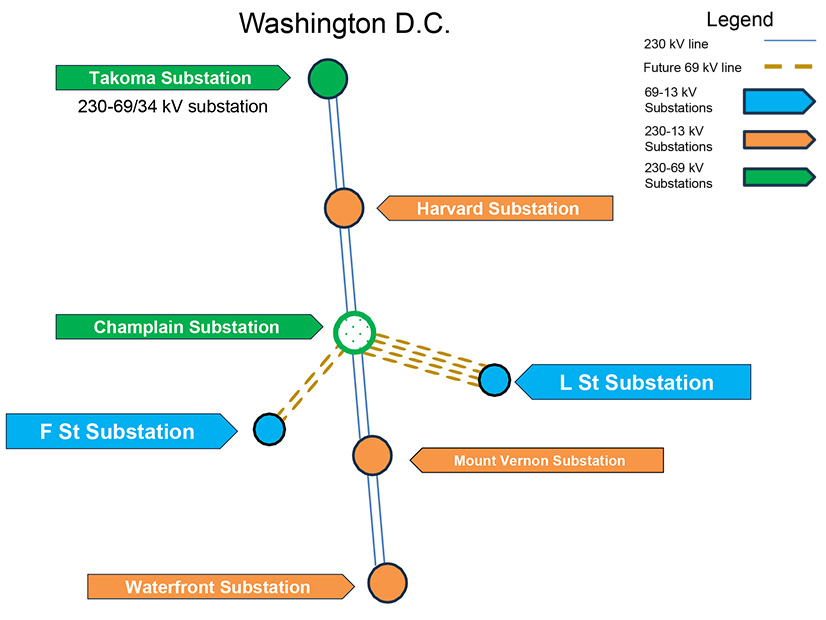
Exelon presented a $590 million project to address issues aging and faulty equipment in the D.C. area by replacing the deactivated Champlain substation with a 230/69-kV station with gas-insulated, BAAH buses for both voltages and three 230/69-kV transformers. The Takoma substation would be upgraded with two 500-MVA phase-shifting transformers to control power flows and prevent overloads in N-1-1 contingencies. The work would create a new 69-kV source to the D.C. core and allow the L Street substation to retire. It would also enable the retiring of 11 oil-filled cables under the Potomac River that have seen operational issues.
Exelon presented a $84.8 million project to serve a customer seeking to bring 225 MW to the Hoffman Estates region of the ComEd zone in September 2028, with the expectation to ramp to 612 MW in 2031. A 345-kV substation, named Beverly Road, would be constructed with two 150-MVAR capacitor banks and a double ring bus to be expanded to a BAAH. The facility would cut into the 345-kV Libertyville-Tollway and Silver Lake-Wayne lines with two half-mile, double-circuit lines. The project is in the conceptual phase with a projected in-service date of Sept. 1, 2028.
Dominion Energy presented a $56.5 million project to construct a 230-kV substation, named Azalea Lane, along the Brambleton-Evergreen Mills line. The facility would serve load growth in Loudoun County, Va., with a requested in-service date of Dec. 31, 2029. The substation would be configured in a four-breaker ring.
The utility also presented a $20 million project to resolve a 300-MW load drop violation identified in the 2025 Do No Harm analysis, which would cause the Racefield and Reed Farm substations to be offline. The solution involves upgrading Azalea Lane and Reed Farm to six breakers and constructing a double-circuit 230-kV line between the two. The project is in the conceptual phase with a projected in-service date of Dec. 31, 2029.
Rappahannock Electric Cooperative has requested a new substation, to be named Matta, in Caroline County, Va., to serve a data center coming online on Dec. 1, 2026, and expected to ramp to 300 MW by 2031. The project is expected to cost $25.5 million, including $18.1 million for the substation and $7.4 million to cut into the Ladysmith CT-Kraken line.
Public Service Electric and Gas presented an $85 million project to provide relief for the Mount Laurel substation in New Jersey, which has a projected contingency overload of 115.3%. The solution would construct a 230/13-kV substation along the 230-kV Cox’s Corner-Burlington line and feature two 230/13-kV transformers. The project is in the conceptual phase with a possible in-service date in May 2031.