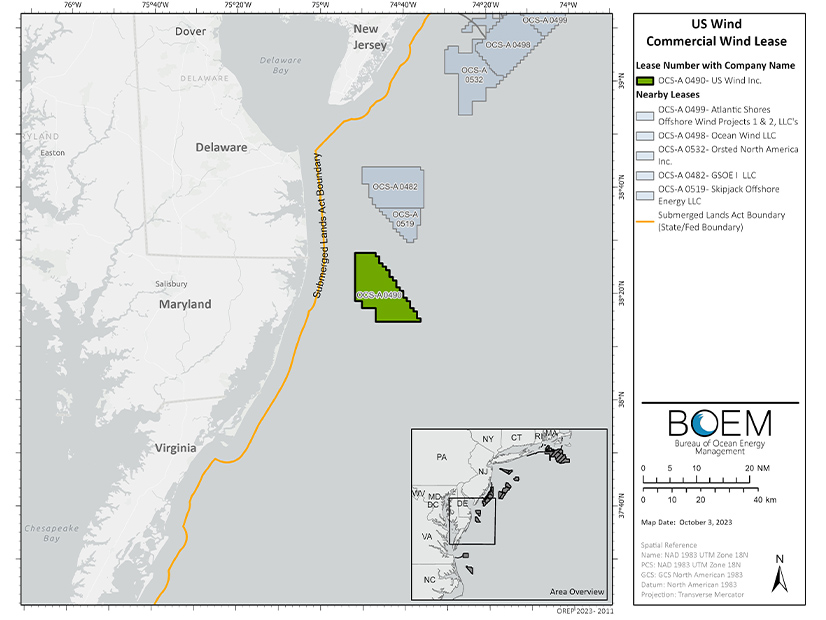
BOEM is formally seeking to vacate approval of the US Wind project off the Maryland coast, saying it made errors in granting the approval.
The move is the latest in the campaign against offshore wind power development that President Donald Trump initiated hours after the start of his second term in January.
Along with erecting a series of new regulatory barriers to future projects, the Trump administration has moved to impede existing projects in advanced development or actual construction.
It issued stop-work orders against Empire Wind and Revolution Wind, two projects in active construction; remanded the air quality permit for Atlantic Shores; and most recently indicated it would seek to remand Biden-era construction and operations plan (COP) approvals for New England Wind, SouthCoast Wind and US Wind. (See Interior Reconsidering Approval of Two OSW Projects and BOEM Plans to Vacate New England Wind Project Approval.)
The three COP remands are sought as part of lawsuits that offshore wind opponents filed against federal agencies seeking to invalidate their approvals of the three projects.
In the US Wind case in U.S. District Court in Maryland (1:24-cv-03111), elected leaders of Ocean City, Md., and others are trying to prevent construction of wind turbines with as much as 2.2 GW of nameplate capacity as close as 10 nautical miles from the popular vacation destination.
On Sept. 12, the Bureau of Ocean Energy Management asked the court to remand and vacate its approval of the COP for the Maryland project. BOEM said its desire to reconsider the approval is by itself sufficient reason to grant remand, and BOEM’s identification of an error in the approval process justifies vacating the approval.
BOEM also asks the court to dismiss the lawsuit if it grants the motion to vacate approval, as the lawsuit would be moot. If only remand is granted, BOEM asks the court to place the lawsuit on hold for the duration of the remand.
There was no real suspense about the Sept. 12 filing: BOEM had indicated in an Aug. 25 filing that it would make such a motion no later than Sept. 12.
US Wind struck back first.
On Sept. 3, it countersued the Department of the Interior and other defendants in 1:24-cv-03111, saying the effort to vacate or otherwise undermine the federal agencies’ previous efforts is illegal, factually incorrect and a pretextual means to achieve policy goals.
It wrote: “The federal defendants’ efforts to vacate and undermine the federal approvals are inextricably tied to a wider plan to hinder or kill outright offshore wind projects (and renewable energy projects more generally) for political purposes, as evidenced by numerous official acts and public statements by federal defendants, various members of the current presidential administration and others within the federal government acting in concert with federal defendants.”
US Wind is asking the court to declare that federal approvals for its project were lawfully issued, to enjoin the federal defendants from taking any action to undermine any of the approvals, and to award legal fees and costs.
In its Sept. 12 motion, BOEM faults its prior assessment of factors in Title 43 Section 1337(p)(4) of the U.S. Code, which pertains to commercial activity on the Outer Continental Shelf.
As examples, BOEM said it now feels it underestimated the effect the offshore wind farm would have on helicopter search and rescue operations and said its impact on commercial fisheries may not be sufficiently mitigated under terms of the COP.
BOEM brushed aside US Wind’s objections: “US Wind may be concerned that BOEM will make a different decision than its prior COP approval, but those concerns are speculative and unripe.”
BOEM also said offshore construction still is months or years away, so it would not be disruptive for the court to vacate the COP approval.
Later Sept. 12, the Oceantic Network criticized BOEM’s motion: “Today’s news is yet another targeted action against American energy. The unlawful actions by the Trump administration against fully permitted offshore wind projects up and down the East Coast represent one of the largest, economically devastating assaults on U.S. workers, businesses and energy in decades. Revoking a permit on an approved project after years of thorough agency review will raise electricity prices for families, jeopardize private investment, delay economic growth and weaken our power grid.”
The Maryland Offshore Wind project dates to an Aug. 19, 2014, auction of what now is OCS-A 0490. BOEM issued a record of decision in favor of the project in September 2024 and approved the COP in December 2024.
The first two phases of the project — the 300-MW MarWin and the 800-MW Momentum Wind — hold offshore renewable energy certificate agreements with Maryland.