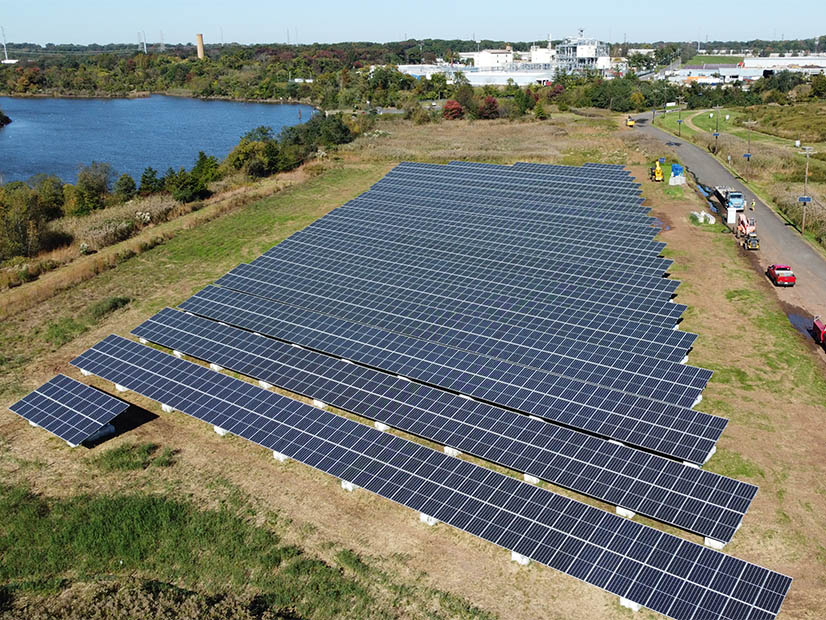
As solar development companies race to meet the deadlines by which they can secure federal investment tax credits (ITCs) before the program expires, developers see a better-than-expected short-term outlook but a grim long term.
Developers say guidelines issued by the Trump administration in August open the window to potentially completing more projects than they expected. In particular, the designation of a four-year period for certain residential and commercial projects to be completed if construction starts before July 2026 will enable more projects to obtain the tax credits, developers say. The credits, for 30% of the cost, are considered a major element toward making a solar project economically viable.
The One Big Beautiful Bill Act, enacted July 4, eliminated the ITC for residential projects that are not in service by Dec. 31. However, guidelines released in mid-August surprised developers by adding some lenience: Commercial projects and some leased residential projects must either be completed by the end of 2027, or, if they begin construction before July 5, 2026, they have four years to be completed.
Fred DeSanti, executive director of the New Jersey Solar Energy Coalition, said the organization was “reasonably pleased” with the guidelines, saying they give developers “some time to continue to get some work done.”
“So we’re under kind of a burning platform to get as many projects going as soon as possible,” he said, adding that utilities will be under “enormous pressure” to meet the demand in connections.
Annika Colston — president of New York City-based AC Power, which has three New Jersey projects in development and is looking for more to complete before the deadline — said recent weeks have “been a bit of a roller coaster.”
The House of Representatives’ version of the bill, which included a tax on the production of solar and wind power that was not passed by the Senate, was “shocking,” she said, but the release of the guidelines meant the “ultimate outcome felt manageable.”
Uncertain Future
But the removal of the tax credit has thrown a cloud of uncertainty over the long-term strength of New Jersey’s now two-decade-old solar sector, raising questions about whether it can even meet the state’s past capacity goals, let alone the far more expansive current predictions of future needs.
The ITC’s demise comes just as state officials are looking to make solar a key element in the effort to boost in-state electricity generation to meet the dramatic surge in demand expected over the next decade, mainly from the development of data centers.
Officials frequently say that solar projects are the quickest new resources able to interconnect and would provide cheap energy for the energy-importing state, especially now that the state’s offshore wind sector is largely dormant. But developers say the economic viability of many projects will be questionable without the ITC. Some developers see potential support from the rising cost of electricity in the region, the state’s vibrant community solar sector, its new storage incentive program and perhaps another, smaller ITC to help buttress the sector. But they don’t see those making up for the loss of the full credit.
DeSanti said its demise will put “a lot of cost pressure” on companies and hurt the large-scale solar sector the most.
“You’re talking about huge investments — tens of millions of dollars,” he said. “Nobody’s going to put that kind of money on the table without some assurances that they’re going to get the 30% ITC.”
Smaller projects “are going to be limping along,” he said. “They’re going to be a lot tighter, and the market’s going to be shrinking from what it is. … I think we’re going to see a lot of the smaller guys go under from the pressure. The bigger companies, the established companies, I think they’ll be OK.”
Ray Cantor, a lobbyist on environmental issues for the New Jersey Business and Industry Association, said that with solar contributing only about 6% of the state’s electricity use, the sector has plenty of room to grow.
But “while it is part of energy future, it’s not the answer to our long-term capacity needs,” he said. “Solar is part of the solution. It is not the way to get out of our deficit of capacity.”
Colston said she still is optimistic that New Jersey’s established solar sector will help it fare better than states with a shorter history to fall back on, and hopes the four-year completion deadline will give federal legislators time to plan for a new tax credit. She noted that the ITC, which has existed in different forms for more than two decades, had been 20% at one point.
“Projects are viable at a lower ITC, assuming we don’t have outrageous tariffs,” said Colston, whose company develops solar on landfills. “There needs to be some relief somewhere.”
Community Solar Boost
The turbulence comes as New Jersey is far from achieving Gov. Phil Murphy’s goal of having 12.2 GW of solar by 2030 and 32 GW by 2050.
As of July, the state had an installed capacity of 5.2 GW, according to the latest figures from the New Jersey Board of Public Utilities. About 80% is behind the meter, 3.5% is community solar and 16% is utility-scale, but those proportions are changing. Community solar accounts for about 53% of the development pipeline, and 30% is grid supply.
State officials see community solar as a key element of the state’s future generation, and Murphy provided a boost on Aug. 22 by signing a law authorizing the BPU to allocate 3,000 MW of capacity by 2029, or whenever the limit is reached. The state currently allocates 150 MW a year, although a one-time measure increased it to 250 MW in 2025.
Strong demand for community solar allocation in two pilot solicitations and three in the permanent program have produced 119 completed projects and another 435 in the pipeline, BPU figures show. The agency in April said the state’s four utilities reported they had received 1,120 community solar interconnection applications totaling about 1,800 MW of power.
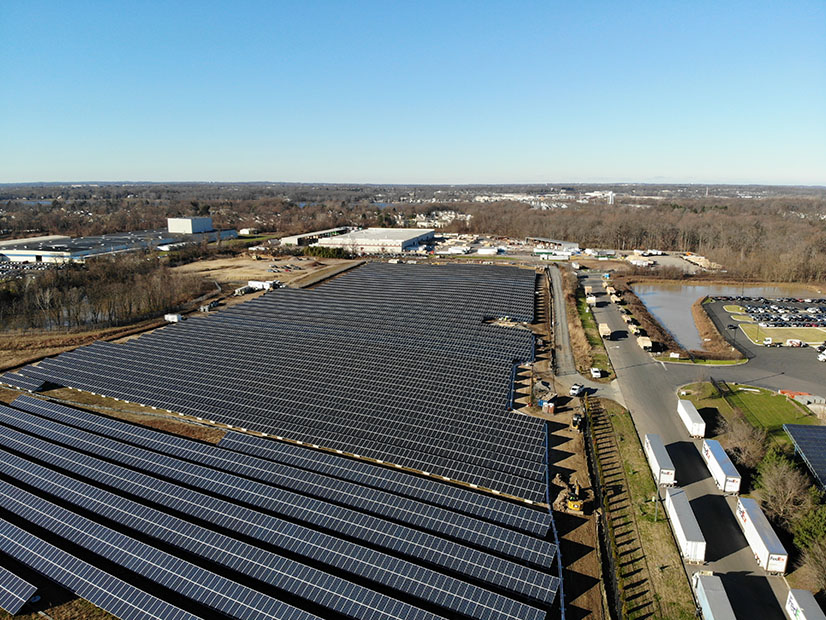
Some developers also hope a new law facilitating the development of storage will help meet the electricity demand surge while supporting the solar sector. The law, also signed by Murphy in August, aims to stimulate the development of “transmission-scale energy storage systems,” defined as those with a capacity of at least 5 MW that are connected to PJM. (See N.J. Boosts Storage, Community Solar Program Capacity.)
Some storage projects also retain the federal tax credit. DeSanti said the storage incentives could help make solar more attractive and cushion the blow from the ITC’s disappearance.
“It gives you another source of revenue,” he said. “Because if your battery is charged under the program, if the utility needs power, you can actually sell the power out of the battery.”
The state’s rising electricity rates also could support solar. The average electricity bill rose by 20% on June 1, driven in large part by record-high PJM capacity auction prices in July 2024, which the RTO says were pushed up by forecasts showing that future demand will far exceed the expected supply. Analysts expect auction prices, along with rates, to continue to rise.
“There’s no end in sight for the price of energy going up,” DeSanti said. “As that occurs, it’s going to push more and more people to say, ‘I’ve got to get out from under these utility bills.’ Once you get a deal on solar, you’re basically insulating yourself from those increases completely.”
Accelerating Solar Submissions
For developers, those benefits are distant and uncertain, and their task at hand is to get as many projects planned, and applications submitted, before the credits expire.
Sawyer Morgan, a project manager in the BPU’s clean energy division, said the agency has seen an “acceleration in the number of applications.”
“We currently have 1.4 GW of projects in the pipeline and expect many more projects to join, even in the next year or so, that will be able to qualify for the federal tax credits,” he said.
“Given that most projects in New Jersey are relatively small, we’re hopeful that a lot of projects will be able to meet these milestones and still qualify for the ITC,” he added. “As more homeowners are aware that the residential tax credit ends at the end of the current year, there’s going to be a ton of interest for the residential direct-owned projects to complete construction as soon as possible.”
Still, agency staff are “very concerned that after the expiration of the ITC, there will be a slowdown in the solar industry,” driven in part by developers who “pull forward” projects to get them inside the deadline, he said.
“There’s certainly likely to be a slowdown in installations,” which the BPU is looking to counter, he said. “We anticipate looking at reviewing programs to see what the appropriate mechanisms will be that help drive down costs through streamlining interconnection and other requirements, other costs that are involved in this other installation process or looking at the incentives that the board provides.”
Brian O. Lipman, executive director for the New Jersey Division of Rate Counsel, said that while solar has a “significant role” in the state’s future energy portfolio, it should “no longer plan an active role in incentivizing solar.”
“The solar market has matured greatly,” he said. “New Jersey ratepayers already pay more than those in any other state for solar subsidies. We no longer need, nor can our electric ratepayers afford to pay, such high subsidies that directly impact residential and business electric bills. Even with the loss of federal subsidies, solar in New Jersey should be able to stand on its own.”