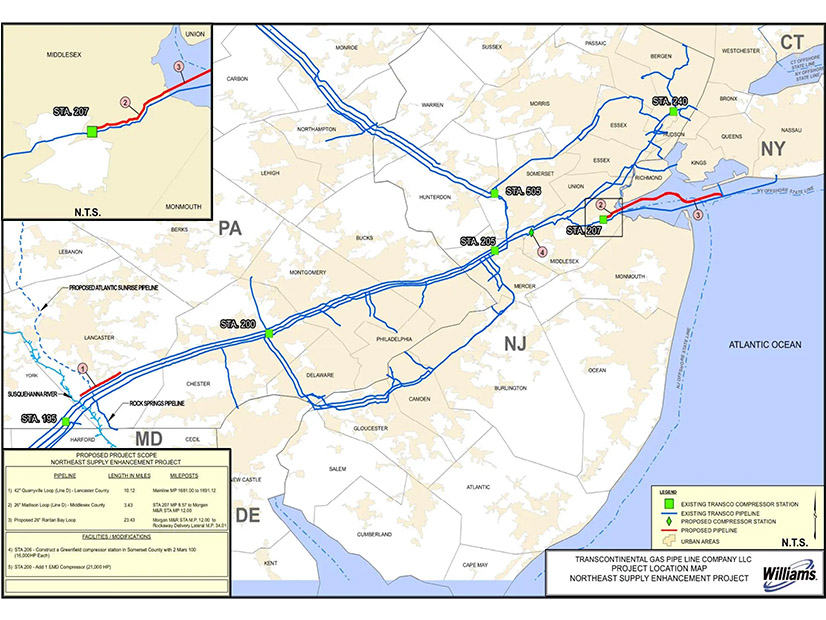
A controversial natural gas pipeline proposal got a boost as the New York Public Service Commission approved the long-term plan for the state’s largest gas delivery system.
In reviewing the proposal by National Grid’s three New York gas utilities, the PSC found a reliability need for the Northeast Supply Enhancement (NESE) project proposed by The Williams Cos. and authorized National Grid to include NESE in its planning.
On its face, the move runs contrary to the state’s statutory requirements to reduce greenhouse gas emissions — a significant component of which comes from combustion of natural gas in buildings and power plants.
More than 3,800 comments were submitted to the PSC in Case 24-G-0248, almost all of them in opposition to the National Grid plan, many of those for environmental reasons.
But New York’s decarbonization efforts are running far behind the schedule envisioned in its landmark Climate Leadership and Community Protection Act. With the Trump administration actively opposing renewable energy development, the state may need to rely on natural gas more heavily and much longer than its leaders and policymakers had hoped.
One of the guideposts for the PSC has been the potentially disastrous nature of a natural gas outage. Restoring service requires utility technicians to visit every customer twice — with police and locksmiths in tow for locations where the customer is not present. National Grid has 2.5 million gas customers in the state, and a widespread outage could take weeks or months to resolve.
“Widespread gas outages are a real possibility today given the narrow margin between available gas supply and demand,” PSC Chair Rory Christian said in a news release. “The gas planning activities we require National Grid to undertake today will ensure that National Grid continues to provide safe, adequate and reliable service while striving to meet the state’s greenhouse gas emissions reduction targets.”
Surrounded by Controversy
Transco, a Williams company, made its initial NESE pre-filing to FERC in 2016, then in 2017 formally sought to extend its existing gas network to increase supply to the New York City/Long Island region (CP17-101-007).
FERC authorized NESE in 2019. But state regulators denied key permits and Williams eventually shelved the concept.
On April 16, 2025, the Department of the Interior slapped a stop-work order on Empire Wind, an important part of New York’s decarbonization strategy. The move now is seen widely as an attempt to coerce New York into approving NESE as well as the Constitution Pipeline, another pipeline extension proposal the state had stopped.
When Interior lifted the stop-work order May 19, Interior Secretary Doug Burgum implied a quid-pro-quo for NESE and Constitution. Publicly, Gov. Kathy Hochul (D) said only that the state would give full consideration to energy proposals that complied with state law.
Ten days later, Transco petitioned FERC to reissue its 2019 authorization of construction and operation of NESE. FERC granted the request Aug. 28.
The PSC’s 6-1 approval Sept. 18 of National Grid’s long-term gas system plan sets a path for offtake from NESE, if it is built. Other New York and New Jersey regulatory agencies are continuing their review of the proposal.
The Next Steps
Requirements in the PSC’s lengthy order include reporting on necessary improvements to demand forecasting, non-pipe alternatives, cost mitigation and electrification.
The three utilities — The Brooklyn Union Gas Co., KeySpan Gas East Corp. and Niagara Mohawk Power Corp. — also must report on how they will optimize supply if NESE is built and how they will address reliability if it is not.
The PSC’s order reflects the quandary that faces New York and Hochul. The state already has some of the most expensive electricity in the nation and must simultaneously harden, expand and decarbonize its aging energy systems. None of these were ever going to be easy or cheap, and by varying degrees they are getting harder and more expensive.
National Grid said it expects NESE to increase natural gas costs and decrease electricity costs for ratepayers, due to construction costs and lower wholesale electricity prices.
Democrats control all levels of state government, but not all Democrats are in lockstep on the energy transition and its costs. Hochul has been pushing back some of the decarbonization initiatives in an effort to keep electricity affordable, drawing criticism from some other Democrats and traditional allies.
The PSC’s decision to let National Grid factor NESE into its planning was a hard truth for climate and clean power advocates who once hoped the concept was dead.
Public Power NY referred to NESE as the “Hochul-Trump pipeline” and said: “The biggest step backward for New York’s climate in at least a decade is just the latest in Hochul’s multiyear assault on our air and lungs.”
Food & Water Watch New York said: “This foolish plan would put everyday New Yorkers on the hook to pay for a filthy, climate-killing fracked gas pipeline that isn’t wanted or needed.”
Leading up to the PSC vote, more than 3,700 opposing comments were submitted by individual New Yorkers and entities ranging from the Sierra Club to the City of New York to the Institute for Energy Economics and Financial Analysis to the Jewish Climate Action Network.
But there also have been voices of support for NESE.
The Plumbing Foundation City of New York called it a critical investment in the state’s energy infrastructure.
IBEW Local Union 1049 pointed to the jobs that would be created by the project.
The Independent Power Producers of New York said NESE is “critically needed to maintain the reliability of the natural gas system in New York to serve Grid’s downstate customers and to augment gas supply to enhance the reliability of the electric markets in the downstate region.”
IPPNY also reminded the PSC of something it is very aware of: Recent federal policy changes complicate the state’s efforts to replace natural gas with renewables.