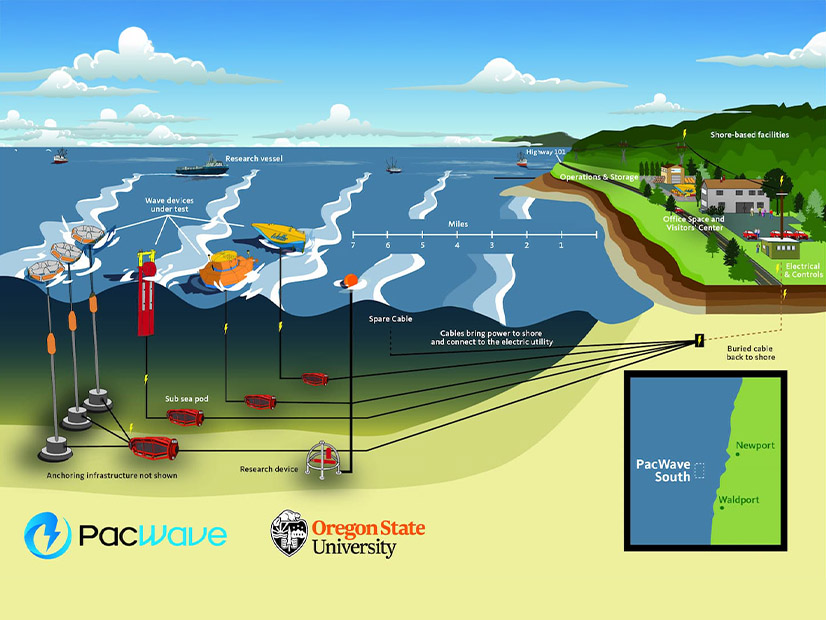
The Bonneville Power Administration has entered into a five-year power purchase agreement to buy wave energy from a test facility managed by Oregon State University (OSU), the agency said.
BPA will buy up to 20 MW/hour of test energy output from the OSU-administered PacWave project starting in 2026 at a purchase price of 75% of the CAISO Western Energy Imbalance Market’s index price, according to the PPA published Sept. 16.
Dan Hellin, PacWave’s director, called the agreement “a significant milestone for PacWave and Oregon State University.”
“We feel that it demonstrates the value of wave energy as an emerging renewable resource and provides a practical pathway for PacWave-generated electricity to enter the grid,” Hellin told RTO Insider. “This agreement not only validates PacWave’s role as a leading open-ocean wave energy test facility but also ensures that the technologies we host are evaluated under real-world market conditions — an essential step toward advancing wave energy from an experimental concept to commercial reality.”
Funded by the U.S. Department of Energy and the state of Oregon, the agreement with BPA concerns one of two facilities under development by PacWave. The project is an open wave energy testing facility and sits seven miles off the Oregon coast. The university submitted a small generator interconnection application in 2015, and BPA has partnered with OSU to ensure the project meets the requirements for new generation in the agency’s balancing authority.
In March 2021, FERC issued a license for construction and operation of the wave project, and the facility was completed in early 2025, according to PacWave’s website.
BPA has agreed to buy energy at a delivery point within a Central Lincoln Public Utility District-owned distribution facility, according to the agreement.
Specifically, BPA entered the agreement under the Northwest Power Act’s section on conservation and resource acquisition. The agency can acquire output under the section if the resource is not a major resource, is experimental, has the “potential” to provide cost-effective services, and if BPA has included the resource in its annual budget to Congress.
The project meets all four conditions, BPA stated, noting the agreement covers only 20 MW of energy per hour and that the project is intended to test the potential of wave energy.
“Because the wave energy industry is in its early stages, the reliability, availability and economics of the various wave energy converter technologies are currently uncertain,” the agreement states. “The project will provide BPA, OSU and the project clients an opportunity to learn more about the operational characteristics and commercial feasibility of wave energy technologies, which will provide BPA with information regarding the industry’s potential cost-effectiveness.”
OSU will select four clients and provide “each with access to an offshore testing berth with a 5-MW-capable power and data cable connection to the shoreside grid connection facility,” the agreement states.
The partners expect the project will begin generating in the spring of 2026.
“This is a small resource purchase that makes economic sense for BPA customers and helps meet BPA’s responsibility to foster emerging technologies in support of its strategic plan, regional and national energy goals,” BPA said in an announcement.
Other states have explored wave energy’s potential. For example, in April, the California Energy Commission found that the Golden State has a significant amount of marine energy potential in the northern part of the state but much less in the south. (See Calif. Report Examines Deep Potential for Wave Energy and CEC Report Shows High Ocean Energy Potential in Northern Calif., Less Down South.)
In 2021, the Hawaii Natural Energy Institute announced it would receive $6 million from the Naval Facilities Engineering Command to research wave energy conversion technology. (See Hawaii Wave Energy Project Gets $6M in US Navy Funding.)