IESO system planners on Sept. 25 recommended the construction of a $1.5 billion HVDC line to meet Toronto’s growing energy needs, saying it would be more “future proof” than two cheaper options.
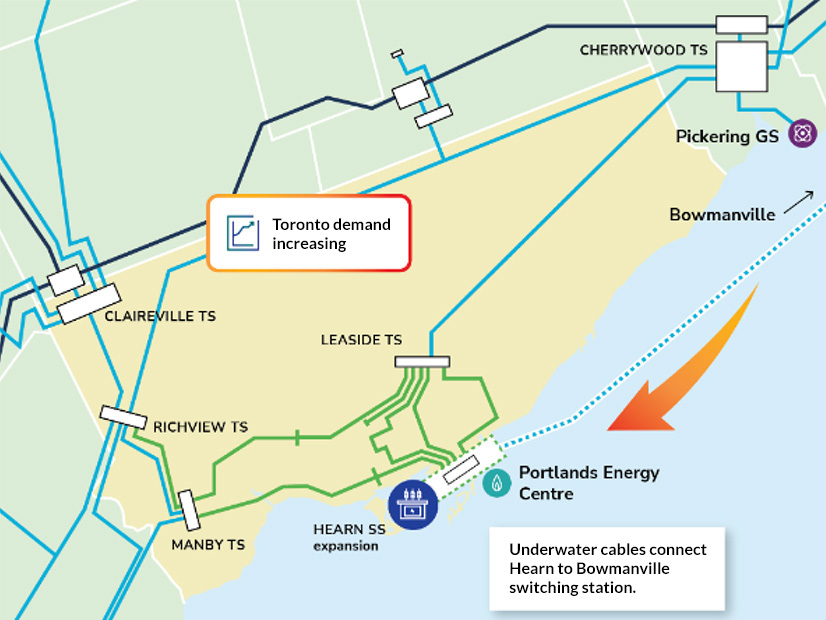
The approximately 40-mile, 900-MW line would run from the Darlington transmission station (TS) in Bowmanville to the Port Lands neighborhood, near Downtown Toronto, via Lake Ontario, requiring expansion of the Hearn switching station in the Port Lands area to add equipment.
“This option can deliver broader bulk system benefits, as it completely bypasses Cherrywood TS and Leaside TS,” the ISO said in a presentation Sept. 25.
Toronto’s electricity demand could increase 70% (reference case) to 100% (high electrification) by 2044 because of new housing and commercial development, data centers, and the electrification of heating and transportation.
As a result, electricity demand is expected to exceed the transmission capacity in 10 to 15 years, creating a “reliability need” by 2038 — or 2034 if the 550-MW gas-fired Portlands Energy Centre (PEC) ceases operations.
IESO’s draft Integrated Regional Resource Plan (IRRP) recommends battery energy storage systems, upgrades to infrastructure and incremental electricity Demand Side Management (eDSM), including residential solar/storage systems, in addition to new transmission infrastructure.
“With or without the supply contributions from PEC, meeting the significant need identified for eastern Toronto due to the significant forecasted growth requires a large-scale wires solution,” the ISO said.
Toronto is currently served by two high-voltage transmission corridors. The underwater line was one of three options planners considered for Toronto’s “Third Supply,” including an overland route from Cherrywood TS (Pickering) to Leaside TS in Toronto estimated at $800 million, and a hybrid of overland and underground segments from Cherrywood TS to the Port Lands, estimated at $900 million.
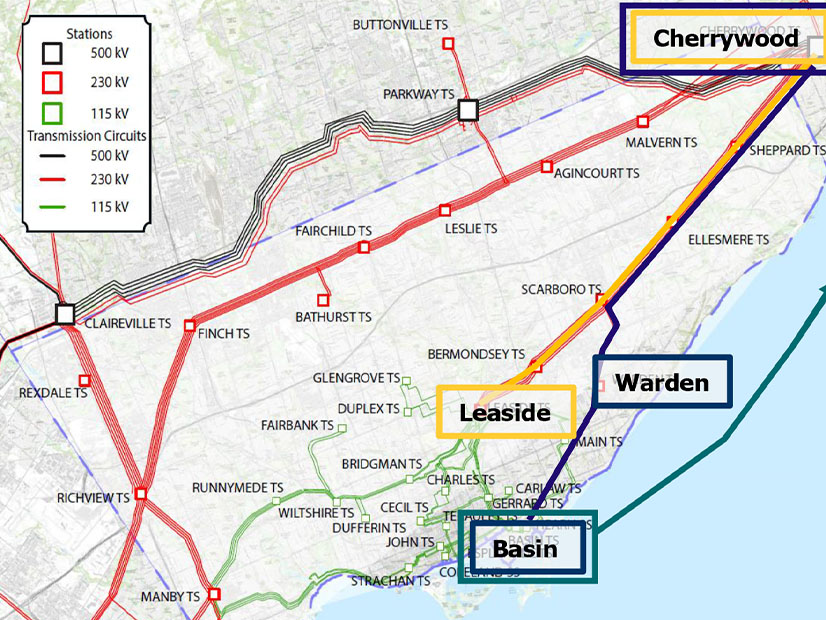
“We chose Bowmanville because here we can connect directly to the bulk power system, and it’s conveniently near the lakeshore,” said Steve Norrie, IESO supervisor of transmission planning. “We picked HVDC technology over the more traditional AC technology for its performance and economics over longer distances underwater. This option offers a new supply path that doesn’t rely on Leaside TS, and it doesn’t rely on any of the 230-kV networks at Cherrywood to inject more power downtown, which means that it can deliver broader benefits for the bulk system.”
While all three options would meet East Toronto’s growth needs into the 2040s, the underwater cable is “the most future-proof option, because it supports the forecasted demand the longest,” Norrie said. “In fact, it will support the demand beyond 2044, so it pushes the need out past the end of the 20-year study in terms of system resilience.”
Norrie said the HVDC line would help the city respond to “high-impact events,” such as the extreme rainfall and flooding that resulted in the loss of supply in July 2024.
Toronto has experienced at least three one-in-100-years rainfall events over the last 20 years, and the last two disrupted power to more than 200,000 customers, “which is something that we really looked at this plan as an opportunity to address,” Norrie said.
The overhead option doesn’t change Toronto’s reliance on the two existing transmission supplies, Norrie said. He said the hybrid would provide some resilience benefit for the downtown core, but the supply to Eastern Toronto would still be reliant on the path coming from Cherrywood.
“The underwater cable provides a new geographically separate and electrically separate supply path to the downtown. It reduces reliance both on Leaside and Cherrywood, plus it provides a means of backing up the other paths into Toronto in the event of a loss of supply,” he said. “So this would be a significant improvement in system performance.”
The ISO will consider written comments on the draft IRRP until Oct. 9.
“We will now be listening to feedback on this draft recommendation, and we will make our final recommendation at the end of October,” IESO spokesman Michael Dodsworth told RTO Insider.