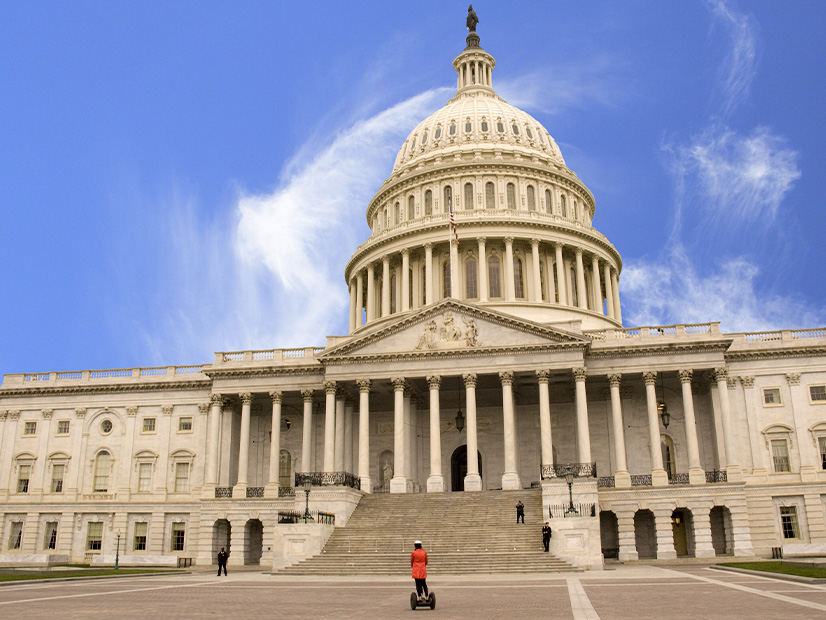
The federal government officially shut down as the clock turned to midnight Oct. 1 after the two parties failed to agree on a spending package to keep it open at the start of fiscal year 2026.
While Democrats and Republicans both blamed each other for the impasse, federal agencies released plans to keep vital employees working and to furlough others, at least once any existing funds are exhausted. For now, both FERC and the Department of Energy have some leftover funds from the previous fiscal year, so they can operate normally, but they will wind down most operations if the shutdown lasts too long.
FERC’s plan allows it to use leftover funds and will keep it running with all 1,478 employees working. Once that runs out, however, just 60 employees and 18 contractors who are needed to “protect life and property” will remain working, it said.
“It is anticipated that there would be no disruption to FERC operations during a short lapse in appropriations of one to five days,” the plan says. “FERC has historically had sufficient previously appropriated funds that remain available to support operations during a short-term lapse. In the event of a lapse extending beyond one to five days, FERC will continue operations using balances from prior years until exhausted.”
If the funding is exhausted in a lengthy shutdown, FERC will continue to inspect hydropower dams and LNG projects under construction for safety. It will monitor the reliability of the bulk power system and threats to energy infrastructure. Some remaining employees will monitor jurisdictional energy markets and offer legal advice to commissioners.
The commissioners are presidentially appointed and Senate-confirmed, so they will continue working, and the office of the secretary of the commission will remain open to release any formal actions publicly.
“Federal employees in offices with funding for salaries continue to report for work as scheduled,” DOE’s plan says. “A prolonged lapse in appropriations may require subsequent employee furloughs. If there is an imminent threat to human life or protection of property, a limited number of employees may be recalled from furlough status.”
Like FERC, DOE has historically remained fully open during short lapses of funding that last just one to five days, and if the money runs out, it has been able to wind down operations in half a day.
The department has 15,523 employees, though that was already scheduled to fall to 13,812 at the start of FY26 on Oct. 1 because of the buyouts the Trump administration offered federal workers early in 2025. An additional 1,409 employees are taking the buyout effective Dec. 31, and 71 others have already left.
The Bonneville Power Administration is self-funded, and its 3,266 employees can keep working with regular pay, though 192 were scheduled to leave on Oct. 1 because of the buyout.
“The other power marketing administrations (Southeastern Power Administration, Southwestern Power Administration [and] Western Area Power Administration) will perform functions related to the safety of human life and the protection of property by engaging in controlling and directing power to utilities, transmission of power and repair of the power transmission system,” DOE says in its plan.
The Nuclear Regulatory Commission has already started to wind down operations under its plan.
“The NRC has some appropriations for performing high-priority activities, such as operator licensing, time-sensitive licensing actions and activities related to recent executive orders, with a core group of employees,” the agency’s plan says. “When NRC appropriations no longer support other high-priority activities, the NRC plans to operate at a reduced level for some period of time and to begin a minimal maintenance and monitoring mode in which the NRC will continue to carry out its responsibility to protect public health and safety.”
The law firm Holland & Knight posted a summary and links to other federal agencies’ plans for the shutdown.
The Maryland Public Service Commission issued a notice saying that utility disconnections are forbidden for any federal workers in the state, noting that Gov. Wes Moore has reminded utilities of that rule.
The White House’s Office of Management and Budget and Office of Personnel Management said that federal employees can expect to be paid on time for work through Sept. 30.
The Government Employee Fair Treatment Act of 2019 requires that all employees, including those who are furloughed, get back pay for the shutdown once it ends, though POLITICO reported Sept. 24 that OMB could try to fire many federal employees during a shutdown.