Projected energy efficiency investments in New England over the next three years will generate an estimated $19.3 billion in lifetime benefits, returning $2.93 for every dollar spent, according to new analysis by the Acadia Center.
The report makes the case that states should not reduce efficiency spending when seeking to provide short-term rate relief, calling on lawmakers and officials to look for ways to fund programs more equitably.
Retail electric and gas rates in New England are among the highest in the country, and prolonged cold weather over the past winter created significant political pressure for lower rates.
In February, the Massachusetts Department of Public Utilities cut $500 million off the state’s three-year efficiency plan. Meanwhile, Rhode Island Energy has proposed reducing its 2026 energy efficiency budget by over $43 million.
In response to the cuts, proponents of energy efficiency are emphasizing the long-term benefits of these investments, while some have advocated for funding efficiency programs outside of gas and electric rates. (See Advocates Defend Energy Efficiency Programs in Massachusetts.)
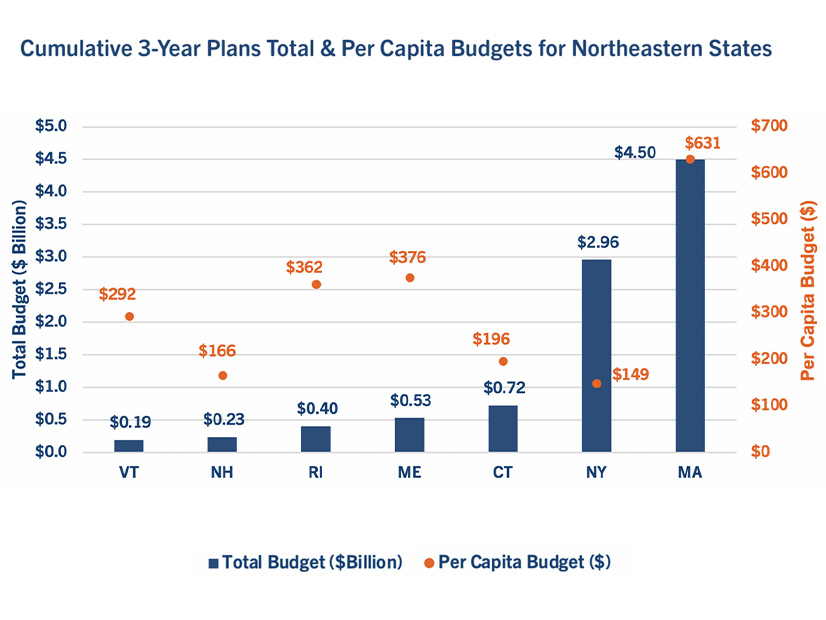
The report, which relies on state-reported data on expected spending and benefits, found $6.6 billion in total expected spending across New England over the next three years.
The bulk of this spending — $4.5 billion — is concentrated in Massachusetts. The state also has the highest per-capita spending, followed by Maine and Rhode Island. New Hampshire has the lowest per-capita expected spending.
Different calculation methodologies make it difficult to compare program benefits among states, Acadia wrote. The group noted that calculations related to the social cost of carbon vary significantly between states, “ranging from a low of $0/short ton in New Hampshire to a high of $415 in Massachusetts.”
Despite these differences, “all states demonstrate a benefits/program budget ratio above 1.0, indicating that $1 invested in energy efficiency programs [generates] more value than the initial investment,” Acadia wrote.
The authors noted that Maine reported a particularly high benefit-to-budget ratio. They wrote that the state stands out for high reported benefits associated with electrification investments and a higher portion of the costs shared by participants in the program. While program participants are responsible for 15 to 35% of overall costs in other New England states, participants are responsible for 48% of costs in Maine.
The report also highlights ISO-NE data showing how the allocation of efficiency investments has changed in recent years. While traditional efficiency upgrades like insulation and appliance upgrades still make up most costs, the percentage of spending dedicated to electrification increased from 6% in 2020 to 30% in 2024.
Acadia also emphasized the climate, public health and employment benefits of efficiency investments, writing that efficiency programs “play an instrumental role in creating and sustaining the over ~161,000 energy efficiency industry jobs in the region that currently exist,” and that planned investments are expected to reduce emissions by about 25.3 million metric tons.
Efficiency improvements also lead to region-wide cost reductions in the ISO-NE wholesale markets, the authors wrote. However, quantifying these effects is made challenging by recent updates to ISO-NE’s load forecasting methodology, which “now omits reporting on annual and peak demand reductions from energy efficiency,” Acadia noted.
To ensure the longevity and maximum effectiveness of efficiency programs, “more focused attention will need to be paid toward how programs are funded, how ambition can be increased cost-effectively, who pays, and over what time period are costs incurred,” the authors wrote.
“New funding concepts and reforms in this arena will ensure that ratepayers continue to benefit greatly from efficiency as an energy resource while perhaps bearing less of a direct responsibility to invest in program budgets exclusively through electric and gas rates,” concludes the report.
Mass Save Changes?
In Massachusetts, advocates are supporting a pair of bills (H.3577, H.3529) that would provide state funding for building efficiency retrofits, efficiency upgrades and electrification.
However, advocates may face an uphill battle to overhaul the funding mechanisms for the state’s Mass Save efficiency program in the 2025/2026 legislative session.
Massachusetts Gov. Maura Healey (D) included some changes intended to “streamline program delivery and enhance the customer experience” for Mass Save in a wide-ranging energy bill filed in May, but the legislation largely shies away from major changes that would shift efficiency costs away from rates. (See Mass. Gov. Healey Introduces Energy Affordability Bill.)
Meanwhile, Sen. Mike Barrett, co-chair of the legislature’s Joint Committee on Telecommunications, Utilities and Energy, indicated at a recent hearing on efficiency legislation that a major overhaul of Mass Save funding appears unlikely in the current environment.