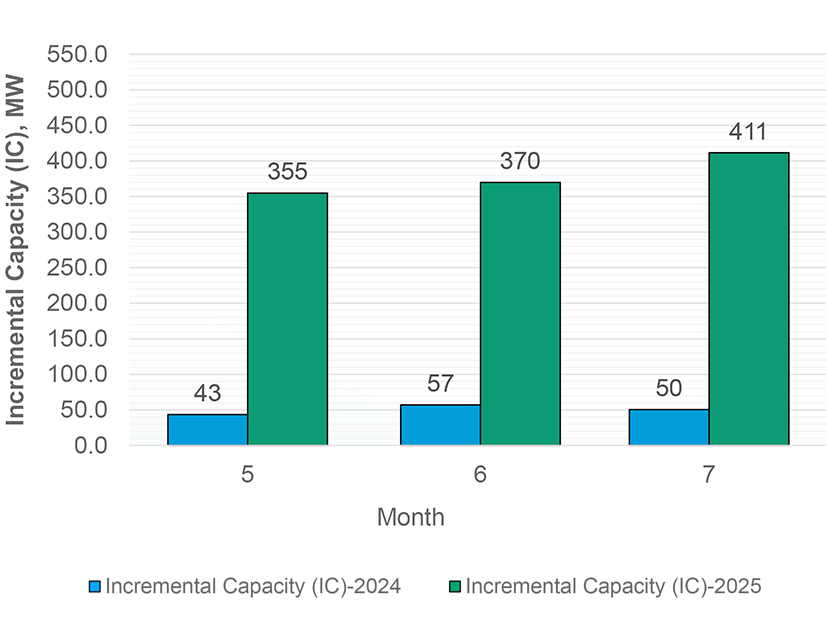
A virtual power plant program with an indeterminate future set a record in 2025 for the capacity the plant contributed to California's electricity grid.
A virtual power plant program with an indeterminate future set a record in 2025 for the capacity the plant contributed to California’s electricity grid.
The California Energy Commission’s VPP program has seen a big increase in available capacity since the end of the 2024 season, CEC analyst Brian Vollbrecht said at an Oct. 15 workshop.
About 38,000 customers participated in the program in 2024, providing about 288 MW to the grid. In August, the program’s capacity exceeded 400 MW.
The VPP program is part of the demand side grid support (DSGS) program, which is within the state’s strategic energy reliability reserve. The reserve provides electricity supply and load reduction and has a goal of 7,000 MW by 2030.
The DSGS program has four options. Most of the workshop focused on VPP Option 3, which rewards battery owners who provide capacity to the grid during energy emergency alerts or when market day-ahead prices go above $200/MWh. Option 3 participants provide this capacity during extreme weather and grid events from May to October.
No residential resources with durations beyond two hours participated in the VPP, and nearly half of the VPP capacity was in the Pacific Gas and Electric region, with the rest in the Southern California Edison region and the San Diego Gas & Electric region.
At the workshop, Robert Castaneda, board president of the Low-Income Oversight Board of the California Public Utilities Commission, asked if the CEC had a socio-demographic breakdown of VPP participants.
Vollbrecht said that this type of data was not a part of the analysis “this time around.”
“But if you have questions about that, feel free to follow up with us,” Vollbrecht said.
An Unknown Future
Although the VPP program reached a new high in 2025, California lawmakers decided not to provide additional funding for the DSGS program. (See VPPs Suffer Setbacks in Calif. Legislative Session.)
DSGS’s funding has experienced “various shifts since its inception due to state fiscal pressures,” Deana Carrillo, director of the CEC’s Reliability, Renewable Energy and Decarbonization Incentives Division, said at the workshop.
“And I recognize that this is challenging for private industry that is participating in the program, because while we’re attesting approaches to grow demand and incorporating the lessons learned, there’s also a need for consistency and a glide path to inform your business models,” she said.
There are, however, “active, ongoing discussions about the program’s budget,” Carrillo added.
“Staff is having conversations with leadership to identify stable funding beyond 2026 and continue the program’s growth into test concepts,” she said.
In total, DSGS’s budget is $109.5 million, with about $30 million remaining at the end of 2025, CEC program manager Payam Narvand said at the workshop.
CEC staff proposes continuing the DSGS program into the 2026 program season. Any changes to the program will be informed by a public engagement process and approved at a CEC business meeting, Narvand added.