IESO hopes to curtail 100 MW of commercial HVAC load next year under a new program targeted at resources available during system peaks, but not for the full six-month commitment of the capacity market.
IESO hopes to curtail 100 MW of commercial HVAC load in 2026 under a new program targeted at resources available during system peaks, but not for the full six-month commitment of the capacity market.
The grid operator outlined the Save on Energy Commercial HVAC Demand Response Program in an engagement session Oct. 16. IESO hopes the program, expected to launch in June 2026, will scale to 230 MW at commercial and institutional facilities (e.g., retailers, offices, universities) in 2027.
Program participants will be required to respond to up to 10 events of up to three hours on business days between June 1 and Sept. 30. The events will be “typically between 3 and 7 p.m.,” IESO said in a presentation.
They will be paid based on the average megawatts curtailed per season. Settlement will be based on local distribution company revenue meter data, using the average megawatt reduction from the top eight of 10 events.
Requirements
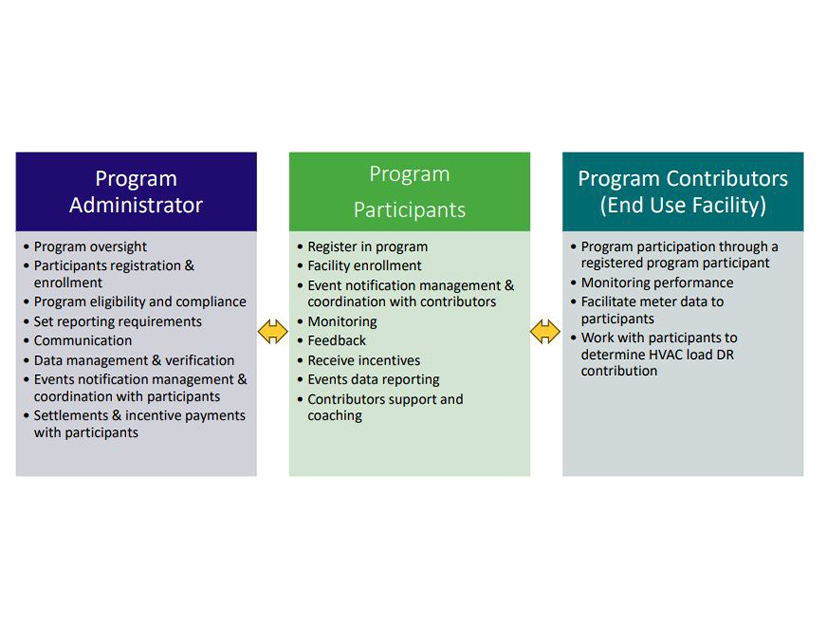
Program participants must aggregate at least 500 kW of demand response load capacity and be able to monitor and verify load reductions, collect metering data and communicate with “program contributors” — the end-use facilities reducing demand.
Following the ISO’s first engagement session June 24, stakeholders called for flexible load eligibility and onboarding support for participants. The program will offer an incentive of $20/kW to offset contributors’ costs for metering, monitoring and control systems.
Stakeholders also identified LDCs as “key partners for coordination [and] visibility,” IESO said.
IESO’s Mohammed Yousif said LDCs also can participate as aggregators. “We’re not … limiting who participates into the program” other than the minimum 500-kW load, Yousif said. “LDCs may decide [on] different approaches.”
Stakeholders supported a day-ahead standby notice with same-day activation by midday. A standby notice will be issued no later than noon the day before the event, with activation notices sent no later than noon on the day of the event.
Non-HVAC Resources
Yousif said the program rules will specify non-HVAC measures that also will be eligible for participation. “The program will be predominantly HVAC — maybe 75% comes from HVAC and 25% comes from non-HVAC,” he said. “Battery energy storage … related to curtailment of HVAC systems could be considered as well.”
Antoni Paleshi, senior energy performance specialist for WSP, asked how owners of new buildings can estimate their contributions without any energy history.
“This is a pay-for-performance program,” Yousif said. “We could use the first few events as a way to … assess the estimate that is provided and adjust accordingly.”
IESO expects to issue the program rules by the end of November and complete program readiness by April.