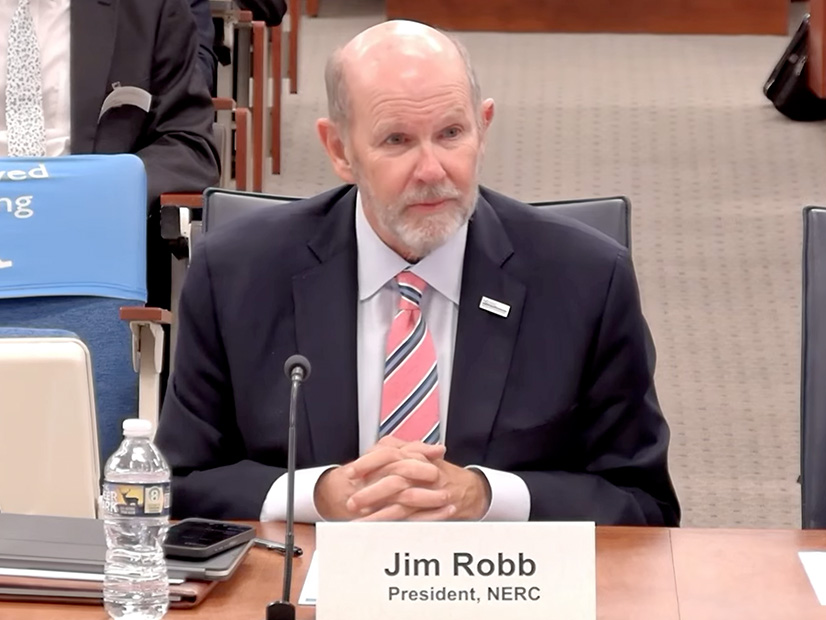
NERC CEO Jim Robb laid out a litany of challenges at FERC’s annual commissioner-led Reliability Technical Conference, warning that the North American electric grid faces “a five-alarm fire when it comes to reliability.”
Speaking in the first panel of the conference Oct. 21, Robb said “an increasing number of small-scale events and near misses” in recent years have raised grid operators’ concerns, despite the fact that — “paradoxically” — grid reliability has remained “extremely high,” with few major outages. While he did not name any specific incidents, he mentioned several familiar concerns for NERC and the industry, including extreme weather incidents, interdependencies with natural gas and other sectors, the growth of data centers and other large loads, and a “toxic soup of security risks.”
Robb was joined on the panel by leaders and executives from several electric utilities, including Tricia Pridemore, president of the National Association of Regulatory Utility Commissioners and a member of the Georgia Public Service Commission.
FERC Chair David Rosner asked Pridemore about the Georgia PSC’s efforts to address the growing burden of data centers on the grid. Her reply focused on the importance of studying, planning and collaboration.
“We saw this load growth coming as data centers started to approach us back in 2019 and 2020. In 2023, we had 63 data centers in the state of Georgia, representing about $1.8 billion in GDP. We expect that to quadruple over the next seven years,” Pridemore said. “One of the things that I’ve been able to share with my colleagues across the country is the … premium that we place on planning — not just planning and writing reports [to shove] in a desk drawer, but an actionable plan that you can give to the utilities, and utilities can operationally build against.”
Pridemore said building out generation has been vital to meeting data center demand in Georgia, and that diversity of generation is another essential element that she promotes through NARUC. According to Pridemore, since 2019, the Georgia PSC has approved 17 GW of capacity additions through 2031. Georgia Power’s new nuclear reactors at Plant Vogtle Units 3 and 4, which came online in 2023 and 2024, respectively, accounted for 3.2 GW of capacity resources. Retiring coal plants have been replaced by natural gas generation and by extending the lives of other coal units.
Commonwealth Edison CEO Gil Quiniones said northern Illinois has become another busy site for data center construction in recent years. Data centers make up about 28 GW of the interconnection applications in process; for comparison, the utility’s all-time peak demand, set in 2011, was 24 GW. Other large loads expected to come online soon include a battery manufacturing facility and a quantum computing center, both in Chicago.
However, he also said operating in a deregulated state leaves “an accountability gap [with] no one in charge making sure that there is adequate generation capacity.” Quiniones told commissioners that ComEd is “trying our best to make sure that we know exactly what the real projects are,” but that “states will have to create new mechanisms, most likely through legislation, to allow … generation [to] get built.”