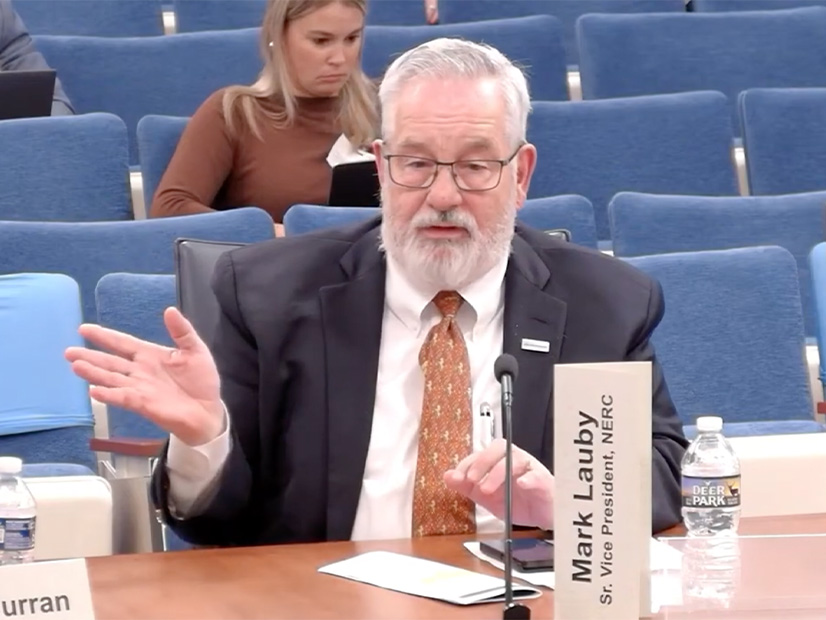
NERC Chief Engineer Mark Lauby told attendees at FERC’s annual Reliability Technical Conference that resource adequacy remains a top priority as the industry anticipates rapid demand growth from data centers and other large loads.
Lauby highlighted some of NERC’s work on the large loads issue, including a Level 2 alert sent to industry in September with guidance on “what you need to be thinking about when you’re interconnecting the load, what … kind of data you should be collecting, what kind of studies you should be creating [and] what kind of interconnection standards you should be considering.”
During the Oct. 21 panel, Lauby also brought up the work of NERC’s Large Loads Task Force, which recently submitted a paper on Characteristics and Risks of Emerging Large Loads for comment from the ERO’s Reliability and Security Technical Committee. Lauby said that when the paper is completed later in 2025, it will form the basis of a reliability guideline along with the responses to NERC’s Level 2 alert. That guideline will, in turn, be “the basis for any kind of standards” regarding registering such loads.
“We believe that we can register large loads because of [their] impact to reliable operation of the [grid],” Lauby said. “Obviously, we’ll use judgment on that. It’ll be risk-based, and we’ll work with [the Large Loads Task Force] to write the standards we’re talking about today — for example, communications during events, when you’re going to come off [and] come on, [and] how do you manage the inverter-based resources?”
Lauby’s fellow panelist, Dominion Power Vice President Matt Gardner, said he was “very pleased to see how the industry has come together” on the LLTF. He said the work of the task force has raised Dominion’s awareness of the issues involved; for example, the company incorporated the LLTF’s data center questionnaire and provisions on ride-through protection into its facility interconnection requirements.
Gardner added that another “extremely important” topic discussed by the LLTF concerns implementing high-quality monitoring of the new large loads’ behavior to provide situational awareness and to help create accurate models for planning purposes. This is needed to help grid planners comprehend the unique risks posed by these new arrivals.
“We’ve had large loads on the system forever: paper mills, steel mills, chip [fabricators], you name it,” Gardner said. “But this type of large load is different in terms of how it can behave in somewhat of a synchronized fashion, and in how the internals change over as well.”
FERC Commissioner Lindsay See picked up on this, observing that “large loads are not created equal.” She asked panelists to go into more detail on the various types of large loads and the reliability risks they can present.
Lauby agreed that “size certainly is not the whole thing” and mentioned several issues that can separate one kind of large load from another, such as their behavior during system events and sensitivity to voltage and frequency changes.
Jennifer Curran, senior vice president for planning and operations at MISO, advocated for a risk-based approach that recognizes that the level and type of risk presented by a load depends on a number of factors beyond its size, such as where it is on the grid and how resilient the grid is.
QTS Data Centers Vice President for Energy and Sustainability Travis Wright agreed that the location of a load matters, stating that “the term that resonated with me was ‘material impact.’”
Chris Matos, strategic negotiator for energy markets at Google, also expressed support for a risk-based strategy but urged the commission and ERO not to place overly onerous reporting requirements that restrict companies’ freedom of movement.
“The question has become, for [RTOs], how much administrative work or burden is that below a certain level as well, and do we recreate the log jams that we’re feeling today?” Matos said. “So, I do think a risk-based approach is necessary, and it should do the best that it can, but exact accuracy may not be as important, provided we also think about revisiting that [assessment] over time.”