Speakers at the American Council on Renewable Energy’s annual Grid Forum weren’t afraid to use strong words on the ineffectiveness of the U.S. permitting system but were bullish that it’s fixable.
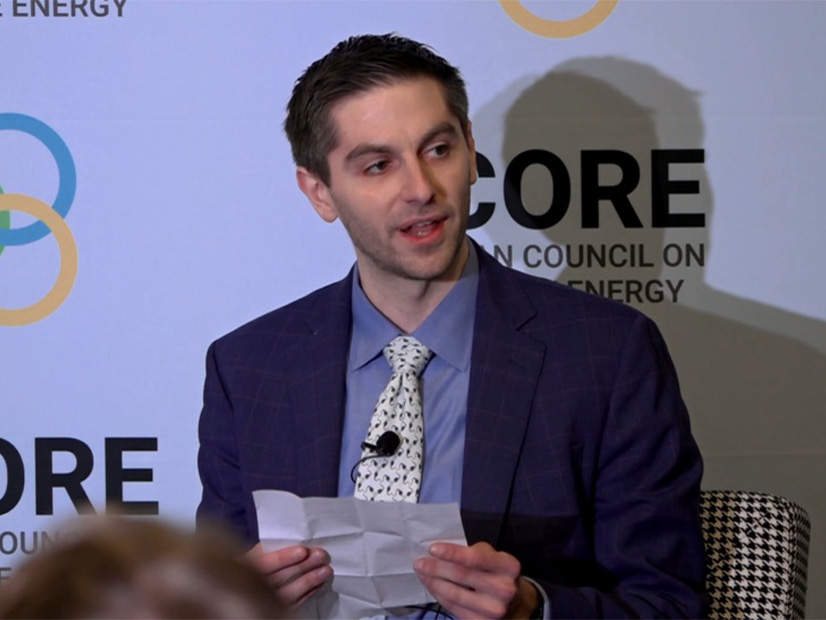
The permitting environment in the U.S. is so “inhospitable” that it results in “dark matter” — beneficial transmission lines that don’t come into existence because weary developers don’t bother to attempt them, Daniel Palken, of philanthropy organization Arnold Ventures, said at ACORE’s annual meetup Oct. 23 in Washington, D.C.
Palken read from the “Simple Sabotage Field Manual” drafted by the U.S. Office of Strategic Services (the predecessor agency to the Central Intelligence Agency), which was distributed to Europeans in German-occupied territories during World War II to disrupt the Nazis.
The manual details “innumerable simple acts which the ordinary individual citizen-saboteur can perform,” it reads. It describes how adopting a “noncooperative attitude” can lead to damage indirectly. “A noncooperative attitude may involve nothing more than creating an unpleasant situation among one’s fellow workers, engaging in bickerings, or displaying surliness and stupidity.”
Palken said these simple acts include:
-
- never permitting shortcuts that could expedite decisions;
- making longwinded speeches littered with anecdotes and patriotism;
- referring matters to intentionally large committees for further study and consideration;
- bringing up irrelevant issues in discussion;
- haggling over precise wording in minutes and resolutions;
- attempting to relitigate matters decided upon in previous meetings;
- frequently advising caution and warning against haste;
- second-guessing decisions and questioning whether the committee held jurisdiction in the first place.
“It should be obvious to anybody in this room that is a very sound description of the transmission planning process, the process by which transmission lines are paid for and cost allocated, and then the process by which they are finally permitted and built in this country,” Palken said.
“We’re, in short, sabotaging ourselves and our ability to build the large-scale infrastructure that we need.”
Elizabeth Horner, of law firm ArentFox Schiff, said part of the challenge of federal efforts to streamline transmission permitting is that jurisdiction is spread across multiple House and Senate committees, FERC and the Department of Energy.
Horner said Republicans and Democrats should come to an agreement on their respective “end goals” of permitting reform, which often are the same, though messaging to their constituents is different.
Despite the ongoing federal government shutdown and Capitol Hill staffers not being paid, closed-door discussions and drafts still are being circulated to make inroads on permitting improvements, she said.
“Do not treat the shutdown as a reason to stop advocacy,” Horner told the audience. Horner said she’s hopeful that Congress could pass a bill in 2026 that would build on the past five years of incremental permitting changes.
Palken agreed, saying the shutdown is “immaterial” to the momentum around transmission permitting changes.
Senator Optimistic on Permitting Improvements
U.S. Sen. Shelley Moore Capito (R-W.Va.), chair of the Environment and Public Works Committee, said the committee still is at work to try to make permitting “faster, fairer and less expensive.”
“We’ve only really nibbled around the edges,” Capito said of previous congressional efforts to streamline permitting. She noted the stops and starts of legislation trying to cut red tape, with the unsuccessful START Act and RESTART Act and the currently on-pause SPEED Act (H.R.4776) in the House of Representatives.
“If there’s skepticism in the room as to whether we can make it again this year, I certainly understand that,” she said. “You might be rolling your eyes, like, ‘does she really think this can happen?’ I am an optimist. I always think everything can happen; everything good can happen.”
But Capito told the audience not to expect a detailed timetable from her on bill passage and admitted that she thought “we were going to reopen the government three weeks ago.”
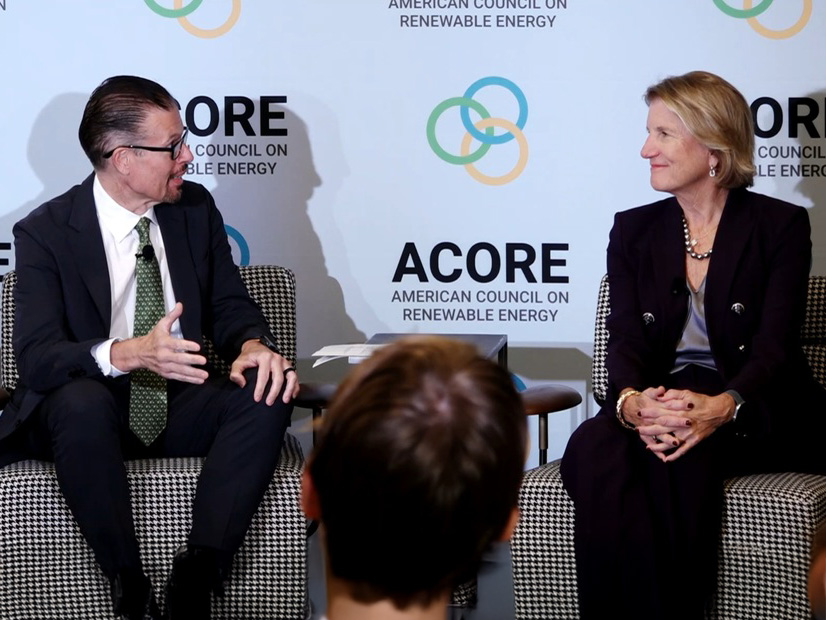
Capito said permitting laws must be fair to “every type of project” and listed solar, wind, geothermal, gas pipelines, coal and nuclear. She said project developers should have confidence they can move forward and “not have to look over your shoulder” in the fears that a new presidential administration could terminate projects.
“We’ve seen that happen on both sides,” Capito said. She added the government needs to “prevent the swings” of scrapping the Keystone XL pipeline under President Joe Biden and then discarding “Sen. [Sheldon] Whitehouse’s” (D-R.I.) offshore wind farms under President Donald Trump. She said any new law needs “specific, locked-down permitting language” to cut out loopholes that are openings to getting projects canceled.
Capito also called for tight timelines on judicial review, so projects aren’t caught in a “circular firing squad” of litigation.
U.S. Rep. Gabe Evans (R-Colo.) — a co-sponsor of the SPEED Act — said permitting reform will be a “massive” undertaking requiring buy-in from five congressional committees involved in permitting.
He said simpler permitting is desperately needed, comparing China’s recent installment of 500 GW on its grid to the U.S.’ current, 1,100-GW system.
“If we can’t build things in the United States, we are going to get our butts kicked by our foreign competitors, and so permitting reform is absolutely critical to be able to speed up that timeline,” Evans said.
Evans said 80% of permits ultimately are issued as-is for big infrastructure projects requiring environmental reviews that have been bogged down in years of litigation.
FERC Chair David Rosner joked he would give a “safe-place, sitting-government-official” answer to whether he believed permitting improvements are necessary: “I will be really delighted to implement any bill that Congress passes and the president signs.
“But with the FERC hat off, as an American citizen, I will say I think it takes too long to build all sorts of infrastructure in this country,” Rosner said. “I think it’s really obvious, and I’m very hopeful we can find bipartisan, durable solutions to that.”
Transmission the ‘Biggest Antidote’ to Load Growth
ACORE CEO Ray Long said the country’s outdated permitting process takes up to 17 years to approve major transmission lines and four to five years for other critical energy infrastructure.
“That delay is more than a bureaucratic frustration. It’s a roadblock to affordability, reliability and national competitiveness,” Long said.
Long said the U.S. cannot power the 21st century with a permitting system designed for the “1970s and before.” He cited Grid Strategies’ December 2023 report concluding the U.S. power grid could require an additional 120 GW of new capacity by 2030, the equivalent of adding the capacity for 12 New York Cities.
Long said the energy industry needs to “think big and act quickly” to accommodate the artificial intelligence boom, new factories and clean energy.
“Everyone in this room understands that every mile of new transmission powers jobs, innovation, prosperity. It strengthens communities, connects technologies and helps ensure that American remains a global leader in energy, in manufacturing,” Long said.
Palken said since FERC issued Order 1000 in 2011, zero new interregional transmission lines have been completed, and most areas of the country have failed to select transmission lines through regional planning processes. Though MISO has had some success in planning regional transmission lines, the RTO essentially ignores half its footprint (the South region) and has no plans to better connect its Midwest and South regions, he said.
Transmission is the “biggest antidote” to unprecedented load growth, Palken said.
“Forty-nine states right now are convulsing, trying to figure out how to accommodate roughly 3% load growth. One state — roughly — has been doing 2 to 3% load growth for the last decade while keeping rates completely steady, in inflation-adjusted terms, while beating all the blue states at their own clean energy deployment goals. This state is of course Texas,” he said.
Palken said Texas features a better interconnection process than in other regions, easier siting laws and more straightforward permitting, in addition to transmission planned through its Competitive Renewable Energy Zones. Though Texas mostly isn’t beholden to FERC or the National Environmental Policy Act, Palken said ERCOT is an “instructive” example for Congress.