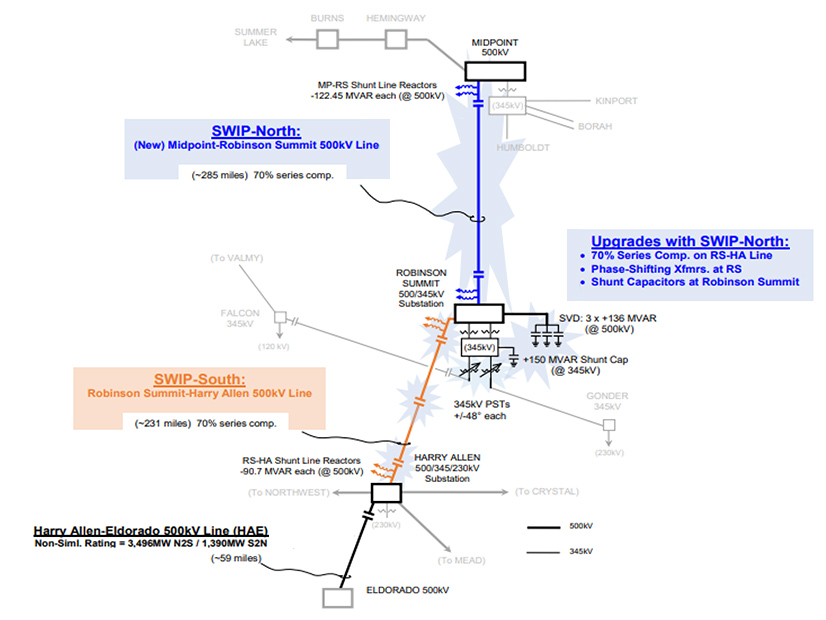
FERC has granted Great Basin Transmission’s request for incentives and a transmission owner tariff for its Southwest Intertie Project-North line — rejecting arguments that the project no longer makes sense with the cancellation of the Lava Ridge wind farm.
In an Oct. 31 order (ER25-2025), FERC accepted Great Basin’s proposed transmission owner tariff and formula rate for the project, also known as SWIP-North.
SWIP-North is a 285-mile, 500-kV line being developed by LS Power subsidiary Great Basin Transmission at an estimated cost of $1 billion. It will run from eastern Nevada near Ely to Idaho Power’s Midpoint Substation near Twin Falls, providing a bi-directional energy pathway between the Desert Southwest and the Pacific Northwest.
Great Basin’s transmission owner tariff includes the terms and conditions to participate as a Participating Transmission Owner (PTO) in CAISO. The PTO model allows lines outside of California to join the ISO while avoiding financial risks. (See CAISO Wins FERC Approval for Subscriber-funded Tx Plan.)
Great Basin said its tariff is consistent with other PTO tariffs on file at FERC, including those of affiliates DesertLink and LS Power Grid California.
FERC also granted Great Basin’s request for several transmission-development incentives.
The abandoned plant incentive will allow the company to recover its costs if the project is abandoned due to events beyond its control.
In addition, the commission granted Great Basin’s request for a regulatory asset incentive, which allows deferred recovery of prudently incurred pre-commercial costs through the creation of a regulatory asset. And FERC approved an RTO adder for SWIP-North, which will take effect when Great Basin joins CAISO and turns over operational control of the transmission line.
FERC Chair Laura Swett and Commissioner David LaCerte did not participate in the decision.
Reducing Congestion Costs
FERC’s approval of the abandoned-plant and regulatory-asset incentives is a reversal from the commission’s previous denial of Great Basin’s request. (See FERC Denies LS Power’s Bid for SWIP-N Incentives.)
In a Feb. 20 order, the commission found that the company failed to meet the criteria of FERC Order 679, which requires transmission incentive applicants to show that a project will ensure reliability or reduce costs associated with transmission congestion.
The incentive request was denied without prejudice. In its new request, filed April 23, Great Basin supplied an economic study by Hitachi Energy that showed annual congestion costs for the California-Oregon Intertie Corridor (COI corridor) would drop by about $38.6 million a year, to $156.7 million, with SWIP-North in place.
In addition, Great Basin argued, SWIP-North would give Idaho Power access to the Desert Southwest market, improving reliability during extreme cold weather events. By alleviating congestion constraints between the Pacific Northwest and Desert Southwest, the project would reduce the cost of delivered power, the company said.
And CAISO identified reliability benefits of the project, including resource diversity and the addition of a parallel path with the COI Corridor. Those could be important factors during wildfires or extreme weather.
A group called Stop Lava Ridge argued that recent policy changes reduce the chances of the development of the 1,000 MW of Idaho wind that Great Basin relies on in its application. The group noted the Department of the Interior’s cancellation Aug. 5 of the 1,000-MW Lava Ridge wind project. (See Interior Reverses Approval of Lava Ridge Wind Project.)
But Great Basin responded that SWIP-North’s congestion relief benefits are not tied to Lava Ridge wind.
“Whether the source is from nuclear generation, gas generation, hydro generation, geothermal generation or other nonwind resources, and regardless of the state of origin (i.e., Idaho, Oregon, Wyoming, Washington, etc.) of such generation, the addition of SWIP-North would still provide COI congestion relief benefits,” Jinxiang Zhu of Hitachi Energy said in a filing.
In fact, SWIP-North would relieve even more congestion without Idaho wind generation, Zhu said, reducing congestion costs by $47.2 million and further reducing the number of COI corridor congestion hours.