FERC has approved the 2026 business plans and budgets for NERC, the regional entities and the Western Interconnection Regional Advisory Body, along with allowing the Midwest Reliability Organization, Northeast Power Coordinating Council and SERC Reliability to tap their reserves to reduce next year’s assessments.
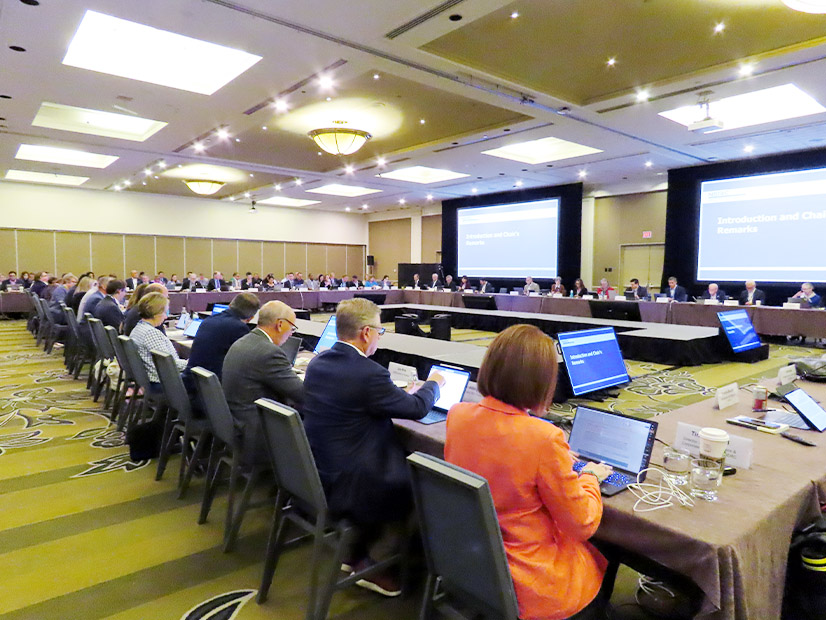
NERC’s Board of Trustees approved the business plans and budgets at its August meeting in Calgary; the ERO filed the documents with the commission later that month. (See Trustees: NERC ‘Front and Center’ Addressing Reliability Challenges.)
Commissioners accepted the budgets in an Oct. 30 filing (RR25-5). Chair Laura Swett and Commissioner David LaCerte, sworn in Oct. 20 and Oct. 27, respectively, did not participate in the decision.
NERC’s budget for 2026 is $129 million, up $5.6 million from its 2025 budget. This includes planned spending in both the U.S. and Canada, as well as $45 million for the Electricity Information Sharing and Analysis Center, up $1.4 million from the prior year. The E-ISAC budget increase reflects rising contractor and consultant costs and the addition of three positions in the areas of stakeholder engagement, security operations and intelligence functions.
Most funding for NERC’s activities comes from its assessment, which load-serving entities pay to support the ERO’s work. NERC’s 2026 assessment is to rise by $5.3 million to $114 million; this figure comprises $103 million from U.S. entities and $11 million from Canada.
The difference between the budget and the assessment will be made up with funding from other sources, including third-party funding for the E-ISAC’s Cyber Risk Information Sharing Program, the System Operator Certification and Credential Maintenance program and the E-ISAC’s partnership with the Downstream Natural Gas ISAC.
NERC CEO Jim Robb said in May that the organization is approaching 2026 as a “bridge year” between the previous three-year plan, which will conclude at the end of 2025, and a new three-year plan, to begin in 2027. (See 2026 to be ‘Bridge Year’ for NERC Budget.) Robb said the uncertainty introduced since the beginning of President Donald Trump’s second term, along with ongoing efforts such as the ERO’s work on modernizing its standards development process, made long-term planning “a fool’s errand at this point in time.”
RE Budgets, Assessments to Rise
The total planned ERO budget, including NERC, the REs and WIRAB, comes to $321 million, up from $304 million in 2025. Assessments for all entities are $290 million, up from $271 million the year before; $260 million of the total assessments for 2026 is allocated to U.S. entities.
NERC asked for, and FERC approved, an exception to Section 1107.2 of the ERO’s Rules of Procedure. The section states that funds received by NERC or REs from penalties assessed in the U.S. must be used to offset the collecting entity’s budget for the subsequent fiscal year if received by July 1, or for the second subsequent fiscal year if received on or after July 1.
The exception granted by FERC allows MRO, NPCC and SERC to deposit penalty monies received before July 1, 2025, into their assessment stabilization reserves, rather than apply them to the REs’ 2026 budgets. FERC will also permit the organizations to use penalties collected before July 1, 2024, and still held in their ASRs to reduce the 2026 assessments.
As a result of FERC’s decision, NPCC will deposit $210,000 collected in penalties between July 1, 2024, and June 30, 2025, into its ASR and withdraw $500,000 from the reserve. SERC will deposit $1.5 million in penalties into its ASR and release $2.5 million from the ASR. MRO will deposit $24,000 in penalties and release $1.6 million.