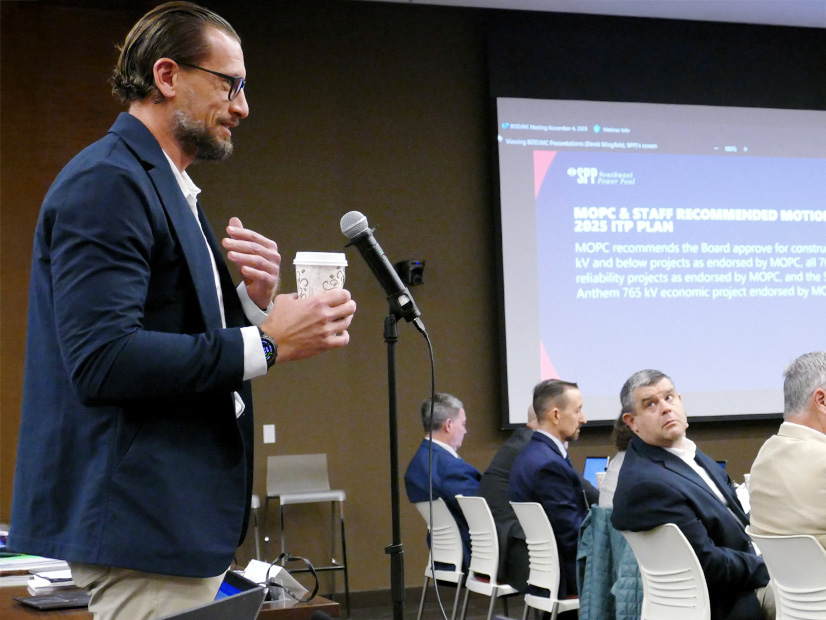
LITTLE ROCK, Ark. — It took almost two months of stakeholder meetings, outreach and education, working group discussions, staff modeling and everyone’s consternation over affordability before SPP’s Board of Directors approved a 2025 Integrated Transmission Plan (ITP) designed to keep pace with accelerating load growth and ensure grid reliability.
The ITP’s portfolio includes four 765-kV projects that total 949 miles and are part of a planned 765-kV backbone, along with 46 other proposals approved for construction permits. It also comes with an $8.6 billion price tag, eclipsing the record 2024 ITP that had SPP’s first 765-kV project and a $7.65 billion cost. (See SPP Board Approves $7.65B ITP, Delays Contentious Issue.)
SPP says the 10-year ITP assessment shows the portfolio is necessary to ensure the grid is ready for future demand, citing industrial electrification, manufacturing onshoring and economic development forecasts that show the grid at its limits. The grid operator is projecting a 25% increase in demand by 2030 for its 14-state footprint and a near doubling of its peak load (56 GW) in 10 years.
The portfolio has regional benefit-to-cost ratios between 12:1 and 18:1, the highest in the RTO’s planning history.
Still, with memories fresh over a recent cost-estimate increase for SPP’s first 765-kV project, members expressed concerns over the portfolio’s expense. The board in September approved a revised cost estimate of $3.62 billion, up from an original projection of $1.69 billion in February, for Southwestern Public Service’s 765-kV project in the 2024 ITP. (See SPP Board Approves 765-kV Project’s Increased Cost.)
“It’s really hard for us at a local level to talk about affordability when the metrics in the report are region-wide. The only thing our customers see in their [bills] is their rates going up,” Evergy’s Denise Buffington said during the Nov. 4 discussion.
“We have the job over the next 12 months, probably 10 months, to go to our legislature and our governor and our customers and explain to them why 765 is important,” she added, asking for “a little grace” and time to advocate about why the 2025 ITP is the right long-term solution. “We have to get the metrics down to a local level.”

Buffington’s message and those of other members were received by the board.
“As a board, we recognize that we’re making decisions that will significantly impact every homeowner and business in SPP,” board Chair Ray Hepper said as the meeting ground on through the lunch hour. “Reliability and affordability are a really delicate balance, and we strive to do our best in making that balance, thinking like every dollar we are approving is our own dollar. We also recognize that economic development for this region and attracting new loads that can serve our national interests is a key driver for a cost-effective system that will support growth in this critical time.”
SPP Mitigation Measures
To help ease concerns, SPP staff filed a memo with the board and the Members Committee outlining their measures to mitigate risks related to the viability and cost of 765-kV projects in the 2025 ITP. The measures will apply to 765-kV projects that receive a conditional construction permit or a request for proposals. They include SPP’s commitment to analyze the proposed 765-kV overlay analysis within the 2026 ITP assessment.
Hepper then added his own requirements for SPP so the board can fulfill its oversight responsibility and help “assure that only appropriate costs for new transmission are incurred.”
“Our goal is a reliable, cost-effective transmission system that will serve the region for years to come,” he said.

Hepper directed staff to file quarterly reports with the board should there be any changes that could affect approved projects in the 2025 ITP or any future assessments. He earned a commitment from COO Antoine Lucas to work through the stakeholder process and complete the 765-kV overlay analysis as part of the 2026 ITP and determine whether further mitigation actions or changes are needed.
Finally, he ordered staff to bring to the February board meeting a plan to expedite and improve the competitive project process, including a plan to improve the evaluation of RFPs.
“You’ve created a set of off-ramps and on-ramps for projects, which makes a lot of sense because things change relative to forecasts,” director Steve Wright said.
The Members Committee’s advisory vote passed 17-3, with three abstentions. Electric Cooperatives of Arkansas, Nebraska Public Power District and Omaha Public Power District voted against the measure.
The portfolio the board approved began as an $18.1 billion package of projects that staff identified to meet 10-year reliability and economic needs. It was whittled down by deferring about $7 billion in projects without near-term needs or that could be “further optimized” within the 2026 ITP, and again by deferring two economic 765-kV projects and their $2.6 billion costs, reducing the package to its final total.
The 2025 ITP does not include another $1 billion in zonal planning criteria projects submitted for study by members.
Most deferred projects will be further evaluated in the 2026 ITP as SPP continues to study a 765-kV backbone. It says a single 765-kV line can carry four times the power of a 345-kV line, using less land and losing less energy over long distances. That makes 765-kV a more efficient, cost-effective and forward-looking solution for a growing grid, staff said.
“We’re building today for the demands of tomorrow,” Casey Cathey, the RTO’s engineering vice president, said.

Stacey Burbure, American Electric Power’s lead for transmission business development and joint ventures, applauded SPP’s decision to move forward with its 765-kV overlay. She noted AEP’s service territory includes some of the poorest parts of Appalachia, where the company has some of its more than 2,000 miles of 765-kV infrastructure.
“It’s our baby. This was the most efficient and effective way for us to serve our customers, and it remains a very effective tool in the bucket for every RTO,” Burbure said. “This is a tool that folks are turning to to solve the issues that confront us, regardless of which RTO you’re in. Is this the right outcome for SPP as a region? I think the answer is obvious. It’s yes.”
Matt Pawlowski, vice president of development for NextEra Energy Transmission, pointed out that the portfolio includes two 765-kV legs on either side of the footprint, but no road connecting the two highways. While NextEra supports the $8.6 billion ITP, it would have preferred the $11.1 billion package, he said.
“Without a connector, the systems on either side of those lines are going to be overloaded,” Pawlowksi said. “We are going to have reliability issues. If we don’t address it with the two economic projects, I think we’re really missing out.”
He said if the two economic projects are again deferred, SPP will face the danger of getting behind an “entire queue of projects in the supply chain.”
“If you defer these projects, you are totally kidding yourself. You are not going to build these projects by 2030 plus, 2035 probably at best,” Pawlowski said. “So what is preventing us from looking at those two projects and improving them as a region when staff has already said that they’re needed?”
The discussion will continue in February when the board gathers again in Little Rock for its first quarterly meeting of 2026. Hepper, who prefers to have people around the table debating issues, has canceled the original virtual scheduled meeting to further discuss in person 765-kV lines and the competitive project process.
“We are going to have some very significant decisions to talk over,” he said.
SPP Introduces CARE Team
SPP has introduced another acronym to its lexicon with the creation of the Cost Control and Allocation Review and Evaluation (CARE) Team. The cross-functional body will review, evaluate, assess and recommend refinements or alternatives to current transmission cost controls and cost-allocation methodology.
Wright and Kayla Hahn, the Missouri Public Service Commission’s chair, will co-chair the 15-person team and have already met once to discuss CARE’s scope. It has been asked to deliver a final report in August 2026.
Other members will include independent director Stuart Solomon, commissioners Chuck Hutchinson (Nebraska), Justin Tate (Arkansas) and Kathleen Jackson (Texas), and state regulatory staffers Jon Thurber (South Dakota), Jason Chaplin (Oklahoma) and Justin Grady (Kansas). Members from the Members Committee and the Strategic Planning Committee will be added later.
“The idea was, ‘Let’s get this conversation happening. Let’s have a conversation between the groups within SPP that have the organizational responsibility for allocation and cost control,’” said New Mexico Commissioner Pat O’Connell, the Regional State Committee’s president.
“So, to me, just getting all those folks together to have this conversation by itself is valuable,” he said. “I am also confident that SPP works to deliver good results, so that the recommendations will be also valuable and impactful.”