Texas regulators have approved ERCOT’s methodologies for determining minimum ancillary services for 2026 while hinting at the same time that they are considering discontinuing the use of conservative operations (54445).
Potomac Economics, which serves as ERCOT’s Independent Market Monitor, has said the grid operator’s practice of setting aside large amounts of operating reserves leads to inefficient scarcity prices that the energy-only market relies on to attract investment. (See Patton Calls on ERCOT to Operate its System Less Conservatively.)
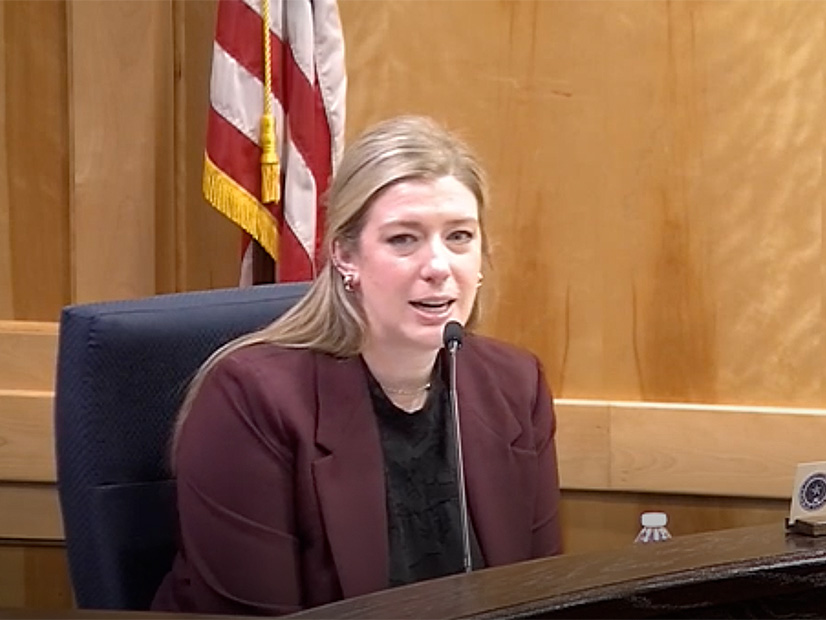
“I think we do need to look at moving away potentially from how conservatively we’ve been operating the grid,” Thomas Gleeson, chair of the Public Utility Commission, said during its Nov. 6 open meeting. “I think we need to talk through all that because we’ve committed to kind of having a refocus on affordability and costs. Every season we get away from [February 2021’s] Winter Storm Uri, I think we need to be asking ourselves, given where we are today, ‘Does our methodology, does our procurement practice, really match what we think we need?’ I think we need to start asking those questions.”
The PUC directed ERCOT to use conservative operations in 2023 after a flurry of conservation calls.
Commission staff said ERCOT’s current ancillary services and the future deployment of Dispatchable Reliability Reserve Service (DRRS) “provide ERCOT sufficient” ancillary service products to comply with NERC requirements and respond to “inherent system variability and uncertainty” (55845).
Staff recommended the PUC minimize the number of significant market design changes during the first several months after the Real-time Co-optimization + Batteries project goes live in December.
RTC+B will “likely produce a fundamental shift in the procurement and deployment of AS, and the industry will be best served if the commission observes those changes and uses RTC-based data to inform subsequent changes to future AS methodologies,” staff said.
The ERCOT Board of Directors endorsed the methodologies during its September meeting. The grid operator will use a probabilistic methodology — an analytical approach incorporating randomness and uncertainty by assigning probabilities to outcomes and events — to calculate hourly ERCOT contingency reserve service (ECRS) and non-spinning reserve service quantities. The probabilistic model aligns ECRS and non-spin requirements with the risk profile, where higher risk equals a higher requirement and vice versa. (See ERCOT Board Approves AS Procurement for 2026.)
The Monitor opposed the methodology during the stakeholder process, saying it was misaligned with reliability outcomes. The IMM’s compromise position included halving the six-hour forecast horizon for determining non-spin and using a one-hour discharge horizon for storage resources rather than four hours.
LCRA Wins 2nd TEF Grant
The commission approved the Lower Colorado River Authority’s eligibility for a Completion Bonus Grant (CBG) of up to $22.56 million in performance-dependent funds over a 10-year period under the Texas Energy Fund (57937).
PUC staff and LCRA signed the agreement Nov. 10, the first under the TEF’s completion bonus program for projects that connect to the grid before June 1, 2029. LCRA’s Timmerman Power Plant Unit 1 was synchronized in August.
Two other applicants in the program are seeking loans totaling $23.06 million, staff said, for projects offering a combined 360 MW.
“I think it’s fair to say this is working well,” Gleeson said.
The unit provides ERCOT 190 MW of dispatchable generation. A second unit is expected to become operational in 2026, adding another 190 MW of capacity to the grid.
Annual payments are contingent upon the plant’s performance as measured by ERCOT during an annual “test period” and compared to the performance of a reference group of other generation resources in the region. Timmerman Unit 1’s first test period will run June 1, 2026, to May 31, 2027.
The PUC announced in October the largest loan under the TEF’s In-ERCOT Generation Loan Program, a 20-year, $1.12 billion loan for about 60% of Competitive Power Ventures’ 1,350-MW natural gas unit in West Texas. The unit has a targeted operational date in 2029.
With the fifth grant under the program, the TEF has now financed more than 3,100 MW of dispatchable power. Twelve more projects are moving through the In-ERCOT program’s due diligence review, representing nearly 6,000 MW of additional generation.
PUC Approves ERCOT Budget
The commission endorsed ERCOT’s biennial 2026-2027 budget and system administrative fee, adding large load interconnections to a list of priority performance measures that must be met (38533).
As approved by the ERCOT board during its June meeting, the grid operator is authorized to spend $485.87 million in 2026 and $585.04 million in 2027. The PUC granted the grid operator’s request to increase an existing $100 million revolving line of credit by $25 million and to reduce its administrative fee from 63 cents/MWh to 61 cents. (See “Board Approves $1.07B 2-year Budget,” ERCOT Board of Directors Briefs: June 23-24, 2025.)
The large load performance measure was added to staff’s original recommendations, all designed to support ERCOT’s implementation of the 2026 reliability standard assessment: deployment and stabilization of the RTC+B project; enactment of Senate Bill 6, the 2025 legislation overhauling several grid regulations; development of DRRS; and implementation of the ancillary services study findings.
ERCOT staff agreed to work with PUC staff to develop the performance measure targets. “We have a lot of ideas,” General Counsel Chad Seely told the commissioners.
In other actions, the PUC:
-
- adopted revisions to ERCOT’s standard generation interconnection agreement (SGIA) that require generators to pay interconnection costs that exceed a “reasonable allowance” established by the commission, effective Jan. 1, 2026. Other changes include revisions adding plain language and clarity to the SGIA; requirements regarding the sharing of contact information between generators and transmission service providers; and requirements that generators comply with the Lone Star Protection Act (58211).
- approved an amendment to established wholesale market power rules that removes the exemption currently preventing a generation entity controlling less than 5% of ERCOT’s total installed capacity from being considered to have market power, commonly referred to as the “small fish rule” (58379).