SEATTLE — A new report from the National Association of Regulatory Utility Commissioners offers state regulators an extensive set of recommendations intended to address risks stemming from the ever evolving interdependence of the natural gas and electric sectors in the U.S.
The release of the 40-page paper by NARUC’s Gas-Electric Alignment for Reliability (GEAR) Task Force was a showpiece at the organization’s annual meeting. The report highlights an issue that has dogged the two industries for over a decade: how to get them to better coordinate their actions to maintain grid reliability.
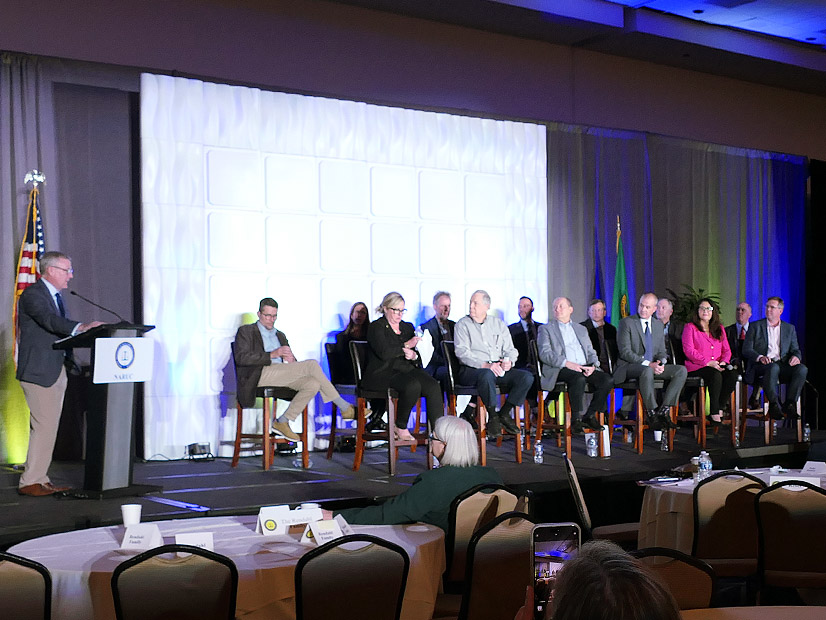
But progress has been halting, as NARUC Executive Director Tony Clark indicated at the start of a Nov. 11 panel discussion at the meeting.
“Ronald Reagan said the closest thing to eternal life on this earth was a government program, but I’m not so sure. For regulatory offices, the closest thing to eternal life is the gas-electric conversation,” Clark said.
The report’s authors, which included state regulators and executives from gas and electric companies, wrote that “the goal of GEAR was to provide a venue for key regulatory and industry stakeholders to discuss and develop solutions to the reliability problems caused by the misalignment of the gas and electric industries.”
They compared “achieving the highest level of reliability” to obtaining an insurance policy.
“It must be planned and purchased ahead of time; you hope you never need it; and if it is not used, it will invariably look expensive,” they wrote. “It is important for regulators and industry experts to help the public understand that those characteristics do not mean the cost to assure reliability are not prudent investments.”
The report draws on source materials and presentations by a wide swath of energy organizations, such as the North American Energy Standards Board, NERC and its regional entities, FERC, RTOs/ISOs, the Electric Power Supply Association and the Interstate Natural Gas Association of America, as well as BP.
The report outlines nine recommendations for state officials:
-
- the creation of a voluntary, ongoing Natural Gas Readiness Forum intended to improve natural gas “value chain reliability via the promotion of communication, peer-to-peer connections, situational awareness and education among its participants.” The task force advised that the American Gas Association lead this effort.
- support for federal permitting changes to encourage the construction of new natural gas pipeline infrastructure.
- have states and organized power markets examine ways to increase investment in and development of “storage of all types” to support the grid in times of high demand.
- encourage regulators to contact their RTOs/ISOs and utilities and review NERC information regarding load shedding practices, and evaluate whether changes are needed given the current electricity consumption landscape.
- ensure greater liquidity and transparency in natural gas markets around winter weekends, when trading is limited.
- “in lieu of direct winterization regulations for natural gas production,” examine the “need and feasibility of a market-driven process” that allows utilities and generators to recover costs for premiums they pay for improved winter performance.
- encourage state regulators and policymakers to support “market-based solutions” to incentivize gas procurement and “provide economic certainty, consistent with recommendations to improve natural gas unit scheduling and dispatch.”
- consider development of “robust” demand response programs to shift energy use during periods of high demand or system stress.
- support or adopt measures “that facilitate more timely and frequent use of interstate capacity release or asset management arrangements” by utilities.
“The GEAR Task Force expects the alignment of the gas and electric systems to remain an ongoing challenge for NARUC, its members and industry in the years and decades to come,” the report says. “These recommendations should serve as a backdrop and ongoing point of discussion to assist regulatory agencies and their partners in serving the needs of the natural gas system, the electric grid and utility customers.”
‘An Education’
During the Nov. 11 panel, Clark asked GEAR participants what state regulators should take away from the report.
Georgia Public Service Commissioner, GEAR Chair and outgoing NARUC President Tricia Pridemore said her state already allows electric utilities to roll firm gas transportation and storage costs into their rate base.
“It’s just a part of our customer expectations and how we operate,” Pridemore said. “Developing a path within your state to do the same provides liability assurances and insurance that’s not matched, and that is a path that I think regulators, who fully understand the systems more than our friends in the legislature do, should be communicating now.”
Kansas Corporation Commissioner Dwight Keen said he thinks state governments should take a role in ensuring that the gas and electric industries “provide continuity of attention to the nuances, the methods and the means by which we continually re-evaluate and reassess … the kinds of techniques we can use to really enhance reliability going forward.”
Rhode Island Public Utilities Commissioner Ron Gerwatowski expressed regret that the report contained many recommendations his agency doesn’t have the authority to implement, but he appreciated that it provides “an education.”
“There’s a lot of information that’s confirming things, some of which we know already, but other things that are new,” Gerwatowski said, adding that the report gives regulators additional information to bring into federal proceedings or conversations at RTOs, allowing them to “act as advocates to try to move things along” when gas and electric entities come into conflict.
Arizona Corporation Commissioner Lea Marquez Peterson said the effort offered “a clear realization how different every state is. In Arizona, we don’t have natural gas supply; we’re dependent on neighbors and distribution lines that come through our state.” She said developing the report revealed the level of interdependence among states on gas issues.
Michigan Public Service Commissioner Dan Scripps recommended that fellow regulators take time to understand their utilities’ load shed procedures because it’s “way, way too late” once a state is in an emergency.
Scripps advised also that regulators in organized electricity markets work with RTOs “around scheduling and dispatch as well as the incentives for things like out-of-market support for natural gas purchases.”
Iowa Utilities Commissioner Josh Byrnes said the report is “a script” for having conversations with utilities.
“Sometimes I struggle with what can we do as regulators when it comes to some of these topics — like, some of them feel like they’re beyond our scope, [or] sometimes it feels like it’s more federal level, or it’s just like, where do I fit into the conversation?” Byrnes said. “So I feel like this report is going to help me to start those conversations and try to find that purpose moving forward as a regulator in this issue.”