The U.S. Department of Energy now has some feedback to consider as it pursues its Speed to Power initiative.
DOE announced the program Sept. 18 as a means to expedite development of the gigawatt-scale generation, transmission and grid infrastructure needed to support large-scale data centers and accelerate the artificial intelligence development those facilities would enable. (See DOE Launches Speed to Power, Eyes Multi-GW Projects.)
DOE launched the initiative by asking stakeholders for their input. The window for the request for information closed Nov. 21. Numerous entities submitted comments, and some shared them publicly.
The American Public Power Association said public power utilities face significant constraints as they try to expand their capacity for new loads while protecting their existing customers from risks and costs. So, APPA welcomed an expanded federal role in accelerating critical projects, and suggested some focus points for DOE, including:
-
- ensuring financial and technical assistance are available for public utilities and streamlining the application process;
- enabling joint action on projects that individual utilities could not undertake alone; and
- coordinating federal agencies’ efforts.
APPA also said public-private joint ownership of transmission is an important tool with a track record of success. APPA flagged supply chain constraints, federal permitting delays and regulatory uncertainty as major barriers to success.
The Software & Information Industry Association raised a central concern: The U.S. lacks a cohesive national framework to ensure sufficient and reliable energy supply for data centers — permitting processes often are fragmented across local, state and federal jurisdictions, creating delays and uncertainty.
SIIA called for streamlining the permitting for AI infrastructure projects and for incentivizing nuclear energy to power AI; strengthening federal authority over transmission development and limiting discriminatory state-level practices; and reforming forecasting processes to include new large loads only when backed by significant upfront investments and financial commitments.
SIIA also suggested DOE use tools such as the Defense Production Act to accelerate American manufacturing of critical grid equipment.
RTO Recommendations
-
- The federal government could assume a key role in identifying which large load additions directly support national security and therefore should be prioritized.
- DOE could designate National Interest Electric Transmission Corridors, and if it did, it should use grid operators’ regional and interregional planning processes.
- DOE should convene transmission planners nationwide to discuss greater standardization and uniformity for large load forecasting.
- DOE could request that FERC direct NERC to ensure to ensure a proper system of registration of large loads, and potentially to submit reliability standards.
- DOE should update its regulations to clarify the role of state and local authorities and grid operations in implementing any future orders under the Defense Production Act.
MISO’s comments focused on how it is addressing the issue now, saying it has “updated and enhanced its processes across the transmission and resource planning horizons to efficiently support large load additions and improve the integration of large loads.” And MISO also is working on several efforts to potentially enhance its existing processes.
One part of the RFI asks how DOE could assist with funding. MISO replied that it would like DOE to continue the $464.5 million Grid Resilience and Innovation Partnerships grant awarded under the Biden administration and threatened with revocation under the Trump administration. (See DOE Terminates $7.56B in Energy Grants for Projects in Blue States and SPP Moving Forward with JTIQ Transmission Projects.)
MISO said supply chain frictions pose a significant threat to constructing the infrastructure needed to meet regional projected load growth. DOE could help the power industry by better understanding these frictions and helping address them.
NRG Energy said DOE is best suited to a role in which it assists in creating a market for supply and flexible demand rather than directly subsidizing individual projects.
It said capital formation in the generation sector is lagging projected AI demand for three reasons: uncertainty of demand, high fixed costs throughout the supply chain and forward energy markets not signaling future demand sufficient to justify the level of investment needed to meet projections.
On this last point, NRG says: “The current situation of seeming underinvestment likely results from some combination of … overstated demand, few long-term buyers for supply relative to those seeking to sell long-term supply, and a tacit understanding that the market one would hope to do the lifting on capital formation is not the venue where this action necessarily takes place.”
The Electric Power Supply Association emphasized the value of competitive wholesale electricity markets, accurate demand forecasting and regulatory and trade reforms.
Understanding the future demand — how much, when and where — is foundational, EPSA said: “We should not rush headlong into potentially trillions of dollars of energy infrastructure investments without a calculated and realistic projection for what infrastructure is needed.”
EPSA also said DOE should encourage voluntary partnerships between generators and large energy users to accelerate development while shielding ratepayers from financial risk; NEPA, the Clean Air Act and similar laws could be updated; and an independent bipartisan FERC would provide essential predictability for investors.
RA, Reliability, Gas Recommendations
Grid Action offered a series of suggestions:
-
- DOE should focus on facilitating transmission development that bridges interconnections and regions.
- DOE should expand the Transmission Facilitation Program for interregional transmission to address capital availability concerns.
- Congress should establish a siting and permitting framework for certain high-capacity interstate transmission lines similar to the Natural Gas Act for interstate pipelines; DOE should strengthen its Coordinated Interagency Transmission Authorizations and Permits Program; and the Trump administration should reduce environmental review bottlenecks.
- Congress and the administration should enact tax credits for high-capacity transmission; address supply chain constraints; cap wildfire liability; and maintain an agency workforce sufficient to support transmission siting and permitting.
The Institute for Policy Integrity at New York University School of Law said DOE should support NERC in development of a robust energy adequacy planning standard; initiate a nationwide study of interstate gas capacity; develop a rule to improve interregional transmission planning; assist development of a co-optimized transmission planning model; prioritize its funding decisions with a cost-benefit framework; and prioritize existing programs that incentivize grid expansion and innovation.
Americans for Prosperity urged consideration of generation, transmission and distribution occurring outside of the traditional grid, such as with microgrids, co-located generators and consumer-regulated electricity.
Secure The Grid Coalition offered a lengthy call for the DOE to protect the grid against geomagnetically induced currents, such as from solar storms or high-altitude nuclear warhead detonation.
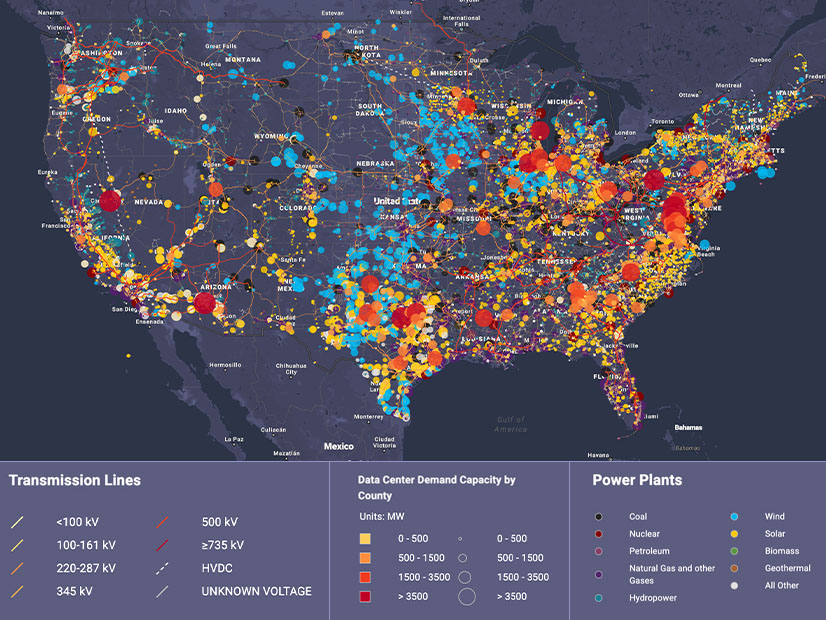
DOE’s National Renewable Energy Laboratory has created a data viewer in support of the Speed to Power initiative, with an interactive U.S. map showing some of the information developers need as they conduct site assessments, including: power demand from data centers that are planned, under construction or in operation; fiber-optic cable networks; transmission lines; power plants; substations; natural gas pipelines; day and night population; NERC reserve margins; FEMA risk indexes; and railroads.