Arizona regulators approved a 286-MW energy supply agreement between Tucson Electric Power and the developer of an embattled data center project near Tucson.
The Arizona Corporation Commission (ACC) voted 4-1 on Dec. 3 to approve TEP’s agreement with data center developer Beale Infrastructure Group and its affiliate, Humphrey’s Peak Power, to supply energy to the Project Blue data center in Pima County.
TEP officials said they won’t need new, dedicated resources for the 286-MW agreement. Instead, they’ll have capacity from resources already planned through the company’s 2023 integrated resource plan. Capacity also will be freed up through expiring wholesale contracts with utilities that now plan to use other market resources, they said, as well as delays and reductions in industrial load.
Commissioners said that without the energy supply agreement (ESA), the developer could simply take service under a large-load tariff — without customer protections that are in the agreement. TEP representatives noted that they’re obligated to provide service to customers in its territory.
“I don’t think we have an option at ‘no,’” Commissioner Lea Marquez Peterson said. “We need to make sure that we have an ESA … that protects all the ratepayers.”
Among the protections in the 10-year agreement is a minimum monthly charge that would apply if actual electricity demand is less than the contracted amount. Beale must give at least three years notice to terminate the agreement.
Power will be provided under a commission-approved rate schedule that would be subject to commission review in future TEP rate case proceedings.
TEP said the agreement would allow it to spread fixed costs across more retail electric sales, reducing the need for rate increases.
Beale will pay TEP the estimated $4 million for two new 138-kV transmission lines to exclusively serve the project. The cost of a new switchyard will be recovered through the utility’s FERC open access transmission tariff.
Beale is expected to start taking service in May 2027, ramping up to 286 MW in 2028.
Opponents Speak Out
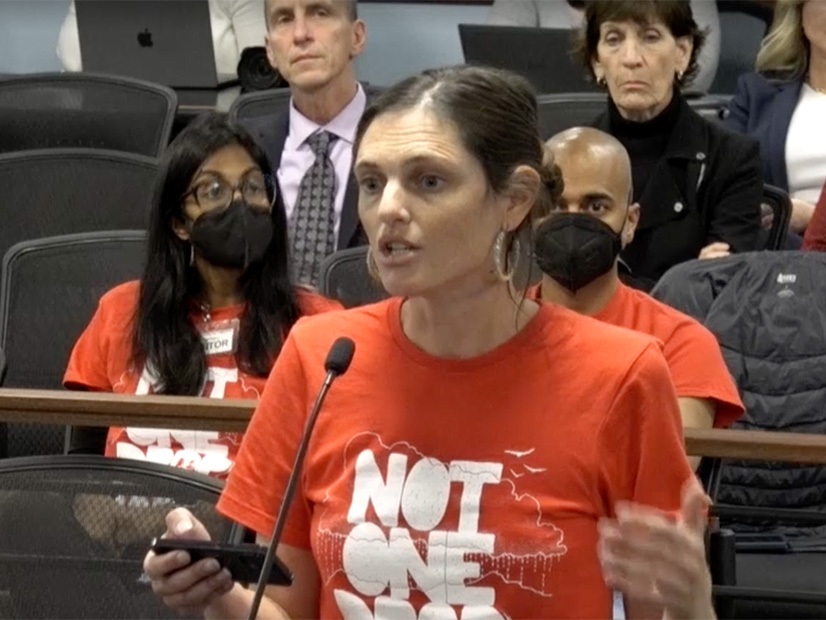
Project opponents, including many Tucson-area residents, expressed skepticism of the agreement. Some predicted the data center would further increase utility bills for residents, who are already struggling to make ends meet.
“The main question that has not been answered by TEP is, where is this 286 MW really coming from and when are we going to pay for that?” Lee Ziesche of the No Desert Data Center Coalition told the commission. “There is nothing in the energy supply agreement that protects us from paying for generation.”
Opponents also questioned the viability of the data center project. Just days before the commission meeting, news outlets reported — based on comments from Pima County supervisors — that Amazon had pulled out of Beale’s data center project.
“As far as we know, Beale doesn’t have a customer,” a project opponent told the commission.
In an email to RTO Insider, a Beale spokesperson pointed to previous public comments from Amazon Web Services saying they had no agreements in place in Tucson. A Beale representative also addressed the issue during the ACC meeting.
“We feel confident that we will have a customer ready by the time the data center comes online,” said Sam Arons, vice president of energy and sustainability for Beale Infrastructure.
Commissioner Rachel Walden voted against the energy supply agreement. She shared residents’ questions about how generation would be paid for and said the agreement should include more protections, such as a higher buyout rate if the developer pulls out.
“This kind of sets the stage for future contracts,” she said.
Annexation Request Rejected
Beale Infrastructure plans to build Project Blue on a 290-acre parcel in Pima County. The county Board of Supervisors approved the sale and rezoning of the county-owned land to Beale in June.
The developer asked the city of Tucson to annex the project site, a step needed to procure water to cool the data center. The developer offered to build an 18-mile pipeline to bring in reclaimed water.
But in August, the Tucson City Council voted unanimously to reject the project, mainly due to concerns about the large amounts of water and energy it would require.
In September, Beale announced an updated design for Project Blue in which a closed-loop, air cooled system would be used for cooling. Under the new design, “minimal” amounts of water would be recirculated through a closed-loop, air-cooled system to provide industrial cooling, Beale said.
The new cooling method didn’t change the amount of capacity requested in TEP’s energy supply agreement.
Beale has also committed to pursuing 100% renewable energy for its Pima County data center. Initially the data center will be powered by renewable and non-renewable energy, and Beale will buy renewable energy credits to offset the non-renewable power.
Longer-term, Beale plans to work with TEP on developing new renewable resources for the data center, which the developer would pay for.
Future Phases
The energy supply agreement approved Dec. 3 applies only to Project Blue, which is the first phase of Beale’s plans for data center development in the Tucson area.
A second project, known as Luckett Industrial, is planned on two parcels in Marana, Ariz. One parcel is served by TEP and the other is served by Trico Electric Cooperative.
“Trico and TEP have both submitted letters stating that they will work with Beale to support the data center’s needs without impact to service or rates for [other] customers,” a Beale spokesperson said in an email.