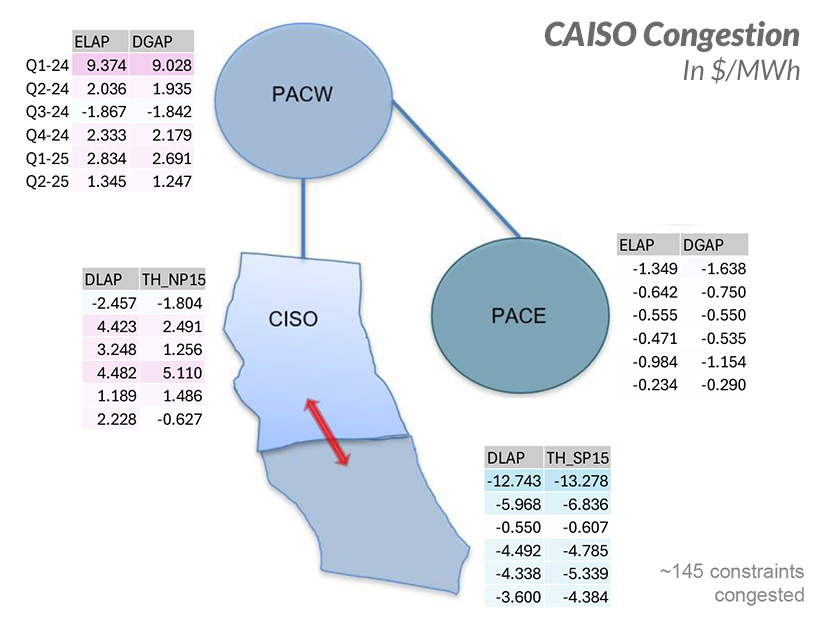
CAISO continues to work to revise the rules around how congestion revenues will be allocated to participants in the ISO’s Extended Day-Ahead Market, which will be launched in spring 2026.
The ISO published a proposed set of design principles that would help eliminate or reduce self-schedule incentives in its approved congestion revenue allocation design. Self-scheduling incentives could lead to significant unintended cost shifts, experts cautioned earlier in 2025.
CAISO early in 2025 prioritized EDAM congestion revenue allocation, specifically under parallel — or loop — flows, after Powerex published a paper contending the EDAM model contained a “design flaw” with potentially $1 billion in unjustifiable charges at stake. (See Powerex Paper Sparks Dispute over EDAM ‘Design Flaw’.)
The expedited allocation design process began in March 2025, resulting in a FERC-approved design in August. (See CAISO’s EDAM Scores Simultaneous Wins at FERC.)
But the approved design stoked concerns among some stakeholders, and CAISO decided to make the design “transitional” for EDAM’s opening in May 2026.
“[The initial design] is transitional to allow us room to further additional enhancements in this second phase, as well as evaluating a more long-term design,” said Milos Bosanac, CAISO regional markets manager, at a Dec. 11 workshop on the subject.
The initial design creates incentives for energy resources to self-schedule in order to receive the congestion rebate, CAISO’s Market Surveillance Committee said in a June letter. Other RTOs/ISOs use financial rights designs to hedge congestion to avoid similar self-scheduling and below-cost bidding incentives, they said.
The MSC cautioned that self-scheduling incentives potentially reduce the benefits of coordinating unit commitment and dispatch across multiple balancing areas that EDAM is intended to provide and could cause cost shifting among participants.
“The potential negative consequences we describe may not be material, particularly in year one given the limited scope of EDAM, but we have not seen enough empirical evidence for us to conclude that this will definitely be the case,” the MSC said. “We recommend that the CAISO seek to transition to financial congestion hedges for future years. How material these self-scheduling incentives and impacts will be during near-term year one EDAM operations with PacifiCorp is uncertain.”
CAISO then started “Phase 2” of its effort to improve the design of congestion revenue allocations.
Phase 2 will study two primary issues: how to eliminate or reduce self-schedule incentives and how to ensure symmetry in allocation of parallel flow congestion revenues for CAISO balancing areas.
ISO staff presented the new design principles at a Dec. 11 stakeholder workshop and they state that:
-
- Congestion revenues should be allocated in an equitable manner to avoid undue cost shifts.
- A revised design should support the ability of transmission customers with firm transmission rights or congestion revenue rights (CRRs) to manage and hedge congestion risk exposure considering grid conditions and feasibility of flow.
- A revised design should support continued administration of CRRs in the CAISO balancing area and continued sale of OATT transmission rights.
The proposed design principles “provide a starting point for consideration but certainly won’t be the universe of design [principles] we will consider,” Bosanac said.
The revised design also should provide a comparable allocation method for the CAISO balancing area with a CRR construct and for EDAM balancing areas that sell firm OATT transmission, CAISO said. Doing so should enable symmetry in allocation between CAISO and EDAM balancing areas.
CAISO requested stakeholder comments on the design principles by Jan. 16. The ISO plans to present a full proposal for approval in the fourth quarter of 2026.