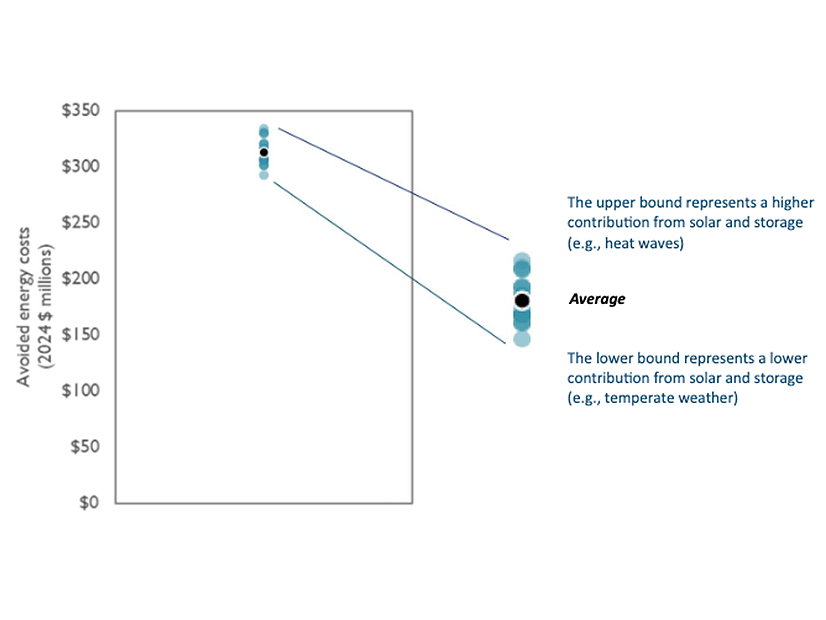
A new report estimates that solar and battery storage growth in New England between 2025 and 2030 could reduce wholesale energy costs across the region by about $684 million annually by 2030.
The analysis, written by Synapse Energy Economics for the Solar Energy Industries Association, makes the case that continued policy support for solar and storage is part of the solution to the region’s energy affordability challenges.
The authors evaluated the wholesale energy market impacts of adding solar and storage resources between 2025 and 2030 at a pace consistent with meeting Massachusetts’ clean energy plans.
Massachusetts consumers would receive $313 million of the savings, the report notes. The added energy supply accounts for about 80% of the estimated savings, while demand reductions accounted for about 20%, the authors wrote.
The increased solar and storage capacity would displace the need for about a quarter of the state’s electric-sector gas demand and provide annual carbon reductions of about 1.6 million metric tons in 2030, the authors wrote, adding that the gas savings could help avoid costly investments in new gas pipeline infrastructure.
“Electricity demand is rising across the country, driven by the expansion of data centers, electric vehicles and heat pumps,” the authors wrote. “Relying on gas to meet this rising demand is risky: Gas prices are volatile, and building new pipeline infrastructure is expensive and unpopular. Solar, increasingly paired with battery energy storage, is fast to deploy and part of a solution to maintain grid reliability and energy independence in Massachusetts.”
The authors wrote that the solar and storage growth will help winter grid reliability by providing additional supply and helping to flatten peak demand. They estimated that about 44% of the savings would occur in the winter months between November and March, adding that “many of these savings are realized during the highest-load winter hours, when reliability risk is the greatest.”
Report co-author Selma Sharaf, a Synapse associate, said the analysis helps to refute a “common misconception” that solar and storage resources do not provide benefits during the winter.
Synapse’s modeling estimated that, “in the top 50% of winter hours ranked by load in 2030, solar and storage serve 11% of demand.”
Co-author Patrick Knight, senior principal at Synapse, emphasized that the energy market cost savings would benefit all electricity consumers throughout the region, not just those that directly deploy behind-the-meter solar or storage.
He noted the analysis largely was focused on energy market impacts and does not provide a full cost-benefit analysis of solar and storage development. It does not consider costs associated with public benefit charges, capacity, ancillary services, transmission and distribution, or public health.
The study comes amid a period of heightened political attention around energy affordability, which has brought tension around the future of state clean energy incentives and programs.
In November, Massachusetts Rep. Mark Cusack (D), co-chair of the Joint Committee on Telecommunications, Utilities and Energy (TUE), introduced a wide-ranging bill that would give the state legal cover for missing its 2030 climate goals; scale back the state’s Renewable Portfolio Standard; and prohibit state agencies from creating any new climate regulations or programs deemed to have “unreasonable adverse impacts” on energy costs. (See Top Mass. House Members Seeking Major Rollback of Climate Laws.)
The proposed legislation, which was supported by the House members of the TUE Committee, faced major pushback from clean energy advocates and grassroots groups, causing House lawmakers to delay further votes on the bill.
Negotiations are poised to resume in 2026, though the legislation has a long way to go before becoming law. Gov. Maura Healey (D) has filed her own energy affordability bill, and Senate lawmakers likely will move forward with their version of an affordability bill at some point in the new year. (See Stakeholders Mixed on Massachusetts Energy Affordability Bill.)
The press release from the Synapse report notably included a statement from Cusack, who said the analysis demonstrates that “solar and energy storage are incredible levers that the commonwealth can pull to deliver utility bill savings, winter reliability and climate benefits to the state’s residents.”
Clean energy advocates have expressed support for select aspects of Cusack’s legislation, including provisions that would give the state greater clean energy procurement authority, raise the municipal cap on solar net-metering and lower barriers to surplus interconnection service.
“To help realize these benefits, we are prioritizing legislation this session that will eliminate barriers blocking these cost-competitive resources,” Cusack said. “We look forward to collaborating with our state government, clean energy industry and environmental partners to pass meaningful legislation.”