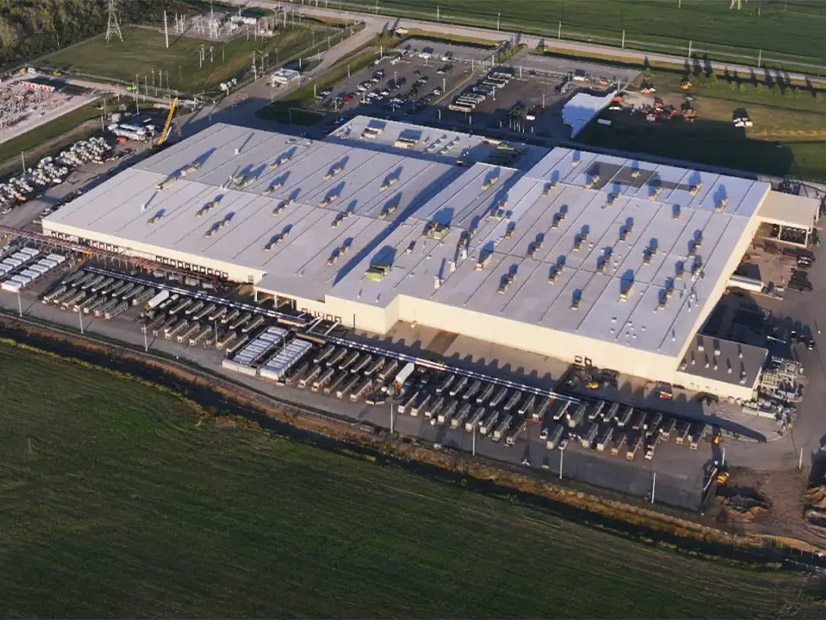
WASHINGTON — Data center developers’ imperative of speed to market not only stresses the power grid but also is felt on the ground as the giant facilities — often paired with onsite generation — spring up in neighborhoods overburdened with pollution.
Infrastructure developers often pick “communities of least resistance” that usually are low-income and often minority-majority, NAACP CEO Derrick Johnson said at a summit his group hosted to develop strategies to ensure the wave of data center development in the U.S. does not overwhelm communities where they are sited.
“Data centers will exist, unfortunately,” Johnson said. “We know this. The real opportunity here is, how do we collaborate and establish best practices for their existence so they’re not predatory in nature, on our environment, our communities and our quality of life?”
The NAACP has organized against xAI’s Colossus data center in Memphis, which went online this year using unlicensed, onsite gas generation in a city that had some of the worst air quality in the region, according to a letter threatening to sue the firm run by Elon Musk.
“Part of the reason why we’re seeing that kind of thing happen in certain communities is because of the wait in order for them to actually get the energy that they need, and so then they’re trying to find these quick fixes in order to get their data center up and running as quickly as possible,” said Abre’ Conner, director of the NAACP’s Center for Environmental and Climate Justice.
In debates around the massive data center, Tennessee state Rep. Justin Pearson (D) often hears that opponents are just “NIMBY” people.
“And I say we’re not that in the way that you think. We’re ‘NIMBY again’ — not in our backyard again,” Pearson said. “Eighty percent of the pollution that comes out of Shelby County is concentrated in the district that I represent today.”
Data centers and other infrastructure often get sited in poor, minority neighbors because the developers think it will be easy, Pearson said.
“One of the things that really ignited the movement was the company literally said: ‘We chose this community because it’s the path of least resistance,’” Pearson said. “And when they looked at the historicity of our communities, that was a story that was being told. They looked at the fact that we had been red-lined, and that the same places that were red-lined became the same places where industrial parks were placed. And so now in this country, 75% of Black, African American or Latino folks live within three miles of a toxic release inventory facility.”
But organizing can counteract that, as Pearson, who is running for the U.S. House next year, pushed back against the Colossus facility and its impact on Memphis. Now xAI is building another massive data center in Southaven, Miss., just outside Memphis in a largely white area.
“They are buying these tools to check the decibels of sound because they’re so close to the turbines, they can hear it inside their homes, and when they go outside, it nearly doubles,” Pearson said.
While the two communities might have their differences, they both are pushing back against the same opponents.
“I’m working with some Republicans who don’t want to see more datamining, don’t want to see more cryptomining, don’t want to see a data center in their own neighborhoods,” Pearson told reporters. “And so, one of the principles that I’m operating with is we have to find common ground without compromising our values. And this is one of the issues where I think we’re going to find common ground across the political spectrum.”
Pearson is running a primary campaign against Rep. Steve Cohen (D-Tenn.), who has held the seat since 2007, and if he gets into office next Congress, he’s ready to propose some broad outlines for federal legislation around data centers.
“We really need to prioritize transparency, siting [and] health protections for the people who are really suffering right now with the way that many data centers are operating,” Pearson said. “I’m hearing stories every single day from communities where the water is disappearing because of these companies, the air is being polluted and communities are being locked out of the conversation. That’s not fair.”
‘Seat at the Table’ for Communities
While data centers are going up around the country wherever they can get access to the grid, fiber-optic networks and other needed resources, the largest market still is Data Center Alley in Northern Virginia, in the suburbs of D.C.
In that region, denser development has taken shape near Metro rail stations, and that was the plan for the Silver Line, which connects Dulles Airport to the district, said Karen Campblin, chair of the Environmental and Climate Justice Committee of the NAACP’s Virginia State Conference.
“Loudoun County developed a long-range plan that was supposed to complement this to the extension of the Silver Line Metro rail,” Campblin said. “AOL headquarters closed down, and so it was a large swath of land that could be redeveloped, and they identified it as this wonderful mixed-use community. It was going to have affordable housing.”
Instead of new housing and commercial spaces, the land was snapped up by data center developers, so the region now has a new metro station in an area where few people live. Campblin noted that a parking garage tied to the station was largely vacant at rush hour recently.
“One of the trends that we’re seeing is localities losing their opportunity to follow their long-term goals,” she added.
The growth around Data Center Alley was intentional as Virginia and the region attracted the businesses with tax incentives and other enticements in the early 2000s, said state Delegate Karen Keys-Gamarra (D).
“They say, if you build it, they will come,” Keys-Gamarra said. “And they have certainly come.”
Keys-Gamarra represents Fairfax County, and she noted that its neighbors in Loudoun County have benefited from data center development in their tax bills, paying about 80 cents per $1,000 worth of real estate compared to $1.30 per $1,000 in her county.
“It creates so much money for the locale,” Keys-Gamarra said. “But now we’re being forced to try to figure out what is the impact on everyone around it.”
U.S. Rep. Jennifer McClellan (D-Va.) now serves in Congress, but during her time in the Virginia legislature, she was one of the main sponsors of the Virginia Clean Economy Act and was a chief backer of the Environmental Justice Act, which was the first time the commonwealth looked into those issues.
“What does environmental justice look like?” McClellan said. “How do we ensure that more people have a seat at the table for zoning decisions, permitting decisions, whether it’s data centers, energy projects, you name it?”
Communities were interested in the tax and other benefits from hosting these major facilities, but residents often did not find out about development plans until it was too late to influence them, she added. Data centers are inevitable, with everyone using the internet requiring their expansion.
“That is a fact of life we’ve got to come to terms with,” McClellan said. “But that doesn’t mean that we can’t be thoughtful about how, where, when data centers are built, how they are operated, how they use energy, how they use water, and where they go. And we’ve got to make sure that the public has a seat at the table at the beginning of the process, not in the middle or at the end.”
‘Disturbing Trend’
Data Center Alley has been a major driver of increased demand in PJM, which has contributed to much higher capacity prices in recent auctions. But the RTO is home to plenty of other smaller data center markets, including the area of southern New Jersey (Exit 1 off the New Jersey Turnpike) that Assemblyman Dave Bailey (D) represents.
“What happens in Virginia affects my folks in New Jersey,” Bailey said. “What I’m doing in New Jersey or not doing in New Jersey affects my cousins in Delaware and Maryland and Ohio and different places across the country. So, it’s important that we keep our eye on the goal.”
Rising costs and narrowing reserve margins have led to calls for reform at PJM, and while Bailey welcomes those, he said the RTO already has made improvements in terms of responding to state concerns. (See Governors Call for More State Authority in PJM.)
“If you look at the minutes of their meetings and their various meetings they’ve had recently, they’re just a different tone,” Bailey said. “There is more transparency. It’s not perfect yet. We’ve got to continue to fight for that, and I fully agree that we need to continue to look at their overall voting procedures and how they make decisions at the various committee levels.”
Ultimately, FERC is the main regulator of PJM, and McClellan said she worries about the agency’s independence.
“Right now, I don’t think FERC has the ability, because of how many federal employees have been fired,” McClellan said. “Trump fired the chair of FERC for no reason, and Congress is not doing its oversight job as strongly as it should be. And so, I think we’ve got to make sure we have a robust federal oversight role of all of the grid operators.”
The situation FERC faces has played out in the states, where legislators often get involved in ratemaking decisions. The NAACP event was held four days after the Supreme Court heard arguments in Trump v. Slaughter, which could lead to the end of independent regulatory agencies at the federal level. (See Supreme Court Justices Seem Skeptical on Agency Independence.)
McClellan pointed to what she called a “disturbing trend” in Virginia and other states in which authority that was granted to expert-driven public utility commissions a century ago is being stripped away.
“Too much of that authority is taken away and given to legislators that are part-time generalists, and to me, that has been one of the biggest problems in electric rate regulation at the state level, and we’re beginning to see it at the federal level,” she said.