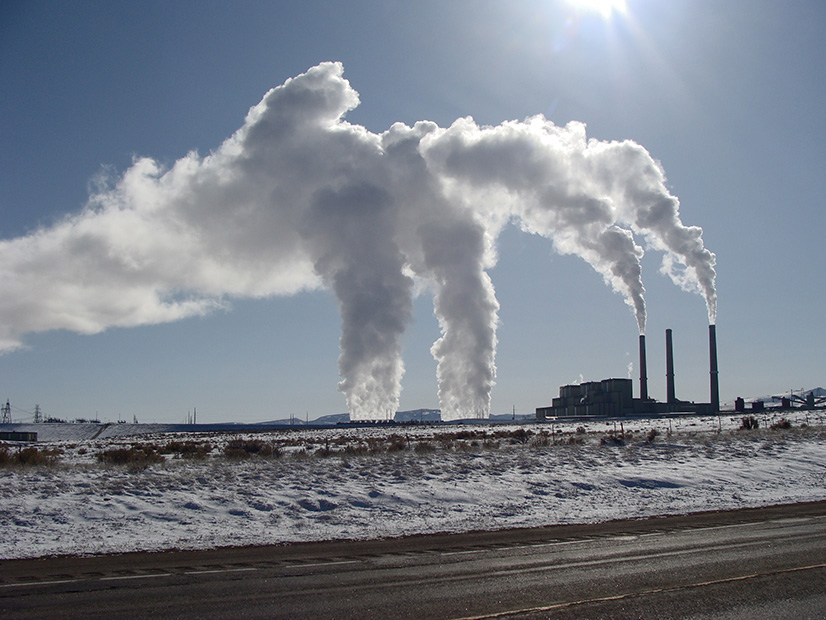
DOE has ordered a non-operational 427-MW coal-fired generator in Colorado to be repaired and remain available for 90 days.
The U.S. Department of Energy has ordered a non-operational 427-MW coal-fired generator in Colorado to be repaired and remain available to meet regional power needs for 90 days.
Energy Secretary Chris Wright issued Order 202-25-14 late Dec. 30, one day before the scheduled retirement of Craig Generating Station Unit 1 and 11 days after a valve failure took the 45-year-old generator offline.
The three-unit, 1,285-MW station in north-central Colorado is operated by Tri-State Generation and Transmission Association, which is co-owner of Units 1 and 2 with four other utilities and sole owner of Unit 3. Units 2 and 3 are scheduled for retirement in 2028; Unit 1 was to be retired Dec. 31.
DOE said in a news release that the Section 202(c) order prioritizes minimizing electricity costs and blackout risks and that Unit 1’s reliable supply of power is essential to keeping the region’s electric grid stable.
Tri-State said in a news release that it has a history of 100% compliance and will work toward the demands of this latest order.
That will need to begin with repairs to the valve that failed Dec. 19 but likely will entail “additional investments in operations, repairs, maintenance and, potentially, fuel supply, all factors increasing costs.”
Tri-State CEO Duane Highley said, “We are continuing to review the order to determine what this means for Craig Station employees and operations, and the financial impacts. As a not-for-profit cooperative, our membership will bear the costs of compliance with this order unless we can identify a method to share costs with those in the region. There is not a clear path for doing so, but we will continue to evaluate our options.”
Colorado Gov. Jared Polis (D) blasted the emergency order.
“This order will pass tens of millions in costs to Colorado ratepayers, in order to keep a coal plant open that is broken and not needed,” he said in a statement to Colorado Public Radio. “Ludicrously, the coal plant isn’t even operational right now, meaning repairs — to the tune of millions of dollars — just to get it running, all on the backs of rural Colorado ratepayers!”
Retirement planning for Craig Unit 1 began in 2016 and is based on economic factors, as well as numerous state and federal requirements.
Tri-State said in its news release that Unit 1’s planned retirement had been analyzed and did not raise resource adequacy concerns: “The retirement of Craig Unit 1 was specified in Colorado Air Quality Control Commission Regulation No. 23 on Regional Haze Limits, and the Regional Haze State Implementation Plan put in place in 2016. Tri-State’s 2020 and 2023 Electric Resource Plan (ERP) modeling reflected the previously announced retirement date for Unit 1. The model results of the 2023 ERP showed adequate resources to maintain reliability on Tri-State’s system following the retirement of Craig Station.”
Section 202(c) of the Federal Power Act was created for use in wartime or during a sudden increase in demand or decrease in supply of electricity. Historically, it has been invoked infrequently — the Biden administration issued 11 such orders in four years, all of them weather-related.
Wright signed 19 202(c) orders from May 16 through Dec. 30, a dozen of which directed continued operation of aging fossil generation assets.
The Trump administration has been using 202(c) as a tool to support its narrative of a national energy emergency and halt the wave of fossil generation retirements seen in recent years. A surge of new-build gas generation is on the way in the next few years, but no new coal generation appears likely to be built. (See Natural Gas Generation in Demand, and Priced Accordingly and Coal’s Decline Slows Amid Demand Growth in 2026, Trump’s Support.)
Against this backdrop, the Dec. 30 order for Craig Unit 1 had been expected, so much so that the Sierra Club commissioned a December 2025 study by Grid Strategies calculating the cost of such an order: at least $20 million for 90 days on standby status and nearly twice as much on must-run status.
The 202(c) orders have been criticized for extending the operation of aging plants that are expensive and/or dirty to operate, but DOE continues to cite its July 2025 Resource Adequacy Report, which warned of a 100-fold increase in outages if the wave of retirements of firm fossil generation continues amid the buildout of intermittent renewables. (See DOE Reliability Report Argues Changes Required to Avoid Outages Past 2030.)
That report itself was criticized by clean energy advocates as an exaggeration, but DOE is standing by its conclusions.
“I hereby determine that an emergency exists within the Western Electricity Coordinating Council (WECC) Northwest assessment area due to a shortage of electric energy, a shortage of facilities for the generation of electric energy and other causes and that issuance of this order will meet the emergency and serve the public interest,” Wright said in the Dec. 30 order for Craig Unit 1.
“From Dec. 30, 2025, Tri-State and the co-owners shall take all measures necessary to ensure that Craig Unit 1 is available to operate at the direction of either Western Area Power Administration (WAPA)-Rocky Mountain Region Western Area Colorado Missouri (WACM) in its role as balancing authority or the SPP West in its role as the reliability coordinator, as applicable.”
The order gives Tri-State and the co-owners of Unit 1 a Jan. 20 deadline to report measures they have taken and plan to take to ensure operational availability of Unit 1.