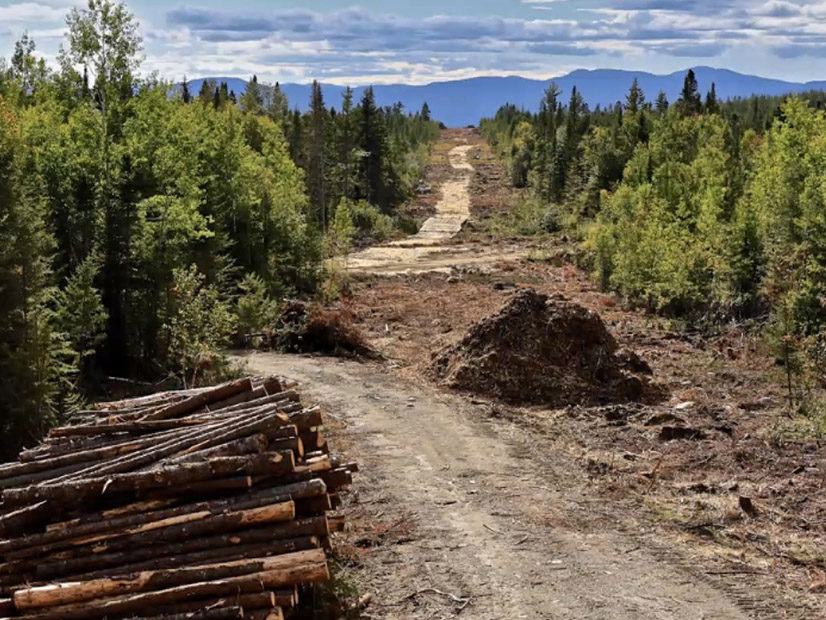
After a multiyear delay caused by intense political opposition, the New England Clean Energy Connect (NECEC) project finally is ready to begin commercial operations, Avangrid wrote in a Jan. 2 filing to the Maine Public Utilities Commission (MPUC 2017-00232).
Once in service, the 1,200-MW transmission line will facilitate baseload power supply from Hydro-Québec to New England. The project was selected in a 2017/18 procurement led by the Massachusetts Department of Energy Resources (DOER), leading to contracts between the state’s electric distribution companies and Avangrid for the transmission line and 20-year supply contracts between the EDCs and Hydro-Québec.
“As of Dec. 31, 2025, the NECEC project has satisfied all conditions precedent for commercial operation,” Avangrid wrote in its filing. “NECEC’s commercial operation is scheduled to commence on Jan. 16, 2026, unless the parties — NECEC, the Massachusetts electric distribution companies and Hydro-Québec — mutually agree in writing to an alternative date (such as a slightly earlier start).”
NECEC began to ramp up bidirectional testing in late November, eventually sending up to about 900 MW of power from New England to Québec and as much as 1,300 MW from Québec to New England, according to ISO-NE data.
The EDCs are working with Avangrid to review final materials before the line officially comes online.
“We have been actively testing the equipment for the past several weeks,” a spokesperson for Hydro-Québec wrote. “We aim to begin contractual energy deliveries this month, taking care that all technical prerequisites are met.”
The new transmission line runs for about 145 miles from the U.S.-Canada border to its interconnection point in Lewiston, Maine, while the Québec portion of the line extends for about 60 miles.
The project faced substantial political opposition in Maine, backed by more than $20 million in funding from NextEra Energy, which owns the Seabrook nuclear plant in New Hampshire and several other fossil fuel and clean energy resources throughout the region.
While the project initially aimed to come online at the end of 2022, a nearly two-year suspension of construction caused by a voter referendum challenging the line contributed to the roughly three-year delay in the project’s in-service date.
In 2024, Avangrid sued NextEra for antitrust violations and alleged NextEra engaged in an “exclusionary and anticompetitive scheme” that caused $350 million in damages to Avangrid. In September 2025, a U.S. District Court judge in Massachusetts dismissed the claims of antitrust violations, ruling Avangrid had not demonstrated NextEra had monopoly power enabling them to set above-market prices in ISO-NE. (See Avangrid Sues NextEra over ‘Scorched-earth Scheme’ to Stop NECEC and Court Dismisses Claims of NextEra Antitrust Violations to Block NECEC.)
The project delay has been costly for ratepayers; the Massachusetts Department of Public Utilities approved a settlement agreement in early 2025 regarding the effects of the delay on project costs. The Massachusetts EDCs estimated the settlement would cost ratepayers about $521 million in 2017 dollars (DPU 24-160).
Despite the cost increase, the DOER estimates that, once in service, NECEC will save Massachusetts electric customers about $18 to $20 annually and cut emissions by about 2 million tons per year. ISO-NE studies also have shown significant winter reliability benefits associated with the line. (See ISO-NE Sees Little Shortfall Risk for 2032.)
It’s unclear how the line will affect net imports and exports between New England and Québec. New England’s imports from the province have declined significantly in recent years, driven by an extended drought and Hydro-Québec’s efforts to prepare for the supply contracts associated with the NECEC and Champlain Hudson Power Express projects. While the NECEC supply contracts require Hydro-Québec to send baseload power over the NECEC line, they do not prevent the company from importing power from New England over other lines.
The upgrades associated with the NECEC project will affect the transfer limits for two internal interfaces in ISO-NE. When NECEC is online, the limit of the Surowiec-South interface will increase to 2,800 MW, compared to the previous limit of 1,800 MW, and the Maine-New Hampshire interface will increase from 2,000 MW to 2,200 MW.