The average U.S. consumer would have spent $6,000 more on utility bills over the past decade without national efficiency standards for appliances, according to a report from the Appliance Standards Awareness Project (ASAP).
The group released the report Jan. 21 as the U.S. House of Representatives was due to vote on H.R. 4626, which would let the Department of Energy unwind existing standards more easily while making it harder to update new ones in the future. Appliance standards have become part of the culture war in recent years, with new ones much more likely to be issued when a Democrat is in the White House, while Republicans largely oppose them.
“These standards have kept utility bills far lower than they would have been,” ASAP Deputy Director Joanna Mauer said in a statement. “If the efforts from Congress and the administration to weaken the standards succeed, families and businesses could see significant increases in costs. Rollbacks are completely misguided, especially at a time when bills are already unaffordable for many people.”
H.R. 4626 — dubbed the Don’t Mess with My Home Appliances Act — was introduced by Rep. Rick Allen (R-Ga.) and cleared the House Energy and Commerce Committee in December.
“Over the last several years, DOE has gone beyond its scope of statutory authority by finalizing rules that do not meet the specific statutory criteria,” Allen said in a statement. “These egregious appliance standards have caused homeowners to spend 34% more on appliances than they did 15 years ago, while having to replace them at a faster rate.”
According to Allen’s office, the bill would eliminate the requirement for DOE to review and update standards every six years, establish a new process that would allow them to be reviewed and amend the criteria for determining whether a new standard is justified.
“The utility bill savings from more efficient appliances and equipment significantly outweigh any increase in purchase price,” the report said. “For all existing standards finalized by DOE since 2008, we estimate that the savings outweigh the costs by more than a factor of three.”
Since the first standards were established, refrigerators have used 50% less electricity, air conditioners 40% and lightbulbs 85%. Additional savings are possible, with ASAP’s report saying air conditioners could be 10 to 15% more efficient, and heat pumps are available that beat 2024 efficiency standards by 20 to 40%.
As part of a broader regulatory rollback, DOE announced plans last May to eliminate or reduce 47 “burdensome and costly” standards.
“Any actions that roll back existing standards or threaten DOE’s ability to set improved ones would raise costs for consumers and businesses and increase electricity demand,” ASAP says in its report.
The report found that businesses across the country would have spent $330 billion more on utility bills over the past decade, while households would have spent $780 billion more.
“In many parts of the country, electricity prices have risen faster than inflation in recent years due to factors including utility investments in transmission and distribution infrastructure, extreme weather and wildfires, and natural gas price fluctuations,” the report says. “A recent analysis found that rising energy bills are driving more households deeper into debt, with the average overdue balance on utility bills increasing by 32% between 2022 and 2025.”
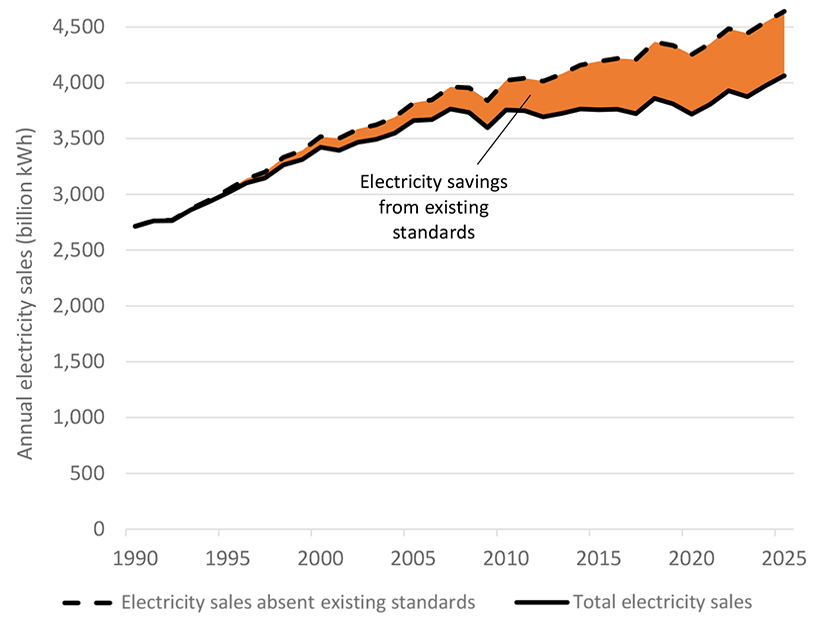
While load growth has returned to being the major focus for the industry, the report notes that between the mid-2000s and 2021, it was relatively flat, and part of the reason was the federal efficiency standards for appliances.
“Absent existing efficiency standards, total U.S. electricity consumption would have been 14% higher in 2025,” the report says. “Summer peak electricity demand would have been 115 GW higher — roughly double the power demand of all data centers in the United States in 2025.”
Power consumption is forecast to grow 25% by 2030 compared to 2023, while peak demand could rise 14%. Any weakening of efficiency standards would increase electricity consumption and peak demand when the grid is already stressed, ASAP said.