California’s two large offshore wind projects could be delayed by up to six years due to recent federal policy actions, a California Public Utilities Commission administrative law judge said Jan. 14.
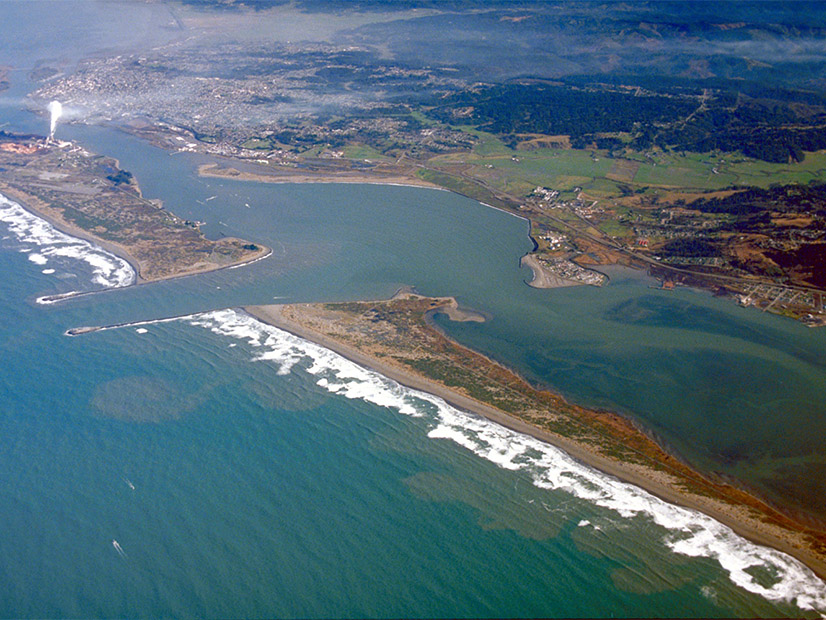
The Morro Bay offshore wind project is now forecast to come online by 2036 rather than 2032, CPUC ALJ Julie Fitch said in a proposed decision on electric integrated resource planning and procurement. A second project, in Humboldt County, is projected to come online by 2041 rather than by 2035.
The delays are “reasonable and should be adopted as the recommendation for CAISO’s 2026-2027 Transmission Planning Process,” Fitch said in the proposed decision.
The forecasted delays are part of the CPUC’s latest electricity and sensitivity resource portfolios, which the commission sends to CAISO for inclusion in the TPP. The ISO uses each TPP to determine whether additional transmission projects are needed in its region.
Although federal policy will affect California’s offshore wind projects, regardless of these policy changes, “it is important to note that offshore wind is not optimally selected in least-cost modeling,” the proposed decision says.
Numerous parties cautioned against delaying transmission planning that would support offshore wind in Humboldt County beyond 2036.
Environmental Defense Fund told the CPUC that the offshore wind industry is “at an inflection point” and that delaying the planned projects’ online dates could cause a “significant chilling effect that would not be in the interest of ratepayers,” the proposed decision says.
CalCCA recommended the CPUC maintain the amount of in-state and offshore wind in previous TPP portfolios and limit out-of-state wind. And Humboldt County representatives questioned why the North Coast offshore wind project is delayed by six years while Central Coast is delayed by only four years, the proposed decision says.
Many other stakeholders expressed concern that the state is planning to rely heavily on new out-of-state solar development when in-state resources, such as offshore wind, would be preferable, the proposed decision says.
In October, the California Energy Commission approved $42 million for five offshore wind projects at California ports. (See CEC Approves 5 Offshore Wind Projects at California Ports.) In November, the CEC added $9.2 million more for research on deepwater HVDC transmission. (See ‘There’s Room for Everybody’: California Ports Prepare for OSW Development.)
The current TPP base case for 2025-2026 includes 4.5 GW of new offshore wind capacity.
Additional RA Procurement Proposed
Under the proposed decision, load-serving entities would need to procure an additional 2,000 MW of net qualifying capacity (NQC) by 2030 and 4,000 MW more by 2032.
This additional procurement is the result of the CEC’s 2024 Integrated Energy Policy Report demand forecast, which showed an increase in demand due to data center growth and vehicle and building electrification, and a decrease in the number of people who plan to install behind-the-meter solar and storage units.
In the CPUC’s analysis, Diablo Canyon Power Plant (DCPP) was modeled as offline in all years, and all combined heat and power plants were kept online. While it is “likely that DCPP will be online through 2030 in reality,” the proposed decision says the CPUC’s model follows the requirements of California’s Senate Bill 846, which extended the operating life of the nuclear plant.
Energy storage resources can account for only up to 50% of the additional NQC amounts under the proposed decision.
The “real winner” of the procurement order is geothermal energy, Farhad Billimoria, representative of Aurora Energy Research, told RTO Insider. With offshore wind development in the state facing continued delays, community choice aggregators will again be forced to scramble for clean firm capacity, leaving geothermal as the only realistic, if still costly, option, Billimoria said.