Stakeholder comments on NERC’s proposed changes to its reliability standards development process revealed widespread support for the ideas in principle, with suggested revisions to specific aspects of the plan.
The ERO’s Modernization of Standards Process and Procedures Task Force (MSPPTF) published its final recommendations in January, proposing a set of changes that affect every stage of the standards development process. (See NERC Modernization Task Force Leaders Present Final Recommendations.) Task force leaders plan to present the recommendations at the open meeting of NERC’s Board of Trustees in Savannah, Ga., on Feb. 12.
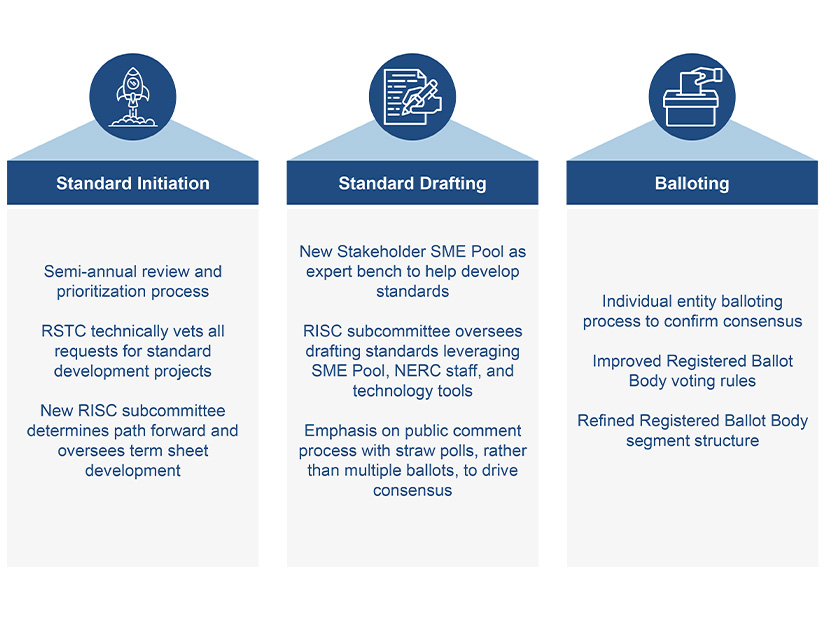
The MSPPTF’s recommendations include initiating standards projects through a biannual review and prioritization process conducted by the Reliability and Security Technical Committee and creating a new subcommittee of the Reliability Issues Steering Committee to determine a plan of development. A “fast track” process that skips certain steps would be permitted for urgent projects.
Updates to the drafting process — covering the writing of proposed standards — would have NERC staff and a pool of subject matter experts create an initial draft of a new standard that can be refined through industry feedback. Stakeholders could submit comments during the process and vote on the final product. The voting process would also be streamlined by restructuring the ballot body and updating the voting rules.
Stakeholder comments were accepted through Feb. 5 and drew feedback from 18 utilities, trade associations and regulators. NERC published the responses Feb. 9 ahead of the board meeting.
Most commenters expressed appreciation for the MSPPTF’s work as a starting point while suggesting further changes. American Electric Power asked that NERC ensure the task force is not “a one-time effort” by establishing a team, selected by industry, to “continuously review and enhance the standards development process.” AEP expressed concern that the MSPPTF’s original goal “was narrowly focused on accelerating the process, rather than both accelerating it and improving the quality of the resulting standards.”
“The MSPPTF’s recommendations rest on an implicit assumption that increased engagement results in better outcomes; however, early engagement alone does not equate to higher-quality standards,” AEP continued. The company also suggested that NERC conduct a pilot using two standard initiation requests — the proposed term for the documents that would start the development process — to allow practical examination of the new process.
The ISO/RTO Council (IRC) also supported a pilot project while encouraging NERC’s board to ensure sufficient resources are available to support implementation of the recommendations. The IRC further reminded the board of “the potential need for region-specific variances,” especially in Canada, and explicitly encouraged the expansion of existing procedures for developing variances on standards to allow Canadian entities to pursue variances in their territories.
Both Electricity Canada and IESO joined the IRC in urging that NERC ensure Canadian participation in the process is protected. Electricity Canada approved of the MSPPTF’s recommendation for “sufficient Canadian representation in the membership of the RISC subcommittee” and echoed IESO and the IRC in requesting additional provisions to allow both Canada-wide and “more granular provincial variances” to standards.
IESO also suggested that the proposed SME pool be solely responsible for creating initial standard drafts, rather than a combination of SMEs and NERC staff. The move “would reduce the risk of over-reliance on NERC staff, who may not always have the specific expertise required for certain standards,” IESO wrote.
Several commenters shared reservations about the proposed revisions to the registered ballot body, particularly the idea of consolidating and eliminating segments. For example, large and small end-use customers would be merged into a single group, electricity end users; electric generators would be combined with brokers, aggregators and marketers; and regional reliability organizations and regional entities would be combined with federal, state and provincial regulatory or other government entities.
Michigan Assistant Attorney General Michael Moody and Pennsylvania Consumer Advocate Darryl Lawrence — who represent small end-use customers on the Member Representatives Committee — criticized the proposal to eliminate the sector. The task force justified this move by the “lack of participation” of the sector in the existing standards process, but Moody and Lawrence wrote that this argument “elevates participation metrics over equitable and meaningful representation.”
“While industry frequently raises concerns about regulatory burden, in practice, many standards create predictable cost recovery pathways that are often welcomed rather than resisted,” Moody and Lawrence wrote. “NERC has a responsibility to ensure that the public interest has appropriate weight in a forum that is already dominated by well-resourced, profit-motivated industry interests.”
The American Clean Power Association disagreed with combining brokers, aggregators and marketers with generators, writing that the merger would “water down the existing representation spots for” independent power producers; ACP instead suggested that IPPs be given their own category “to ensure that [they] are sufficiently represented.”
Invenergy also objected to eliminating the brokers, aggregators and marketers segment, arguing that it “represents a unique function and business model among stakeholders.” The utility observed that 71% of entities represented in the load-serving entities segment are also represented in the transmission owners segment, but neither of these has been proposed for elimination.
“We urge NERC not to eliminate this stakeholder pool from its balloting process (which would also eliminate some entities’ balloting rights entirely),” Invenergy wrote. “Retaining [the brokers segment] is in keeping with NERC’s laudable goal to maximize stakeholder engagement to foster and accelerate reliability standards … by virtue of an inclusive stakeholder consensus-building process.”