EPA has rescinded its 2009 finding that greenhouse gases are air pollutants that endanger public health and thus require regulation under the Clean Air Act, along with every vehicle emission standard that it had issued since 2012 as a result.
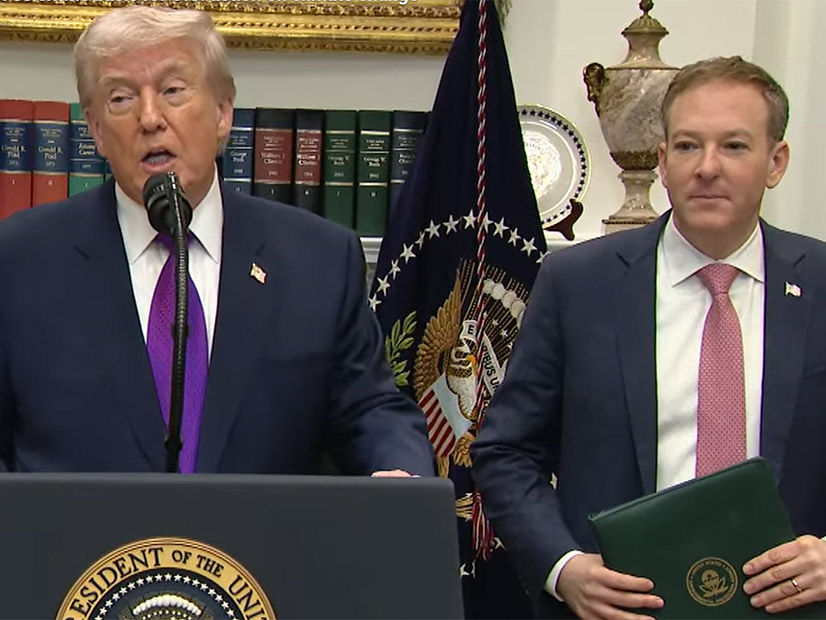
President Donald Trump and EPA Administrator Lee Zeldin announced the move Feb. 12, with both calling it the “single largest deregulatory action in American history.” They claimed it would save the U.S. $1.3 trillion in regulatory costs and an average of $2,400 on a new car.
Trump called the endangerment finding “a disastrous Obama-era policy that severely damaged the American auto industry and massively drove up prices for American consumers.” He said it “had no basis in fact, had none whatsoever, and it had no basis in law.”
The agency’s rollbacks, while significant, are limited to regulations under Section 202 of the Clean Air Act. The section pertains to emissions from new motor vehicles and engines that “may reasonably be anticipated to endanger public health or welfare.” That phrase is found elsewhere in the law, including Section 111, which allowed for regulation of new stationary sources of emissions.
Zeldin said the Supreme Court had established a “clear precedent” with its decisions in West Virginia v. EPA and Loper Bright Enterprises v. Raimondo that “if Congress didn’t authorize it, EPA shouldn’t be doing it. Congress never voted for these climate mandates. … If Congress wants EPA to regulate the heck out of greenhouse gases emitted out of motor vehicles, then Congress can clearly make that law, which they haven’t done, for good reason.”
Congress, however, did make that the law with the Inflation Reduction Act of 2022, which amended the CAA to specifically classify six greenhouse gases — carbon dioxide, hydrofluorocarbons, methane, nitrous oxide, perfluorocarbons and sulfur hexafluoride — as air pollutants to be regulated by EPA, mostly through incentives for zero-emission vehicles.
The agency issued the endangerment finding in 2009, nearly a year after President Barack Obama took office. It had been ordered by President George W. Bush in 2007 to begin regulating emissions of the six gases after the Supreme Court found it was required to in Massachusetts v. EPA.
“Today, the Trump administration repealed the endangerment finding: the ruling that served as the basis for limits on tailpipe emissions and power plant rules,” Obama posted on X. “Without it, we’ll be less safe, less healthy and less able to fight climate change — all so the fossil fuel industry can make even more money.”
EPA’s recission, which is likely to face a legal challenge, may rely on the court overturning Massachusetts v. EPA, or ruling that the IRA’s amendments do not mean the agency is required to regulate greenhouse gases, though it has the authority to do so. In 2022’s West Virginia v. EPA, the court affirmed the agency’s ability to regulate power plant emissions through reduction technologies. All six of the same conservative justices in the majority on that decision are still serving.
“This decision will drive up costs for businesses and consumers and weaken our economy. It upends nearly two decades of commonsense policy,” Sandra Purohit, federal advocacy director for business group E2, said in a statement. “It discourages capital investment and innovation in the auto industry. And it ignores the economic costs of extreme weather that’s only made worse by rising GHG pollution — including disaster clean-up, higher insurance premiums, lost productivity and supply chain disruption.”
EPA first proposed the recission in July 2025. (See EPA Proposes Rescission of Endangerment Finding that Underpins All GHG Rules.) It already had proposed eliminating regulations on power plants under a different rationale. (See EPA Proposes Repealing Limits on Power Plant Greenhouse Gas Emissions.)
The agency did not respond to a request for comment on what, if any, changes to the proposal, as published in the Federal Register, had been made in the final rule, the text of which had not been released as of publication time.