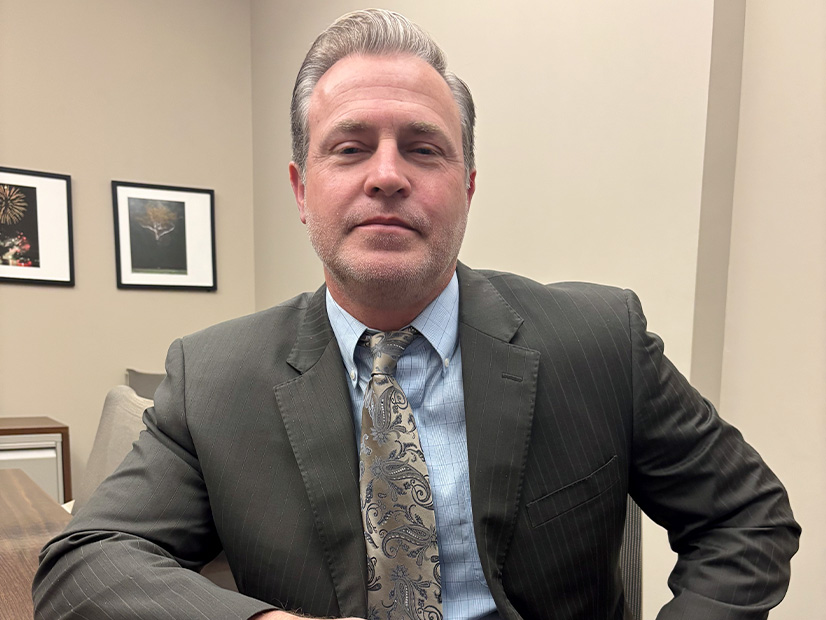
It’s been a little more than a year since Lanny Nickell was selected as SPP’s next CEO and began a three-month transition with his predecessor, Barbara Sugg.
What has he learned since then? He says it’s that the issues and challenges facing the industry aren’t getting any easier.
“That shouldn’t be a surprise necessarily, but the pressure is still on, and we know what that pressure looks like,” he said in an interview with RTO Insider. “It’s about resource adequacy. It’s about speed to power, accelerating the ability to build transmission, the ability to build generation. Those challenges still exist despite what I believe to be innovative and creative efforts to address those concerns and those issues and those challenges.”
Those challenges have forced SPP’s staff and their stakeholders to step up the pace. No longer can the RTO be said to be a follower among its peers, preferring to learn from others’ mistakes.
Nickell is one of the featured speakers at the Yes Energy EMPOWER 26 conference Feb. 26, where he shares the main stage with CAISO CEO Elliot Mainzer.
Faced with the same demand from data centers and crypto miners as other grid operators, SPP responded by putting together a 30-person team to recommend a process to interconnect the large loads. About three months later, staff had devised a method to interconnect what they called high-impact large loads; the method received stakeholder and board approval.
“I’ve learned that we can, in fact, do things faster and still maintain our very inclusive and collaborative stakeholder environment,” said Nickell, who calls SPP’s stakeholder-driven approach with its members its “secret sauce.” (See Nickell: SPP’s Culture Paves Way for its 2025 Success.)
“We’ve never moved that fast as an organization before,” he said, “and I think we’re getting a pretty high degree of support from the stakeholders as we’ve done those things. Now that we’ve demonstrated it, it gives me more hope and optimism that we can do it again.”
That is what Nickell calls “boldly leading.”
“I mean, that’s probably the biggest change is just trying to incorporate that into the culture,” he said. “We’ve had to transform, and we’ve needed to become more of a performance-based culture. I’d characterize that as a subtle shift in some ways and a large shift in others, but a lot of our employees are excited about that.
“It’s setting very clear goals for each and every employee. The downside is it’s dealing with those who aren’t able to perform at the level they need to in order for this company to survive and succeed. It’s just raising the expectations of what every employee needs to be able to do in order for them to not only be successful personally, but also to help SPP be successful.”
So far, so good. SPP has completed all but a handful of the 42 milestones attached to its three corporate goals: western expansion, continued resource adequacy risk mitigation and accelerated generator and load interconnections — see recently FERC-approved high-impact large loads, or HILLs and HILL generator assessment, and now conditional HILLs policies.
The grid operator has been involved in the West over the past decade. On April 1, it will become the first U.S. RTO to provide full market services in both the Eastern and Western Interconnections when eight utilities from Arizona, Colorado, Utah and Wyoming become members.
SPP’s presence will become even larger in September 2027 when Markets+ goes live. The market and its bundle of day-ahead services have drawn almost 40 potential market participants, with operations focused in the Pacific Northwest, Mountain West and Desert Southwest regions.
The grid operator’s staff says Markets+ offers Western entities a choice between it and CAISO’s Extended Day-Ahead Market (EDAM). Nickell says when SPP first began its pre-pandemic forays into the West, it did so because of interest expressed by various Western stakeholders.
“We didn’t go out there trying to conquer the world,” he said. “We went because we were asked and invited and we brought forward a proposal and we said, ‘Competition is good because it makes the competing parties better, right?’”
It also creates winners and losers, right?
“It makes both parties, or however many there are, try to get better,” Nickell said. As an example, he offers kudos to CAISO for making changes to their governance model that address one of the main concerns other Western stakeholders had about EDAM.
“I know that has made them better,” Nickell said. “You have to ask yourself the question, ‘Would that have happened without SPP being a competitive force in the West?’ And I think we need to remain in the West, because once the competition goes away, the incentives and the motivations to get better also go away.”
The RTO’s ambitious efforts have led it to roll out a $150 million project that will create about 190 new engineering, IT and administrative jobs. That will push SPP’s headcount to about 1,000.
Obviously, it’s not the same company Nickell joined in 1997 after five years at the Public Service Company of Oklahoma. It was his first job after graduating from Tulsa University with an electrical engineering degree. He was born and raised in Arkansas, and it was the only time he left the state.
Now, Nickell has embarked on a concerted effort to raise awareness of SPP’s value proposition — it says it has the lowest wholesale energy prices of any RTO and that its members derived $3.62 billion in benefits (a 20-to-1 return) in 2023 — and explain the generational challenge the industry faces. He has visited politicians and regulators across much of the RTO’s current 14-state footprint.
“We have to set the narrative before somebody else sets it. That’s still a big goal of mine, and it’s probably the goal that I would like to see even more progress being made,” he said. “I’ve talked to my peers at the other RTOs, and I think we’re all on the same page. We provide tremendous value, and I think the members of those ISOs and RTOs understand that.
“It’s more than our members that need to understand it,” he added. “We’ve got to expand the audience to key decision makers, legislators, the general public. … [They] need to have a stronger appreciation for the value that we provide.”
As a CEO, Nickell says he often is asked what keeps him up at night.
His answer?
“We’ve done some great things, done a lot of really cool things this first year, but the question that keeps me up at night is, ‘Have we done enough?’”
Nickell’s appearance with CAISO’s Mainzer: “The Race to Shape Western Power Markets,” will occur Feb. 26 on the main stage at Yes Energy’s EMPOWER 2026 conference in Boulder, Colo. To learn more about EMPOWER visit empower.yesenergy.com.