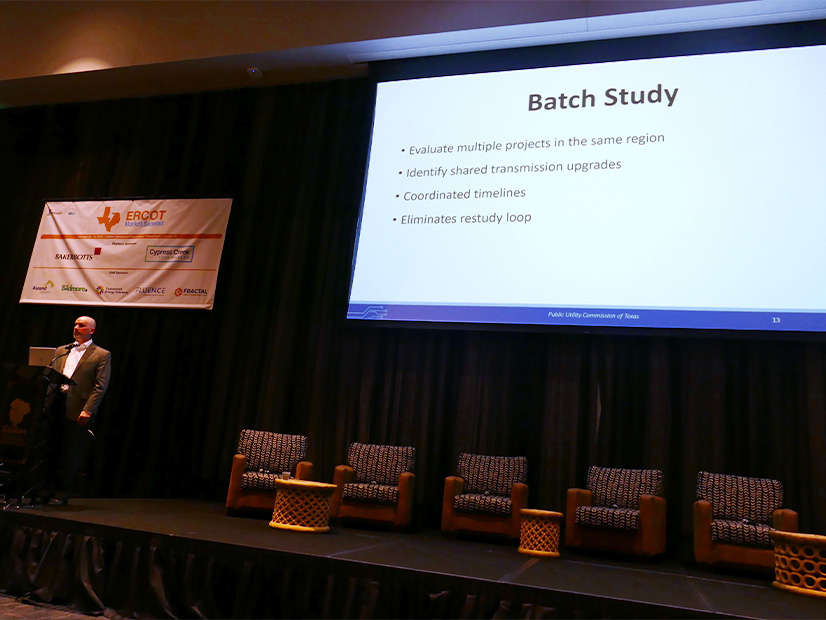
AUSTIN, Texas — Speaking at a recent industry conference, Thomas Gleeson, who chairs Texas’ Public Utility Commission, pointed to a slide on the screen behind him.
“So, this is my job right now,” he said.
Above him, under the title “Batch Study,” were four bullet points that detailed how the state’s regulatory body plans to grapple with the 232 GW of interconnection requests in ERCOT’s large load queue:
-
- “Evaluate multiple projects in the same region
- Identify shared transmissions upgrades
- Coordinated timelines
- Eliminates restudy loop.”
The weight of the task that lies ahead hit Gleeson during the PUC’s open meeting Feb. 6. He said at least half of those in attendance were lobbyists or representatives for data centers, a result of Texas’ open-door policy for all kinds of large loads. Under Gov. Greg Abbott’s direction, the state is expected to overtake Virginia as the world’s largest data center market by 2030.
“It’s really quickly changing, [with] an interest from a diverse group of folks in the work that we do. [It] has really made my job a lot more interesting. A little more difficult, but definitely a lot more interesting,” Gleeson said.
Drawn to the state’s wide-open spaces, energy access and transmission infrastructure, developers filed 225 interconnection requests for large loads through mid-November. ERCOT received only 152 interconnection requests from 2022 to 2024.
“The load forecasts are insane,” Enverus’ Adam Jordan said during a panel discussion at the Infocast ERCOT Market Summit where Gleeson made his presentation.
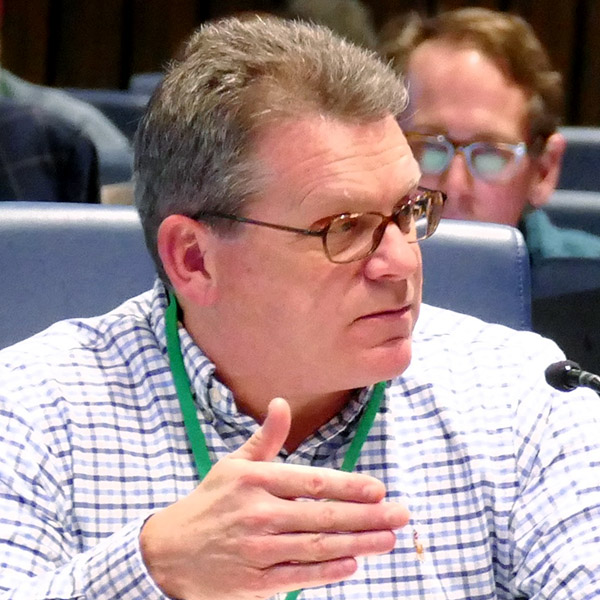
“We have this explosion,” Cholla Petroleum’s Clayton Greer said during the conference’s obligatory panel on load growth.
During the PUC’s open meeting, Gleeson and his fellow commissioners agreed ERCOT needed to back off its original plan to request a good-cause exception, allowing the grid operator to deviate from its normal study processes and begin the first batch analysis in late February. (See ERCOT Taps the Brakes on Batch Study Process.)
Gleeson said that while he was “very supportive” of ERCOT’s initial direction, after watching the concerns raised in the first workshop on large load interconnections, reading filed comments and talking with different interested parties, he had become “convinced that slowing down a little is the right answer.”
“We have to get this right, and I don’t want to sacrifice the quality of what we’re doing to get it done quickly,” he said. “I know the governor and others want to make sure that we get this right, but they also want to make sure we do it expediently, so that we’re not holding up development. As we’re trying to solve for both speed and quality, I think this gives us the best chance of being successful.”
The plan now is to use ERCOT’s stakeholder process to work out the details of the batch process, using input from market participants rather than a top-down approach driven by the grid operator and PUC. Working with the stakeholder-led Technical Advisory Committee and its Protocol Revision Subcommittee, ERCOT plans to draft nodal protocol revision requests (NPRRs) codifying the process that will be approved by market participants, the Board of Directors and the commission.
“The message was that we need to get it right,” Jeff Billo, ERCOT vice president of interconnection and grid analysis, told stakeholders during a Feb. 12 workshop. “However, [the PUC] also expressed that we need to still move quickly through that revision request process, so this cannot be a revision request that sits in the stakeholder process for half a year or anything like that. We’ve got to move this quickly because those same stakeholders, those developers that have that uncertainty and want to move their projects quickly, that still exists.”
ERCOT staff and stakeholders will begin by writing the protocol change for “Batch Zero,” the transitional study for large loads that face restudies in the current interconnection process. Staff have a mandate, as Gleeson made clear during his conference appearance, to bring the NPRR for the board’s consideration during its June 1-2 meeting. They plan to file the NPRR in early March.
Billo said that would allow Batch Zero studies to begin by late summer. By then, staff and stakeholders should be working on the NPRR for ongoing batch studies, with a September deadline for submission to the board.
The studies would take place every six months, with ERCOT reviewing the projects to evaluate their collective impact on the grid instead of subjecting each project to an individual study. The goal is to integrate the large load requests, adjust the grid as needed, then move on to the next batch.
Anxious to get started, staff limited the Feb. 12 workshop to three and a half hours of discussion. ERCOT’s Matt Mereness, fresh off guiding the successful Real-time Co-optimization plus Batteries project that was deployed in December, noted that “we have a long journey. … That’s why the workshop is short today, because [staff are] going into a room to beat up a whiteboard.” (See ERCOT Successfully Deploys Real-time Co-optimization.)
At the same time, staff also will file revision requests on controllable load resources (CLRs) and large loads proposed concurrently with generation interconnection requests, aligning them with the Batch Zero RRs.
The revisions would allow large loads to declare their intent to register as CLRs and be treated accordingly in the batch process. It would create a binding framework that would require the large load to remain a CLR until it meets defined exit conditions.
For loads proposing to build new generation to meet some or all the requested demand — bring your own generation (BYOG) — ERCOT intends to define the technical requirements needed for a large load “never” to be seen or served by the grid. The protocol change would define the scenarios to be assessed in the batch and other planning studies and would establish rules preventing a large load studied with new co-located generation to be energized until the generation is operational.
Mereness said ERCOT will keep the CLR and BYOG protocol changes “decoupled … but ‘bolt-able’ together, if that’s a good word.”
“When I say ‘bolt-able,’ it would mean, ‘Let’s create the batch study framework,’ and if the CLR concept can be vetted and fit together to where it can be approved at the same time and it all fits together, that would then be the batch process and the CLR.”
Stakeholders generally agreed on the principles outlined, reserving additional discussions on CLR and BYOG topics for future meetings. A third batch study workshop will be held Feb. 26, with as many as five more scheduled.
ERCOT says the critical path for a successful Batch Zero NPRR relies on a series of approval votes in May. That’s when TAC, the PRS and the Reliability and Operations Subcommittee — the latter for accompanying Planning Guide revisions — all will hold votes before the changes go to the board.
“We will brace ourselves for many workshops,” NRG Energy’s Bill Barnes said Feb. 12. It “makes sense that we are supportive of a modified, potentially ad hoc stakeholder approval process where we can accelerate this.”
The interest is there. The Feb. 12 workshop drew more than 150 attendees, according to a head count inscribed on a staffer’s palm. The Feb. 3 workshop had between 800 and 900 people listening in, with 187 in the room.
The PUC has received more than 100 comments from different organizations, while consulting firm McKinsey & Co., supporting ERCOT, has interviewed stakeholders and conducted surveys over the past two months. McKinsey said a strong majority (more than 80%) prefer some form of screening by transmission and distribution service providers to ensure realism and feasibility, with debate on whether it should be optional or mandatory.
“The biggest frustration for these loads is the lack of uniformity from TDSP to TDSP,” Google Energy’s Chris Matos said during the second workshop.
The discussions will continue through the spring. As Greer said, the “massive” data center load growth is “being kind of hampered by the existing process that we have.”
“Hopefully, the batch process will allow the dam to break a little bit and moves it from a planning blockade to a supply chain blockade,” he said. “We’ll see how it goes after that.”