Advanced conductor manufacturer CTC Global is working with Google Cloud and Tapestry to launch the GridVista System, which combines conductors with fiberoptic cables to offer operators visibility along the entire transmission line.
GridVista’s line awareness, paired with Google Cloud and Tapestry’s artificial intelligence-powered tools, turn line data into actionable intelligence that can optimize grid capacity, prevent outages, cut wildfire risk and lower operational costs, the companies say.
CTC’s advanced conductor technology can double the capacity of an existing transmission line, having worked on 1,400 projects with more than 300 utilities in 65 countries, CEO J.D. Sitton said in an interview.
“Now with the GridVista System, we’re adding data-grade fiber optics to the product that enables the measurement of strain and temperature and capacity and events along the entire length of the power line; not at discrete points, but literally the entire length between substations,” Sitton said. “And so, GridVista really is providing an entirely new level of detail and insight into the operating status of the transmission lines.”
Unlike traditional dynamic line rating products that add sensors at discrete points along a transmission line, the fiber optics in GridVista give utilities full knowledge of what is happening.
“It’s a much higher degree of resolution and a much faster feedback loop to the utilities about an event: a line down, a hot spot, a lightning strike, a rifle shot, a tree branch falling on the power line. These sorts of things,” Sitton said. “We know about it immediately. We know exactly where it is.”
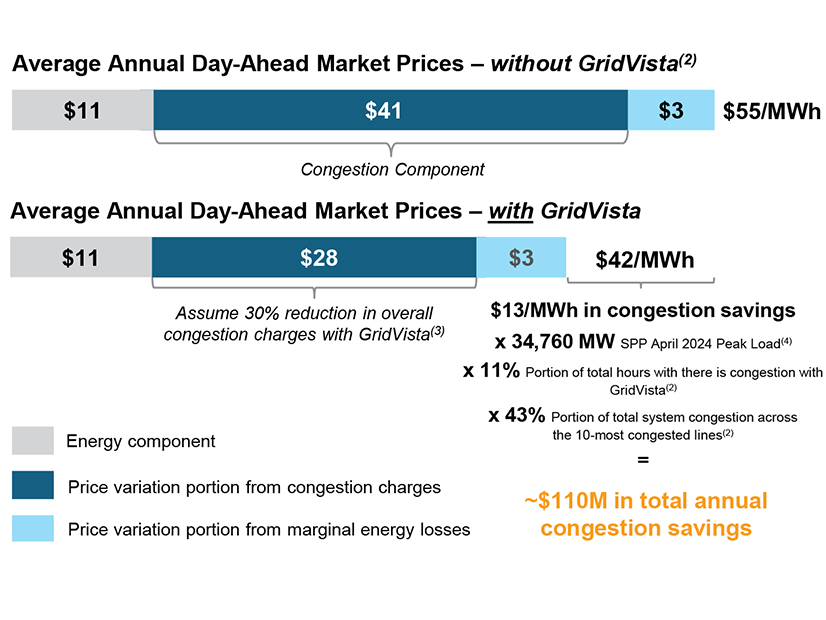
Combining that visibility with advanced conductors puts utilities in a position to operate more cheaply, he said.
“We save them money on the capacity upgrade, and we’re saving them money from an operations perspective, because they’re much smarter about how they dispatch their operating resources and their lines,” Sitton said. “We enable them to operate with a higher degree of reliability because they no longer have these blind spots in their operation between the substations where they’re guessing what’s going on or not going on with their power line.”
The growing demand from data centers that want to connect to the grid much faster than the industry historically has been able to add new power plants or transmission is leading to more demand for products like GridVista.
“I think probably for the first time, we’re seeing utilities in the United States and Western Europe realize that they are, in fact, capital constrained, and so they need to get more out of their existing systems faster than historically they’ve had to,” Sitton said. “So, all of these things are, I would say, accelerated by the dramatic pickup of demand from the data centers that’s creating an environment where the utilities are very open to much more capital and operating cost-efficient solutions.”
Utility customers increasingly have higher expectations for a safe and reliable grid, which can benefit from the awareness the new product unlocks, he added.
CTC had a pre-existing relationship with Google around speed-to-power for its data centers. With GridVista, Google Cloud helped with the user-interface system, and Tapestry is working on reforming grid operations.
“Google is using GridVista as the source for what they call ‘ground-truth data,’ so the fundamental operating data that will feed the capabilities of their software platforms,” Sitton said. “So, it’s basically a two-way street, and it’s really quite exciting to see the early reactions of some of the utilities that we’ve been engaging with about the combined capabilities.”
AI applications are starting to transform how the grid is operated as the industry adopts the technology.
“We’re starting to see utilities rethink how they dispatch their grids, how they respond to operating challenges within their operating assets, and how they think about the kind of the planning aspects of their system,” Sitton said. “So, the next round of interconnections, and the next retirements of generators along their transmission lines and … the way they plan for these things is fundamentally changing.”
Utilities move at different speeds, but the “thought leaders” in the industry are starting to roll out AI applications that improve their operations and planning, he added.
“Utilities are utilities,” Sitton said. “They are, by definition, some of the most conservative organizations on the planet, I think, for good reason. But they’re not all cut from the kind of the absolute conservative cloth, and so we are seeing many utilities moving much more quickly.”