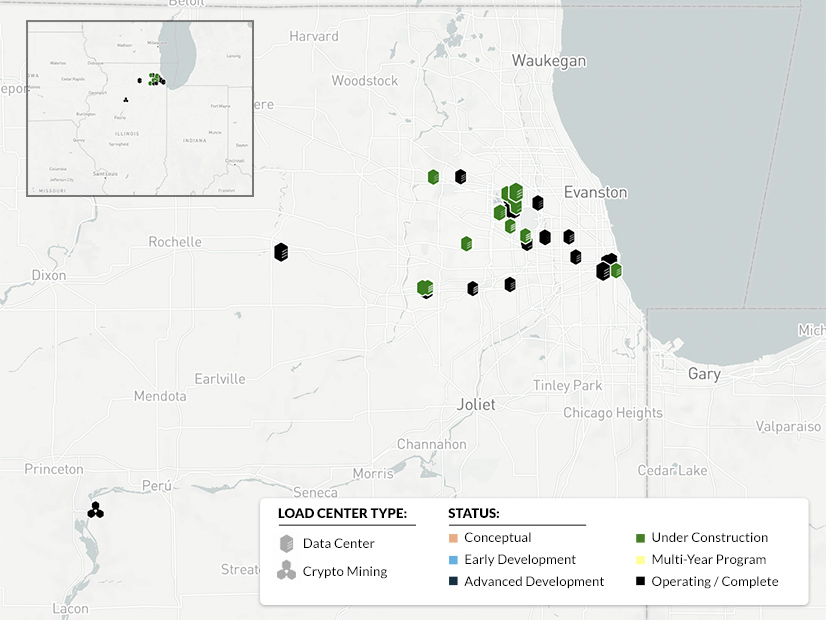
FERC approved four transmission security agreements between Exelon’s Commonwealth Edison and new data center customers in Illinois, laying out conditions for their transmission service.
All four orders, issued Feb. 17, included two identical concurrences: one from Commissioner Judy Chang, and a joint concurrence from FERC Chair Laura Swett and Commissioner David LaCerte apparently in response to Chang’s.
The customers include Karis Critical, for a data center in DeKalb (ER26-853); Aligned Data Centers, for a facility in Coal City (ER26-838); Monarch Rock Air, for a facility in Rockford (ER26-839); and Red Energy Partners, for a data center in DeKalb (ER26-841).
The deals all cover the terms of ComEd’s provision of retail service to the data centers; they had to be submitted to FERC for approval because they include the construction and operation of transmission facilities. They include provisions seeking to ensure the data centers pay for those investments even if their development is delayed; they use less power than planned; or they shut down earlier than expected.
To submit a commentary on this topic, email forum@rtoinsider.com.
FERC approved the proposal under the Mobile-Sierra public interest standard of review, which holds that the terms of arms-length contract negotiations are presumed just and reasonable, absent a showing they are contrary to the public interest.
The entire commission agreed that the deals offer protections for other customers that would not otherwise exist and that the Illinois Commerce Commission can use its authority to place additional conditions protecting other retail customers.
But in her concurrence, Chang noted that using Mobile-Sierra means FERC has not independently assessed the deals against its just-and-reasonable standard. She referenced her concurrence on a similar deal FERC approved for another Exelon subsidiary, PECO Energy, in November. (See FERC Approves PECO-Amazon Transmission Agreement for Pa. Data Center.)
“I write separately to reinforce my concern that reliance on bilaterally negotiated agreements, particularly ones shielded from meaningful commission review by the Mobile-Sierra presumption, may not be sufficient to ensure that customers are protected against unjust cost shifts from new large loads,” Chang said.
The commitments are better than not having an agreement, Chang acknowledged, and they reflect a meaningful revenue contribution to transmission costs that other customers would otherwise have to pay.
“However, there is a need to protect other customers from potential unjustified cost shifts, and neither the terms of the agreement nor ComEd demonstrate how these commitments achieve that higher and more essential standard,” Chang said. “So, while the commission properly accepts the agreement under the Mobile-Sierra framework, that acceptance does not necessarily protect other customers.”
When utilities must expand their transmission systems to offer new service, it can lead to an increase in rolled-in embedded cost rates. To protect wholesale customers, FERC allows transmission providers to charge the higher of the rolled-in embedded cost of the expanded system, or the incremental costs of the expansion itself, but not the sum of the two.
“Today’s order conforms to this line of precedent by acknowledging ComEd’s intention to seek rolled-in rate treatment to recover the costs of serving these new customers,” Swett and LaCerte wrote. “The commission will always reject a rate that seriously harms the consuming public.”
In the PECO concurrence, Chang suggested that FERC could apply “the higher” policy to large loads interconnecting directly to the grid. But that would first require the incremental costs of the upgrades to be quantified, “an exercise that notably has not been conducted and reflected in” the four ComEd agreements, she wrote.
“In fact, the agreement does not identify any specific upgrades needed to interconnect the data center,” Chang said. “Instead, it contemplates that, if the large load that materializes through this agreement triggers transmission upgrades on ComEd’s system, the costs of those system upgrades would be added to ComEd’s transmission revenue requirements and thereby rolled into transmission rates that all customers pay.”
That doesn’t necessarily mean rates for other customers will rise, she noted, but they certainly could.
“The commission and our state counterparts must not let the commission’s acceptance of the agreement and others like it dissuade us from taking additional action to protect customers where we think it is necessary,” Chang said. “Instead, absent some demonstration that the agreement and similar arrangements provide the necessary level of consumer protection, they should be treated simply as one piece of a broader package of federal and state measures to protect customers, rather than the primary or exclusive means to do so.”
For FERC’s part, Chang suggested assessing how to develop customer protection frameworks that can complement and supplement ongoing efforts at the state level.
Swett and LaCerte noted that Mobile-Sierra is just a presumption that presents a higher legal bar to overturning contracts, but that can be done if one “seriously harms the public interest.”
“The Mobile-Sierra presumption is not a straw man behind which the commission hides to evade its statutory duty of ensuring that the American consumer pays just and reasonable rates,” they wrote.
If the circumstances demonstrate serious harm to the public interest, especially other ratepayers, then FERC has a statutory responsibility to act, which could include overcoming the Mobile-Sierra presumptions.
“As we head down the road where it appears that agreements similar to those approved today may become more common, we also would like to clarify that the commission’s existing transmission policy ‘endorses transmission pricing flexibility,’ not a linear analysis,” they said.