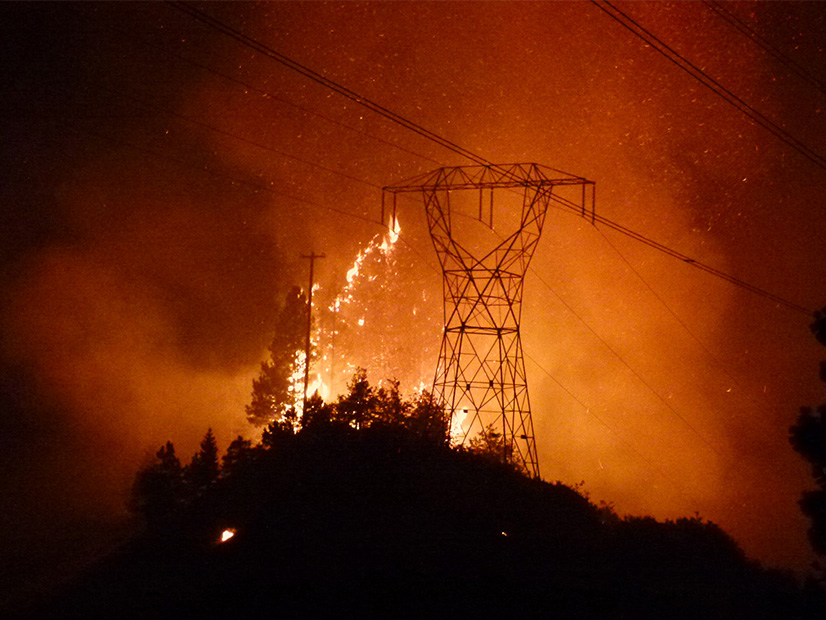
Permitting delays can exacerbate risks for electric transmission lines to spark wildfires, experts told the U.S. House Natural Resources Subcommittee on Water, Wildlife and Fisheries.
Midstate Electric Cooperative CEO Jim Anderson opened his testimony by stating a previous CEO of the Oregon co-op had testified at the same committee 30 years ago on the same subject.
“In that case, Midstate Electric requested permission to trim hazard trees along our rights of way on U.S. forest land,” Anderson said. “The Forest Service denied the request. Predictably, a tree fell into the powerline, sparking a wildfire for which Midstate was held strictly liable for a cost of $327,000.”
Decades later, the co-op was facing the same issues: bureaucratic delays and regulations that slow down wildfire mitigation work, said Anderson, who was speaking on behalf of the National Rural Electric Cooperative Association.
Nearly 70% of the land in Midstate’s territory is federally managed. Anderson argued that vegetation management is one of the most cost-effective ways to address risks.
“Our members pay the equivalent of two months [of] power bills just to fund wildfire mitigation,” Anderson said.
NV Energy inspects 14,000 poles a year, trims 15,000 trees annually and clears 2,000 miles of lines in its efforts to cut wildfire risk, said Jesse Murray, senior vice president of energy delivery. “This year, NV Energy will invest $500 million in the program.
“Ultimately, our customers do pay this cost; we must invest that money as efficiently as possible to reduce the risk. The process to permit work on federal lands is a noteworthy cost driver that can have an impact on customers’ bills depending on what requirements actions and timelines the utilities must follow.”
NV Energy’s territory covers multiple federal forests, and each can apply the rules differently, adding additional work for little benefit, he said.
“I think these divergent requirements result from local staff having to interpret risks and considerations based on unclear, complex rules that translate into an approach that cover ‘all the bases,’” Murray said. “Combining these complex requirements with limited resources, timelines get extended that generate more risk due to the inability to complete the work.”
House Natural Resources Committee Chair Bruce Westerman (R-Ark.) and other Republicans urged the Senate to pass his Fix Our Forests Act (H.R. 471), which cleared the House of the Representatives early in 2025.
“FOFA would allow utilities to remove hazardous trees within 150 feet of the right of way,” Westerman said. “The legislation also included a new categorical exclusion for approval of vegetation management plans and activities carried out consistent with those plans. This new categorical exclusion would significantly reduce wildfire risk and keep electricity reliable and affordable in the West.”
Vegetation management can be improved if companies start developing stable, native habitats with their transmission lines that can discourage tree growth, said Pennsylvania State University professor Carolyn Mahan.
“Integrated vegetation management is something that is recognized and approved by U.S. Forest Service, EPA and U.S. Fish and Wildlife Service,” she added. “It’s written as a recommended practice, but it really hasn’t been put into policy yet.”
The Sacramento Municipal Utility District has used the technique on federal land in its territory, using low-growing vegetation dominated by native species. For example, it has planted native loop pines that are too small to interfere with its power lines but provide good habitats for native species, Mahan said.
Permitting reform would help deal with wildfire risk, which has raised costs for utilities with major impacts on their credit risks, said Christina Hayes, executive director of Americans for a Clean Energy Grid. But permitting laws need to change to get new, major interstate transmission lines that offer major reliability benefits during extreme weather events.
“High-capacity, multistate transmission lines — the lines most critical to achieving reliability and affordability, particularly during extreme events — should have a one-stop shop for siting and permitting just like natural gas pipelines do,” Hayes said. “Streamlining multiple rounds of permitting for infrastructure that is in the national interest will ensure that it is built faster and cheaper.”