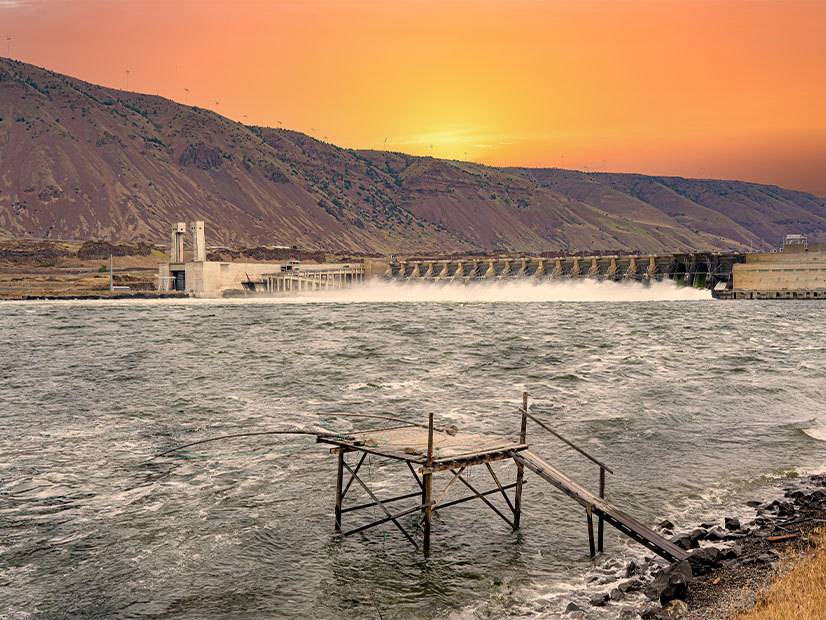
A federal judge in Oregon ordered increased spill levels at eight dams on the Columbia and Snake rivers to protect endangered salmon species, rejecting claims that doing so would impede power generation.
U.S. District Judge Michael H. Simon on Feb. 25 granted a preliminary injunction sought by the states of Oregon and Washington, tribes and environmental groups. The order requires the U.S. Army Corps of Engineers and the Bureau of Reclamation to spill large amounts of water over the dams instead of running it through turbines to protect migrating salmon and steelhead in the Columbia and Snake rivers.
Simon said the salmon species have “dwindled to near extinction levels” as the issue has played out in courts over the decades.
“One of the foundational symbols of the West, a critical recreational, cultural, and economic driver for Western states, and the beating heart and guaranteed resource protected by treaties with several Native American tribes is disappearing from the landscape,” Simon wrote. “And yet the litigation continues in much the same way as it has for 30 years.”
The case, which began in 2001, now concerns an environmental impact statement and a biological opinion from 2020 that the court ordered the federal agencies to prepare for the Federal Columbia River Power System.
In challenging the analysis, the plaintiffs alleged the Army Corps of Engineers’ plan failed to adequately protect salmon.
The case was stayed after former President Joe Biden assumed office and allowed the parties to work out a deal. An agreement was reached in 2023, which included $1 billion toward salmon restoration.
The Biden administration was considering breaching four dams on the Snake River that produce more than 3,000 MW, but it did not make a final decision.
The parties resumed litigation after President Donald Trump upended the deal in June 2025. The Trump administration said the deal would have several negative impacts on energy production, shipping channels and water supply for local farmers. (See Trump Directs Feds to Withdraw from Deal on Snake River Dams and BPA Cuts Payments for Tribes, Salmon Restoration Under Revised Cost Projections.)
In resuming the case, the plaintiffs asked the judge for injunctive relief beginning March 1.
Specifically, they sought a preliminary injunction to address alleged violations of the Endangered Species Act.
They urged the court to order federal defendants to increase spill levels, lower reservoir levels and implement emergency conservation measures for the salmon.
In his Feb. 25 order, Simon granted the motion in part, writing he “declines to impose many of plaintiffs’ requests challenged by the federal defendants as outside of this court’s equitable authority to grant.”
Simon said the injunction includes a provision for the federal agencies to adjust spill for emergency power generation and transportation needs. However, he rejected arguments that increasing spill levels could impact power generation, saying the granted relief is “narrowly tailored and essentially maintains the status quo.”
“The court is unpersuaded by arguments that spill will create various catastrophic results,” Simon wrote. He added that defendants have presented similar concerns in the past “without them coming to fruition.”
“The majority of the spill has been implemented over the years without such negative repercussions, and the court does not anticipate such calamities will ensue from the current spill order,” Simon wrote.
PPC ‘Disappointed’
Though Simon ordered modifications to spill levels, he granted defendants’ request to keep reservoir levels at the 2025 operating levels and declined to implement a series of nonoperational conservation measures.
“Those limited acknowledgments, however, do not offset the broader impacts this decision could have on the region’s power supply, transmission operations, greenhouse gas emissions, and customer costs,” Public Power Council’s Scott Simms said in a statement.
PPC is the lead defendant-intervenor for public power in the case. The group represents Northwest publicly owned utilities that buy federal hydropower marketed by the Bonneville Power Administration.
“PPC is disappointed that the court adopted a sweeping operational injunction that will materially affect the region’s clean hydropower system and the millions of people who depend on it,” Simms said. “The Columbia River system already operates under some of the most protective fish measures in the nation, and public power utilities have invested billions of dollars over decades to support salmon recovery while producing reliable and affordable electricity.”
A spokesperson for the U.S. Department of Justice declined to comment.
Meanwhile, plaintiffs celebrated the ruling.
“We absolutely can have clean energy and restored salmon runs, and today’s ruling is an important step in the right direction,” Zachariah Baker, NW Energy Coalition’s regional and state policy director, said in a statement. “The ruling helps protect salmon, while the region continues to collaborate on the comprehensive, strategic solutions envisioned in the Resilient Columbia Basin Agreement the administration withdrew from, including how to ensure abundant, affordable and reliable clean energy across the Northwest.”
Simon denied the defendants’ request to stay the case pending appeal.