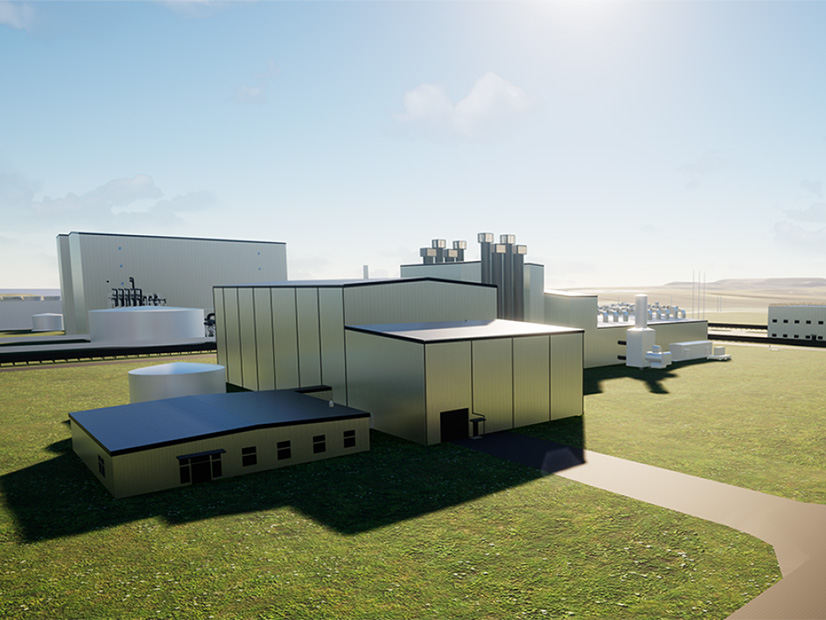
WASHINGTON — Bill Gates-backed nuclear power startup TerraPower expects to break ground on its planned Natrium power plant in Wyoming within weeks, the company’s top executive said Feb. 24.
“We’re probably just a few weeks from the [Nuclear Regulatory Commission] awarding the construction license for our plant,” TerraPower CEO Chris Levesque said at the annual Energy Aspects Conference at the Waldorf Astoria hotel in D.C.
Once the permit is in hand, TerraPower can begin building its 345-MW sodium-cooled, small modular reactor, which would be the first commercial venture of this nature to reach this stage. The company hopes to complete construction by 2031, after which it will seek a permit to begin operations.
“This will be really huge for us as a nation,” Levesque said, calling the project a key step forward in deploying the next generation of grid-scale nuclear reactors.
The U.S. needs these next-generation reactors to achieve parity with Russia and China, he argued.
At least 12 commercial reactors featuring state-of-the art small modular technologies are at various stages of development in the U.S., according to data from Yes Energy’s Infrastructure Insights.
Among them is an 80-MW small modular reactor being jointly developed by Dow Chemical and X-energy at Dow’s UCC Seadrift Operations along the Texas Gulf Coast. X-energy submitted a construction permit for it in March 2025.
The Trump administration has prioritized nuclear power to meet rising demand from data centers to power artificial intelligence applications and replace aging baseload generation. Just the day after the conference, the Department of Energy announced a $26.5 billion loan package for Southern Co. subsidiaries Alabama Power and Georgia Power that includes licensing and upgrades for about 6 GW of nuclear generation. (See related story, DOE Loans $26.5B to Southern Co. for Infrastructure Upgrades.)
Federal regulators also are moving to streamline licensing and regulations. DOE recently created a new categorical exclusion under the National Environmental Policy Act for certain advanced reactor projects, while the NRC is developing a new regulatory framework for advanced reactors under Parts 53 and 57. Those rules are expected to be finalized by the end of the year, NRC Commissioner David Wright said at the conference.
Still, challenges remain. “To say that nuclear power is not without its challenges would be ingenuous,” Deputy Energy Secretary James Danly said in an earlier panel.
Deploying first-of-a-kind technology, such as the kind Oklo and TerraPower are pioneering in the U.S., comes with its own challenges, including access to financing, reliable supply chain and a skilled workforce, as well as supportive government policies, NIA CEO Judi Greenwald said during a webinar Feb. 26 on the project tracker.
“And we are in that place now.”