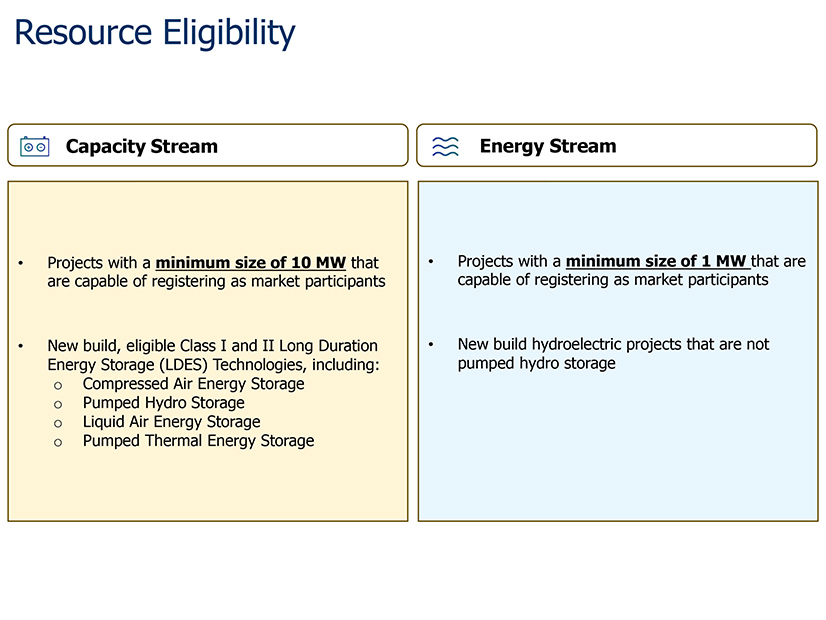
IESO officials have broadened the eligibility for hydropower projects in the ISO’s upcoming Long Lead-Time (LLT) procurement, agreeing to accept separately metered expansions as “new build” projects.
Such expansions will be eligible to participate in both the energy and capacity streams of the LLT procurement, which the ISO created for resources that require at least a five-year lead time.
ISO officials had said previously that such expansions would not be eligible for the LLT procurement. But IESO’s Danielle D’Souza told stakeholders Feb. 26 that it changed its position in response to stakeholder feedback that such expansions may require longer design and construction cycles and would be unable to compete against wind and solar projects in its long-term procurements. (See IESO Holds Firm on Hydro Exclusion, Reserve Price in Long Lead-time RFP.)
“What that means is that hydroelectric expansions that are separately metered will be eligible to participate, and this is consistent with the treatment of separately metered expansions under” the pending Long-Term 2 (LT2) procurement, D’Souza said. While the LT2 procurement is limited to resources that can go into operation within four years, the LLT resources will have up to eight years to go into operation.
IESO plans to procure up to 800 MW of capacity and up to 1 TWh of energy from resources requiring at least five years of lead time.
‘Rated Criteria’ Incentives
Pending a final directive from the Ministry of Energy and Mines, IESO expects to offer “rated criteria” incentives to developers by reducing their “submitted” price to an “evaluated” price for comparison against competing offers.
Developers who commit to sourcing 75% of materials and construction services from Canadian suppliers would receive a 2% reduction in their “evaluated” price. The ISO requested feedback on whether the incentive would impact supply chain decisions and whether a 75% threshold is achievable.
Developers making energy proposals will receive up to a 5% reduction for Indigenous economic participation and up to an additional 5% for projects located on tribal lands.
In addition to those incentives, capacity projects will be eligible for up to an additional 5% reduction for facilities that can offer more than the minimum eight hours of continuous energy.
“All of that is pending the final [ministry] directive, but we have a good sense of where that’s going to land now,” IESO’s Ben Weir said.
Prime Agricultural Areas
Weir said IESO expects the ministry to eliminate rated criteria incentives for projects locating outside of Prime Agricultural Areas.
“I think part of the reason why government has been more comfortable in the LLT context to [remove rated criteria] is because of the technologies that are at play,” he said. “Hydroelectric — unless you can prove me wrong — isn’t going to be built on ag land. … And when we’re talking about the [long-duration energy storage] technologies, by and large, the acres taken per megawatt of capacity is a lot smaller … than when we’re talking about wind [or] solar projects.
“I don’t expect government to change tack on that for the LLT,” he added. “But for full transparency, we have not had that discussion with them.”
Assuming the ISO receives a final directive from the ministry in March, Weir said it should complete the request for proposals and contract documents by mid-April. That would enable an Oct. 1 deadline for proposal submissions, with contract awards targeted for March 30, 2027.
Feedback on the supply chain disclosure provisions is due March 5, and comments on the rest of the materials are due March 12 to engagement@ieso.ca.