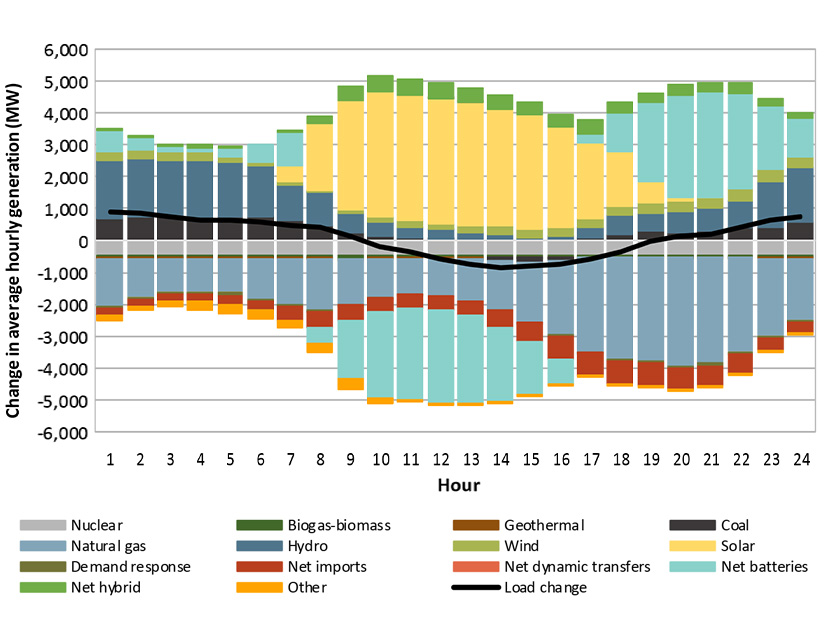
CAISO’s Western Energy Imbalance Market saw an increase in battery storage capacity and coal use in 2025 compared with 2024, although the total load across the market — which represents about 80% of the load in the West — did not increase over the year.
Battery capacity reached 25,600 MW by the end of 2025, up about 42% from the previous year, CAISO’s Department of Market Monitoring (DMM) said in memo at the joint CAISO Board of Governors and Western Energy Markets Governing Body meeting held March 4.
Most of that battery capacity exists in CAISO’s region — about 17,100 MW — with the rest of the WEIM containing about 8,500 MW.
During evening hours, batteries discharged about 2,500 MW more energy in 2025 than in 2024. This was due in part to a larger amount of solar generation on the system in 2025, which allowed the batteries to charge during the day and discharge at night, DMM said.
Coal-fired output in the WEIM increased by an average of about 800 MW during the hours between about 11 p.m. and 8 a.m. in 2025. In total, coal generated about 17,000 MW/hour in the WEIM over 2025.
The DMM specifically found that transfers out of the Intermountain West region increased during morning and evening non-solar hours in 2025 compared with 2024. This coincided with increased generation from coal resources in the region, DMM said.
Average total system load in the WEIM was the same in 2025 as in 2024 — about 78.3 GW. Load increased in the Pacific Northwest, Intermountain West and Desert Southwest regions but was down about 2% in California to 27.9 GW in 2025. Most of California’s decrease occurred during mid-day solar hours and evening peak net load hours, DMM said.
Although battery and coal usage increased in 2025, natural gas and hydropower resources continued to be WEIM’s primary resources, DMM said. Natural gas hourly generation averaged about 23,110 MW, down about 1,900 MW compared to 2024, while hydropower came in at 22,120 MW, an increase of about 920 MW in 2025.
Big Transmission Lines on Schedule
Three important transmission projects in the WEIM are progressing toward completion, CAISO CEO Elliot Mainzer said in a report at the joint board meeting.
The SunZia project, a 550-mile line across New Mexico and Arizona, began its commissioning and testing phase, Mainzer said. The line’s 3,650-MW capacity will deliver more than 3,000 MW of wind energy to the region.
The Southwest Intertie Project-North, a 285-mile line across Idaho, Nevada and California, is on track to open in June 2028, Mainzer said. Engineering and procurement are on schedule, with construction contracts signed and right-of-way requirements 99% secured.
The TransWest Express, a 732-mile line across Wyoming and nearby states, is on track to provide 3,000 MW of wind generation capacity by Q4 2031. Construction is currently happening at substations, transmission tower pads and access roads.