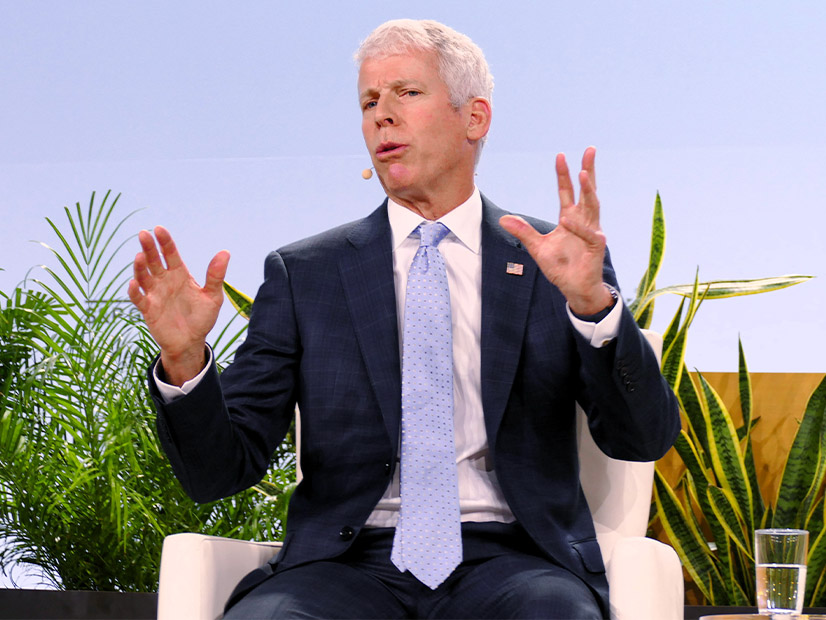
HOUSTON — U.S. Energy Secretary Chris Wright opened the CERAWeek conference with a plenary session during which he praised fossil fuels and bashed clean energy.
He patted himself on the back for delaying the retirement of 17 GW of coal-fired power plants: “We stopped energy subtraction policies.”
He said the coal plants were instrumental in preventing “significant blackouts” during the late January winter storm that pushed the Eastern grid “to the edge.” (See DOE Touts Fossil Fuels’ Role in Meeting Peak Energy Demand This Winter.)
“The truth is simple. Energy is life, and the world needs massively more of it,” he said, taking the stage as a cheering section led by Secretary of the Interior Doug Burgum in the front row urged him on.
“President Trump’s goal from Day 1 was to get rid of the nonsense and restore common sense,” Wright said. “That means turbo-charging American energy production, including electricity that’s been relatively stagnant for a few decades. Surging energy production will drive down costs for Americans, drive reshoring of manufacturing back to our country, and that in turn will drive up wages. Lower costs, higher wages. In short, that’s the economic agenda.”
To meet the administration’s goal of leading the world in artificial intelligence, he said the U.S. will have to build more electricity generation, preferably baseload, and do so at a rapid pace.
“We haven’t done that in a while,” Wright said, laying the blame at the feet of Democratic administrations. “No one really wanted to build a new gas or coal generation plant when some time in the near future you were going to have to capture the CO2 emissions from it, use a third of the power from the power plant to capture emissions, and then dispose them in quantity underground, which has never been done at scale. Do you really want to spend $100 for something that might give a $1 benefit? That’s not a businesslike attitude.”
He said that by “clearing out a lot of the morass that disincentivizes people from building things,” the marketplace will sort out winners and losers.
As an example, Wright said the Department of Energy is offering the national laboratories’ more than 1 million acres to companies interested in developing small nuclear reactors. The White House issued an executive order in 2025 that set a DOE goal to have three SMRs reach criticality by July 4, 2026.
“Why this year? Because it’s our 250th anniversary,” he said, acknowledging that the deadline is “an aggressive time frame.”
“As I stand here today, we look to be on track to have three next generation nuclear reactors running. They won’t be selling electricity into the grid, but all the nuclear systems will be running and generating the heat that would be used to produce electricity by July 4,” Wright said.
He said 11 SMR technologies are in the queue. At the same time, DOE is reforming permitting for nuclear reactors and trying to ramp up domestic uranium enrichment, fuel fabrication and reprocessing, and permanent waste disposal sites with a “competitive state-level opt-in process.”
With the Nuclear Regulatory Commission “at our side,” Wright said the agency is asking states to compete to host nuclear innovation campuses that will prove the worth of SMRs.
“These are small SMRs that can be built and constructed quickly. Fortunately, in America’s free market society, there’s a few dozen small modular reactor companies pursuing different technologies [and] different sizes,” he said. “We welcome it all. This will really speed up the development … nuclear has just been slow and hasn’t moved for decades. We want to get it moving quickly so it could win economically.”
Although there have been significant signs of progress for new nuclear power, nuclear analysts say it also faces a long timeline and plenty of potential obstacles. The analysts add that meaningful capacity increases are still years in the future. (See Nuclear Power Retains Great Potential in 2026.)