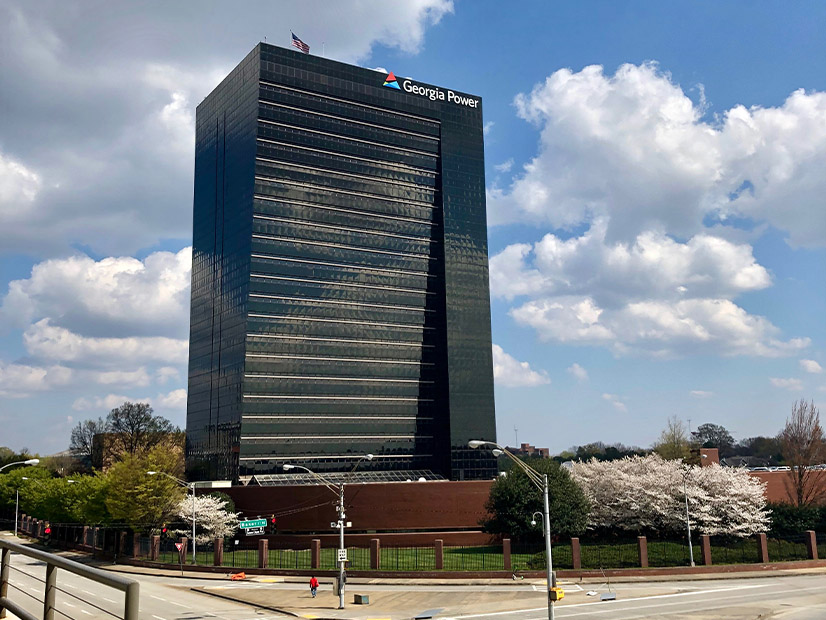
Georgia Power will pay $175,000 to SERC Reliability for violating NERC’s reliability standards, according to a settlement between the utility and the regional entity approved by FERC March 27 (NP26-6).
NERC filed the settlement with the commission Feb. 26 in its monthly spreadsheet notice of penalty, along with a separate notice of penalty and SNOP regarding violations of NERC’s Critical Infrastructure Protection standards. Details of those settlements, including the REs and utilities involved, were not made public in accordance with NERC and FERC policies regarding CIP violations as critical energy/electric infrastructure information (NP26-5).
Georgia Power settled with SERC over a violation of PRC-023-6 (Transmission relay loadability). The utility reported the infringement in June 2024, according to the settlement, but it began July 1, 2010.
Requirement R1 of PRC-023-6 sets criteria to “prevent [their] circuit terminals’ phase protective relay settings from limiting transmission system loadability while maintaining reliable protection of the [grid] for all fault conditions.” Transmission owners, generator owners and distribution providers are required to apply one of 13 criteria provided to their transmission line relays.
Georgia Power notified SERC that on Dec. 19, 2023, it discovered two 230-kV line relays at the Wiregrass substation — energized four days earlier — did not meet any of the criteria in the standard. The utility did use one of the criteria, which specified that transmission line relays must not operate at or below 150% of a circuit’s highest seasonal facility rating, but the relays in question were found to be set “in the range of 140-150% … of the highest seasonal rating.”
The contract settings engineer for the project had calculated settings that would comply with both the standard and Georgia Power’s internal requirements, but a quality assurance engineer modified the settings in a way that still would comply with PRC-023-6 but not with the company’s requirements. An oversight engineer reviewed the settings and requested changes that would have ensured compliance with both, but these revisions were not fully implemented, and the relay remained noncompliant with the standard.
Georgia Power brought the Wiregrass substation’s relays back into compliance by Dec. 20, 2023. The utility also performed an extent of condition assessment on all 1,331 relays to which the R1 criteria apply and found four more substations with incorrect settings:
-
- North Tifton — An element of the switch-on-fault scheme was set to 136% of the highest seasonal rating instead of 150%. The noncompliance began when PRC-023-1 (the predecessor to PRC-023-6) took effect in July 2010 and ended July 30, 2024, when the element was removed from the SOTF.
- Bowen — Like North Tifton, an element on the SOTF was set to 111% of the highest seasonal rating instead of 150%. The instance began Oct. 21, 2022, when Georgia Power modified the settings, and ended July 30, 2024, when the utility removed the element from the SOTF.
- Ohara and Thompson Primary substations — Each substation had a relay on a 500-kV line with phase distance reach set below the highest seasonal rating because of incorrectly implemented load encroachment logic. The Ohara infringement began July 1, 2010, when PRC-023-1 became effective and the Thompson Primary infringement on Nov. 18, 2021. Both ended in September 2024 when Georgia Power changed the relay setting.
SERC identified the cause of the Wiregrass violation as ineffective controls. The RE wrote that Georgia Power “had an unknown limitation in [its] work management tool program” that prevented automated emails that would have informed the PRC-023 coordinator on the project of the settings change. The procedure for issuing settings also did not provide any guidance on when settings changes are needed after settings for active projects already have been transmitted to the field.
For the other four instances, SERC determined the cause to be ineffective training as related to non-standard relays. The RE observed that all the violations “involved situations that are not present in most of the system and therefore represent unfamiliar situations that engineers may not have seen before during their careers.”
SERC wrote that of the relays on Georgia Power’s system to which PRC-023-6 applies, only 52 use the overcurrent elements used at Bowen and North Tifton, and 50 use the relays found in Ohara and Thompson Primary. As a result, SERC suggested “engineers made assumptions” about how to approach these situations that turned out to be incorrect. The RE determined the violation — counting all the instances together — posed a moderate risk to grid reliability, observing that “no harm is known to have occurred” because of the infringement.
To mitigate the violation, Georgia Power implemented corrected settings at all the identified noncompliant substations. The utility also developed new procedures for making settings changes after settings are transmitted. The utility communicated to compliance-related personnel the importance of notifying the compliance department as soon as possible after finding a potential noncompliance. It also conducted training on the unusual situations found in the extent of condition review.
Finally, Georgia Power implemented a new tool to check database line relay settings against the PRC-023-6 R1 criteria. The utility plans to use the tool to check settings prior to field implementation, and for periodic checks after installation.