IESO’s plan to change the initialization logic for non-quick-start (NQS) resources left some stakeholders wondering why during an engagement March 24.
NQS generators require a formal commitment through the day-ahead market (DAM) or pre-dispatch (PD) to manage their longer startup times — at least one hour — and multihour run requirements.
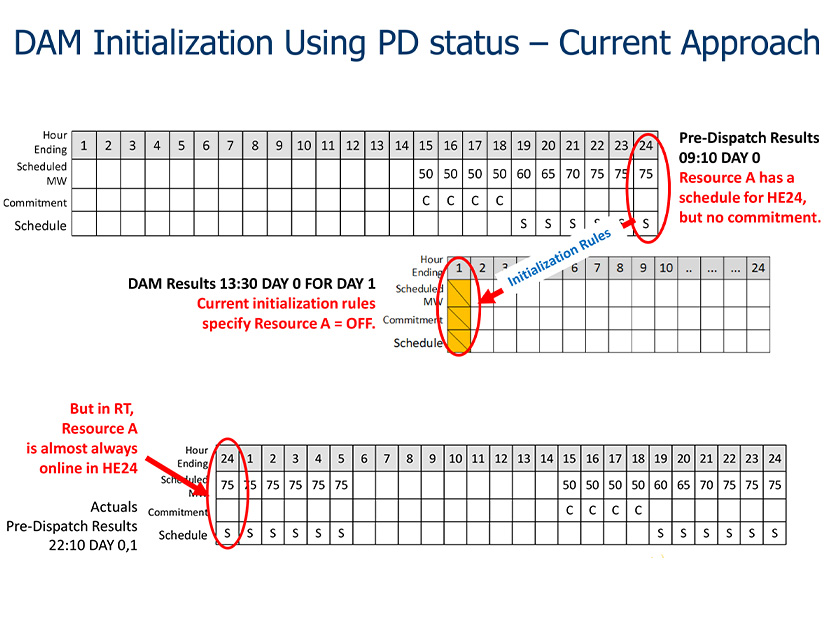
IESO says the DAM needs to know the physical status of NQS resources at the end of the previous operating day to ensure the transition from real-time operation at hour ending 24 to the next day’s DAM “reflect a realistic and physically accurate operating state.”
Currently, the initialization logic assumes that an NQS unit is “ON” only if it has a “commitment” in HE24 of the PD run. NQS resources without a commitment in HE24 of PD are assumed to have an online status of “OFF,” regardless of whether the resource has a PD “schedule” for HE24. A commitment is an instruction to come online and provides greater certainty than a schedule.
When an NQS resource has a schedule in HE24 of the PD initialization run, it is online about 95% of the time when HE24 arrives in real time, said Garth Nash, an adviser in the market development unit. As a result, relying solely on the PD HE24 commitment flag causes many NQS resources to be improperly initialized as “OFF” in the DA engine.
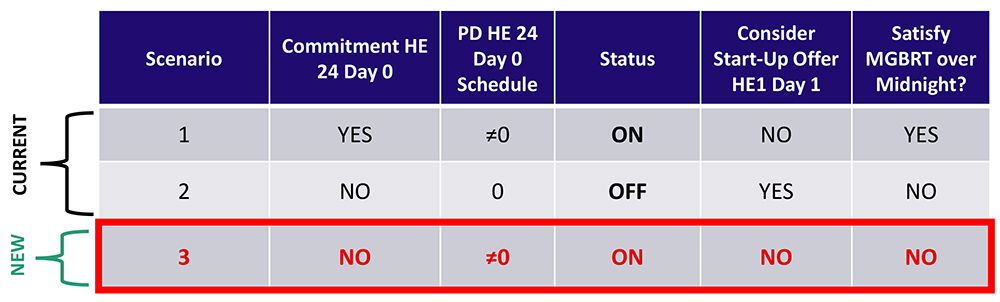
Starting in June, IESO says, it will set the initialization status to “ON” if a resource has a schedule in Day 0 HE24, regardless of whether it has a commitment in the hour. NQS generators will receive no additional start-up costs for HE1.
What’s the Problem?
IESO officials did not cite any financial impact of the current assumptions or the proposed change.
“Can we … clarify what you’re trying to solve here?” asked Jennifer Jayapalan, of Workbench Energy.
“It’s just trying to better align what the status of a unit is and what is assumed to be,” Nash responded. “It’s just trying to have that alignment between what the DAM is assuming and what the physical reality is.”
“I just want to make sure that there has been significant … analysis that these hours aren’t going to be isolated, because the market participants are going to be financially bound to hours that potentially … they can’t operationally meet,” Jayapalan said.
“The problem I’m seeing here is now you have a DAM schedule that, in theory, you’re supposed to continue through,” she continued. “We know there’s an issue here right now, where, if the PD no longer wants a resource, it takes it offline even though it’s scheduled all day, and then it brings it back up. We already are not paying startup costs [for] the second start of the day if the PD does not want it.”
Karen Backman, supervisor of market development, said NQS operators who do not want a day-ahead schedule for the following day must “make sure that the 9 a.m. pre-dispatch does not show them in the hour ending 24 as being scheduled.”
Jayapalan acknowledged that IESO’s new market has seen “some extreme conditions where NQS resources have been scheduled day after day.”
“I understand that it probably is a high probability so far. But there’s going to be these cases in there where [NQS units] have isolated hours that … they operationally can’t meet. And there are going to be cases where the PD is going to change significantly,” she added. “It happens all the time now.”
Sean Vincent, of Greenfield South Power, echoed Jayapalan’s concerns over the ISO’s reliability and cost benefit analysis. “In the future, it would be really beneficial if these points were … something that you were able to provide for in these meetings — the actual benefit that’s being provided here, and the amount of people … or runs that are being impacted; how much this is actually changing things,” he said. “I think this is all extremely great information that should be publicly available here in these meetings.”