NERC has postponed its work on a new three-year plan that would have guided its work starting in 2026 amid recent economic and political uncertainty, CEO Jim Robb said during an informational webinar May 21 on the ERO’s draft 2026 Business Plan and Budget.
Robb reminded attendees that NERC is nearing the end of its current three-year plan, which the ERO created in 2022. NERC had planned to create another plan in 2025, but leadership decided a different approach was needed in light of the uncertainty that has grown since the beginning of President Donald Trump’s second term in January 2025.
“When we started that planning process in earnest, we concluded that that was really kind of a fool’s errand at this point in time,” Robb said. “We decided that we should probably not do a robust three-year plan this year, but … let a few things mature over the balance of this year.”
The efforts that need to “mature” include NERC’s Large Loads Task Force and the Modernization of Standards Processes and Procedures Task Force created by the Board of Trustees in February to examine the ERO’s standard development process for opportunities for improvement. (See “Task Force to Examine Standards Process,” NERC Leaders Highlight Canada-US Collaboration.)
Instead of setting an overarching plan, Robb said NERC will “approach 2026 as a bridge,” with the budget covering only a single year. The ERO hopes to resume its three-year planning process in 2026, creating a plan for 2027-2029.
As for the 2026 budget, which NERC posted for public review the day after the webinar along with the draft budgets of the regional entities, Robb said the ERO is “painfully aware of all the austerity measures” underway at the federal government and “took a very hard look at what we really needed [for] the core needs of” the ERO’s mission.
“We all know that the risks aren’t taking a timeout. If anything, they’re accelerating and expanding,” Robb said. “So you’ll see not a flat budget for 2026, but, I think, a very prudent budget in light of everything going on in the world around us.”
NERC CFO Andy Sharp provided more details on the draft budget, which is set to increase $5.3 million over the 2025 budget to $128.3 million. The organization’s assessment, which load-serving entities pay to support the ERO’s work, also is expected to rise by $5.3 million, to $113.7 million, with the remaining budgeted expenses to be covered by its other sources of funding, such as fees from the Electricity Information Sharing and Analysis Center’s Cyber Risk Information Sharing Program and vendor affiliate program.
The biggest driver of the projected budget increase is personnel, Sharp said, with NERC planning to add 9.1 full-time-equivalent positions in 2026 relating to engineering, security and engagement. These additions, along with an average pay increase of 4% and increased spending on benefits, add up to a total budget of $76.2 million, $4.7 million higher than 2025.
Operating expenses are expected to decrease by 1.4% to $43.3 million, which Sharp attributed primarily to the end of the lease on NERC’s Atlanta office in October 2025. The ERO will move operations to its office in D.C.
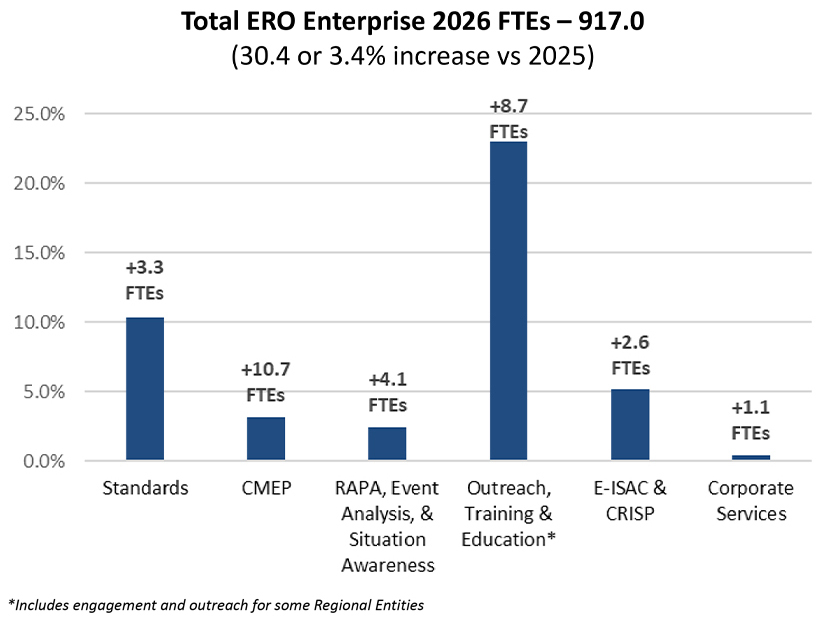
Personnel is the largest increase in the REs’ budgets as well, with every entity except SERC Reliability planning to add staff in the coming year for a total of 30.4 new FTEs across the ERO Enterprise. Nearly 25% of the new hires are earmarked for outreach, training and education, followed by standards with 10%.
Overall, all of the RE budgets are projected to grow, with the Northeast Power Coordinating Council planning the biggest increase, at $2.7 million — to $28.4 million — and WECC growing the least, with $800,000, to $40.1 million. WECC’s budget is the highest of the REs; the Texas Reliability Entity will remain the lowest, with $21.6 million, up from $20.3 million in 2025.
NERC will accept comments on the draft business plans and budgets for 30 days beginning May 23, Sharp said. On July 22, the Member Representatives Committee’s Business Plan and Budget Input Group will review NERC’s final budget, which will be submitted to the board at its meeting Aug. 14. NERC and the REs plan to file their final budgets with FERC by Aug. 25.