Nuclear energy got at least a temporary boost May 22 as the reconciliation bill hashed out in the House of Representatives spared it from most of the policy changes aimed at other forms of clean energy.
How nuclear energy fares in Senate deliberations and whether the provisions extend far enough into the future to benefit the slow-moving nuclear industry remains to be seen.
The 45U zero-emission nuclear power production credit would remain in place almost as long as specified in current law rather than gradually phasing out sooner, as specified in one of the drafts of the bill.
Also, a new advanced nuclear facility or expansion of an existing nuclear facility would remain eligible for production tax credits and investment tax credits if construction begins by the end of 2028 — which may be a tight timeline for some of the new designs that still must complete their R&D phases and then undergo regulatory review.
Nonetheless, it is a much better picture than the one that faces other clean energy technologies under the Republican-engineered megabill.
Law firm Akin Gump Strauss Hauer & Feld wrote in a May 22 alert:
“While advanced nuclear facilities would only experience a one-year credit window haircut under the bill, other technologies that currently qualify under the ‘tech-neutral’ Clean Electricity Production Tax Credit (§ 45Y) and the Clean Electricity Investment Tax Credit (§ 48E) would be eliminated under the bill if construction of the applicable facility did not begin before 60 days after enactment.” (See House Passes Reconciliation Package that Would End Energy Tax Credits.)
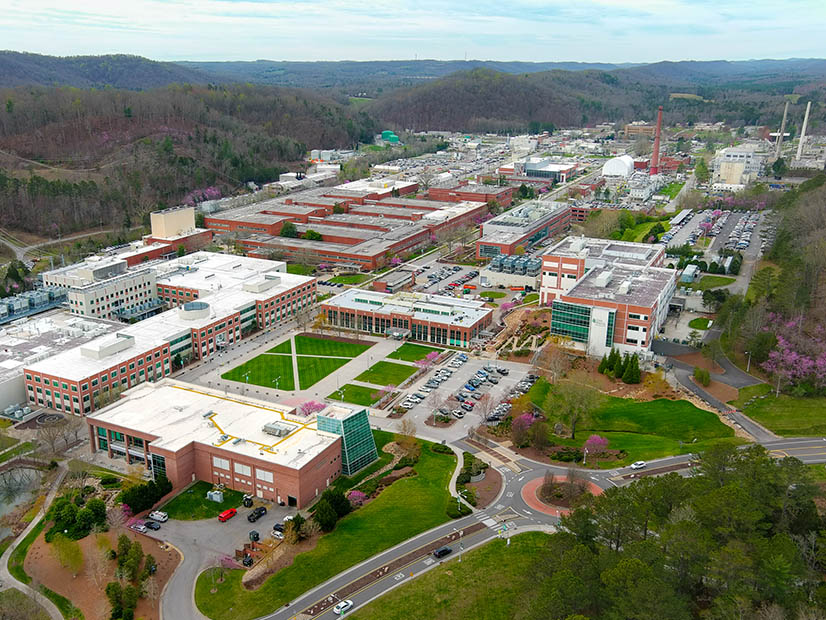
Also on May 22, Oak Ridge National Laboratory highlighted the work it’s doing to connect nuclear developers with national laboratory resources and expertise amid the push for more and better nuclear generation.
Oak Ridge pointed to its collaboration with Elementl Power on a data-driven approach to siting advanced nuclear projects, intended to make siting less complicated and time-consuming.
Elementl and Google on May 7 announced an agreement to pre-position three sites for development of at least 600 MW of advanced nuclear generation on each.
Google is committing early-stage development capital as Elementl prioritizes sites for development and continues its evaluation of technology, engineering procurement and construction.
Elementl is supplementing its in-house methodology with the Oak Ridge Siting Analysis for power Generation Expansion (OR-SAGE) tool, which uses GIS data including population density, water proximity and seismic data to identify potential sites for small modular reactors.
Google and Kairos Power in October 2024 announced the first corporate agreement for multiple advanced reactors. It envisions deployment by 2035 of 500 MW of the high-temperature salt-cooled reactors Kairos is designing.
Elementl is not designing its own reactor. It is a technology-agnostic developer creating a procurement model that offers turnkey development, finance and ownership solutions to companies that may not want to own or operate reactors themselves.
Elementl COO David Faherty said his company gained access to the national laboratory system through a Gateway for Accelerated Innovation in Nuclear voucher. This allowed it to overcome technological and commercialization challenges and accelerate predevelopment work that Elementl would have needed years to replicate on its own.
The OR-SAGE platform “gives us a data-driven foundation to screen regional siting options efficiently and allows our team to layer in our own project-specific criteria with greater speed and confidence,” Faherty said.
The growing support being shown for advanced nuclear technology can go only so far in making its development and deployment progress at a faster pace and lower cost. Pioneering projects are expected to be expensive, making federal policy support an important part of project finance, and making the timing of credit expiration a critical detail as the reconciliation bill goes to the Senate.
Kairos has begun construction of its Hermes demonstration reactor in Oak Ridge, for example, and intends to use it inform and de-risk subsequent commercial projects. But Hermes is not expected to be operational until 2027.